The necessity of high-pressure consolidation in titanium powder metallurgy stems from the material's inherent resistance to deformation and the need for structural integrity. Specifically, a range of 360 to 600 MPa is required to transition titanium powder into a plastic state, overcoming the flow resistance between particles to close internal pores. This high-pressure environment is the only way to achieve a residual porosity level below 1.0%–1.5%, resulting in a bulk material that effectively reaches its theoretical density.
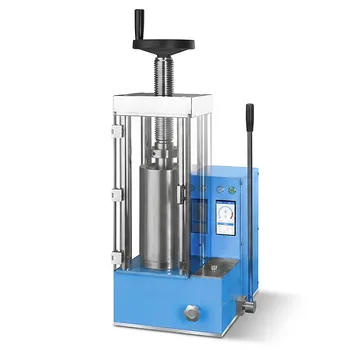
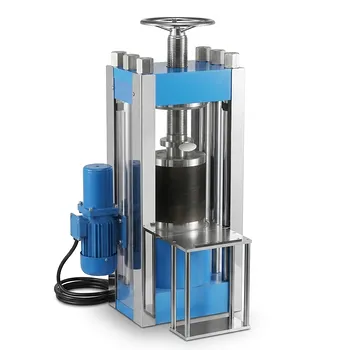
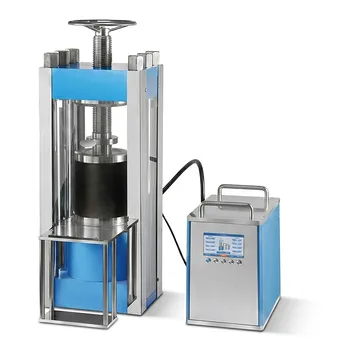
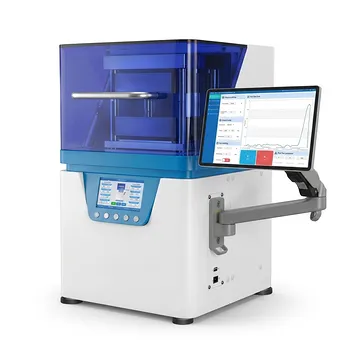
High-pressure laboratory presses are required to induce the plastic deformation and mechanical interlocking necessary to transform loose titanium powder into a dense "green compact." This process minimizes voids and establishes the particle-to-particle contact surface required for successful high-temperature sintering.
Achieving Near-Theoretical Density
Closing Internal Pores
At pressures between 360 and 600 MPa, titanium powder particles are forced to overcome flow resistance. This pressure is sufficient to close internal pores that would otherwise remain as structural defects in the final part.
Reaching the Plastic State
The application of high pressure, often combined with heating, allows the titanium to reach a plastic state. In this state, the material flows into the gaps between particles, ensuring the final compact is nearly equal to its theoretical density.
Minimizing Residual Porosity
Consistently applying these high pressures ensures that residual porosity is kept below 1.0%–1.5%. Low porosity is critical for the mechanical performance and fatigue resistance of the finished titanium component.
The Mechanics of Particle Bonding
Overcoming Internal Friction
A laboratory press must provide significant force to overcome the internal friction between irregular titanium particles and alloying elements. This force enables the particles to rearrange and bond tightly together.
Mechanical Interlocking and Cold Welding
High axial pressure forces fine particles into the cavities of larger particles, creating mechanical interlocking. In many cases, this pressure also induces a cold welding effect, where bare metal surfaces bond upon contact, increasing the strength of the compact.
Managing Low-Plasticity Alloys
For specialized materials like Titanium Aluminum (TiAl) alloys, which are inherently brittle, high pressure (often 600-800 MPa) is vital. Without this force, these low-plasticity compounds cannot be shaped into stable forms without cracking or crumbling.
The Physical Foundation for Sintering
Driving Solid-State Sintering
High green density (the density before firing) provides the driving force for solid-state sintering. The more contact area created during pressing, the easier it is for atoms to diffuse and form robust "sintering necks" between particles.
Preventing Sintering Deformation
By achieving a relative density of 88% to 92% (or higher) during the pressing stage, the risk of sintering deformation is minimized. A dense green body ensures that the final part retains its intended dimensions during the high-temperature densification process.
Ensuring Green Strength
The pressure creates a green compact with enough structural strength to be handled and ejected from the mold. Sufficient pressure prevents the compact from delaminating or falling apart during the transition from the press to the furnace.
Understanding the Trade-offs
Equipment Wear and Precision
While higher pressures (up to 1.6 GPa) can produce even higher densities, they significantly increase wear and tear on precision molds. Operating in the 360-600 MPa range is often the "sweet spot" for achieving high density while maintaining tool longevity.
Theoretical vs. Practical Limits
There is a point of diminishing returns where increasing pressure no longer significantly improves density but increases the risk of internal stresses. Balancing pressure with the specific yield strength of the titanium alloy is essential to avoid structural micro-cracks.
Applying These Principles to Your Process
How to Apply This to Your Project
- If your primary focus is maximum mechanical strength: Prioritize the upper end of the range (600 MPa+) to ensure porosity is below 1% and maximize sintering neck formation.
- If your primary focus is complex alloy stability (like TiAl): Use high precision presses capable of at least 600 MPa to overcome low plasticity and induce cold welding for better green strength.
- If your primary focus is mold longevity and high throughput: Calibrate your pressure to the minimum required (near 360-400 MPa) to achieve the necessary 88% relative density while reducing die friction.
Utilizing the correct high-pressure range ensures that titanium powder transitions from a loose collection of particles into a high-performance, fully dense engineering material.
Summary Table:
| Requirement | Pressure Range | Impact on Titanium Consolidation |
|---|---|---|
| Pore Closing | 360 - 600 MPa | Eliminates internal voids; achieves <1.5% porosity |
| Plastic Deformation | 360 - 600 MPa | Transitions powder to plastic state for maximum density |
| Mechanical Interlocking | High Axial Force | Creates cold welding effects and strong green compacts |
| TiAl Alloy Shaping | 600 - 800 MPa | Overcomes low plasticity in brittle compounds to prevent cracking |
| Sintering Readiness | Optimized Range | Provides 88-92% relative density to prevent deformation |
Elevate your material science and battery research with KINTEK’s comprehensive laboratory pressing solutions. Whether you need manual, automatic, heated, multifunctional, or glovebox-compatible models—or specialized cold and warm isostatic presses—we offer the precision force required to achieve near-theoretical density in titanium consolidation. Avoid delamination and minimize sintering deformation with equipment built for durability and high performance. Contact our specialists today to find the perfect press for your lab!
References
- Г. А. Прибытков, В. П. Кривопалов. Hot Consolidation of Titanium Powders. DOI: 10.3390/powders2020029
This article is also based on technical information from Kintek Solution Knowledge Base .
Related Products
- Electric Isostatic Pressing Machine 40 Tons Automatic Laboratory Powder Compacting Press
- Lab Round Bidirectional Press Mold
- Split Warm Isostatic Lab Press 200 Ton Powder Compaction Chamber for Battery Research and Material Science
- Lab Polygon Press Mold
- Special Shape Lab Press Mold for Laboratory Applications
People Also Ask
- What are the key characteristics of the isostatic pressing process? Unlock Uniform Density and Complex Geometries
- Why is vacuum-sealed packaging necessary before isostatic pressing of CuPc thin films? Protect Integrity & Uniformity
- How is pressure applied to the material during isostatic pressing? Master Uniform Density and Complex Geometries
- How does pressure distribute during isostatic pressing of aluminum? Achieve Uniform Density for Your Lab Materials
- What are the applications of isostatic pressing in the automotive industry? Precision Manufacturing for High-Performance Parts