
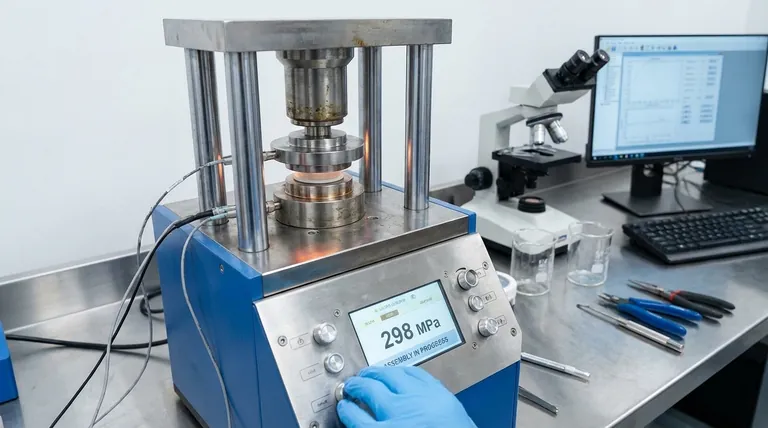
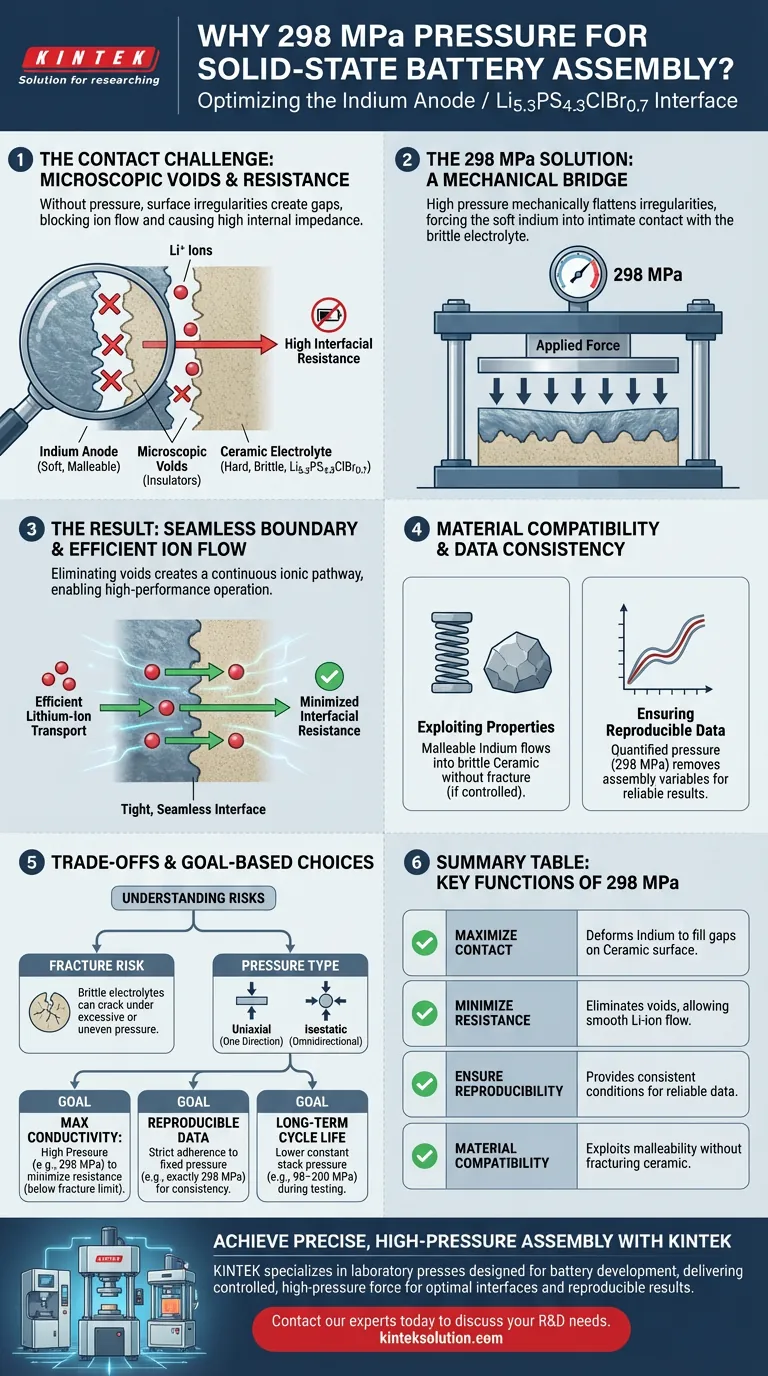
The application of 298 MPa via a hydraulic press is a critical assembly step designed to mechanically force the soft indium anode into intimate physical contact with the hard Li5.3PS4.3ClBr0.7 ceramic electrolyte. This high pressure eliminates microscopic voids at the interface, which is the primary requirement for minimizing interfacial resistance and enabling efficient lithium-ion transport.
Core Takeaway Unlike liquid electrolytes that naturally "wet" electrode surfaces, solid-state batteries rely entirely on mechanical pressure to establish ionic pathways. The application of 298 MPa acts as a physical bridge, deforming the malleable anode to match the surface of the brittle electrolyte, ensuring the low impedance necessary for high-performance operation.
The Physics of the Solid-Solid Interface
Overcoming Surface Roughness
On a microscopic level, even "smooth" solid materials have rough surfaces. When an indium anode is placed against a ceramic electrolyte separator without pressure, these surface irregularities create gaps.
At 298 MPa, the hydraulic press forces the materials together with enough intensity to flatten these irregularities. This ensures the physical contact area is maximized, creating a seamless boundary rather than a series of disconnected touchpoints.
Eliminating Ionic Transport Resistance
The gaps mentioned above act as insulators, blocking the flow of lithium ions.
By applying this specific pressure, you eliminate these voids. This directly reduces the interfacial resistance, allowing ions to move smoothly between the anode and the electrolyte. Without this step, the battery would suffer from high internal impedance, severely limiting its ability to charge or discharge effectively.
Material Compatibility and Consistency
Exploiting Indium’s Malleability
The process relies on the difference in mechanical properties between the two materials. Indium is a soft, metallic anode, while Li5.3PS4.3ClBr0.7 is a hard ceramic.
The 298 MPa pressure exploits the softness of indium, causing it to deform and flow into the surface texture of the harder ceramic. This creates a "tight" interface that would be impossible to achieve if both materials were equally brittle.
Ensuring Reproducible Data
Using a hydraulic press to apply a quantified pressure (298 MPa) creates consistency across different distinct cells.
If the contact area varied from cell to cell, the internal resistance would also fluctuate, making it impossible to gather reliable data. Controlled pressure ensures that any performance changes are due to the materials themselves, not variations in assembly technique.
Understanding the Trade-offs
The Risk of Component Fracture
While high pressure is necessary for contact, it introduces significant risk. Ceramic electrolytes like Li5.3PS4.3ClBr0.7 are brittle.
If the pressure exceeds the material's structural limits or is applied unevenly, the ceramic layer can crack. This mechanical fracture destroys the structural integrity of the cell and can lead to internal short circuits, rendering the battery useless.
Uniaxial vs. Isostatic Pressure
A hydraulic press typically applies uniaxial pressure (pressure from one direction).
While effective for the specific bonding of the anode described here, uniaxial pressing can create pressure gradients where the edges are less dense than the center. In contrast, isostatic pressing (using fluid or gas) applies omnidirectional pressure, which is sometimes preferred for final cell sealing to ensure uniform densification throughout the entire geometry.
Making the Right Choice for Your Goal
When designing your assembly protocol, consider how pressure application aligns with your specific objectives:
- If your primary focus is maximizing ionic conductivity: Prioritize high-pressure steps (like the 298 MPa press) to minimize grain boundary resistance and interfacial voids, but remain below the fracture threshold of your ceramic.
- If your primary focus is reproducible research data: strict adherence to a specific pressure value (e.g., exactly 298 MPa every time) is more important than the magnitude itself, as it eliminates assembly variables.
- If your primary focus is long-term cycle life: You must look beyond the initial assembly; consider maintaining a lower constant stack pressure (e.g., 98–200 MPa) during testing to compensate for volume changes during charge/discharge cycles.
Ultimately, the 298 MPa press is the mechanical key that unlocks the chemical potential of the indium-electrolyte interface.
Summary Table:
| Key Function | Reason for 298 MPa Pressure |
|---|---|
| Maximize Contact | Deforms soft indium anode to fill microscopic gaps on the hard ceramic electrolyte surface. |
| Minimize Resistance | Eliminates voids that block lithium-ion flow, drastically reducing interfacial impedance. |
| Ensure Reproducibility | Provides consistent assembly conditions for reliable, comparable experimental data. |
| Material Compatibility | Exploits the malleability of indium without fracturing the brittle ceramic electrolyte. |
Ready to achieve precise, high-pressure assembly for your solid-state battery research?
KINTEK specializes in laboratory press machines, including automatic lab presses and heated lab presses, designed to meet the exacting demands of battery development. Our equipment delivers the controlled, high-pressure force you need to create optimal material interfaces and ensure reproducible results.
Contact our experts today via our Contact Form to discuss how a KINTEK lab press can enhance your R&D process and help you build better batteries.
Visual Guide
Related Products
- Automatic High Temperature Heated Hydraulic Press Machine with Heated Plates for Lab
- Manual Heated Hydraulic Lab Press with Integrated Hot Plates Hydraulic Press Machine
- Heated Hydraulic Press Machine with Heated Plates for Vacuum Box Laboratory Hot Press
- Laboratory Hydraulic Press 2T Lab Pellet Press for KBR FTIR
- Laboratory Hydraulic Press Lab Pellet Press Machine for Glove Box
People Also Ask
- Function of a Laboratory Hydraulic Press with Heated Platens in SSE? Enhance Battery Density & Conductivity
- How does a laboratory heated hydraulic press facilitate PBN sample prep for WAXS? Achieve Precise X-Ray Scattering
- What are the requirements for electrode pressing with high-viscosity ionic liquids like EMIM TFSI? Optimize Performance
- What are the industrial applications of heated hydraulic presses? Master Heat & Force for Precision Manufacturing
- Why is a laboratory hydraulic press with heating plates required for PLA/TEC films? Achieve Precise Sample Integrity



















