
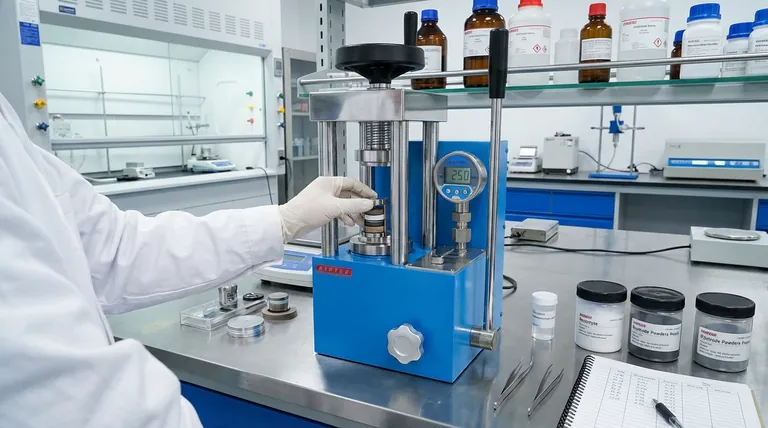
The primary role of a lab press machine in assembling all-solid-state lithium-selenium batteries is to apply immense mechanical pressure to compact powder components into a dense, unified structure.
By exerting pressures ranging from 60 MPa to upwards of 500 MPa, the machine eliminates microscopic voids between the cathode, anode, and solid electrolyte layers. This transformation from loose powder to a solid pellet is the only way to establish the physical connectivity required for the battery to function.
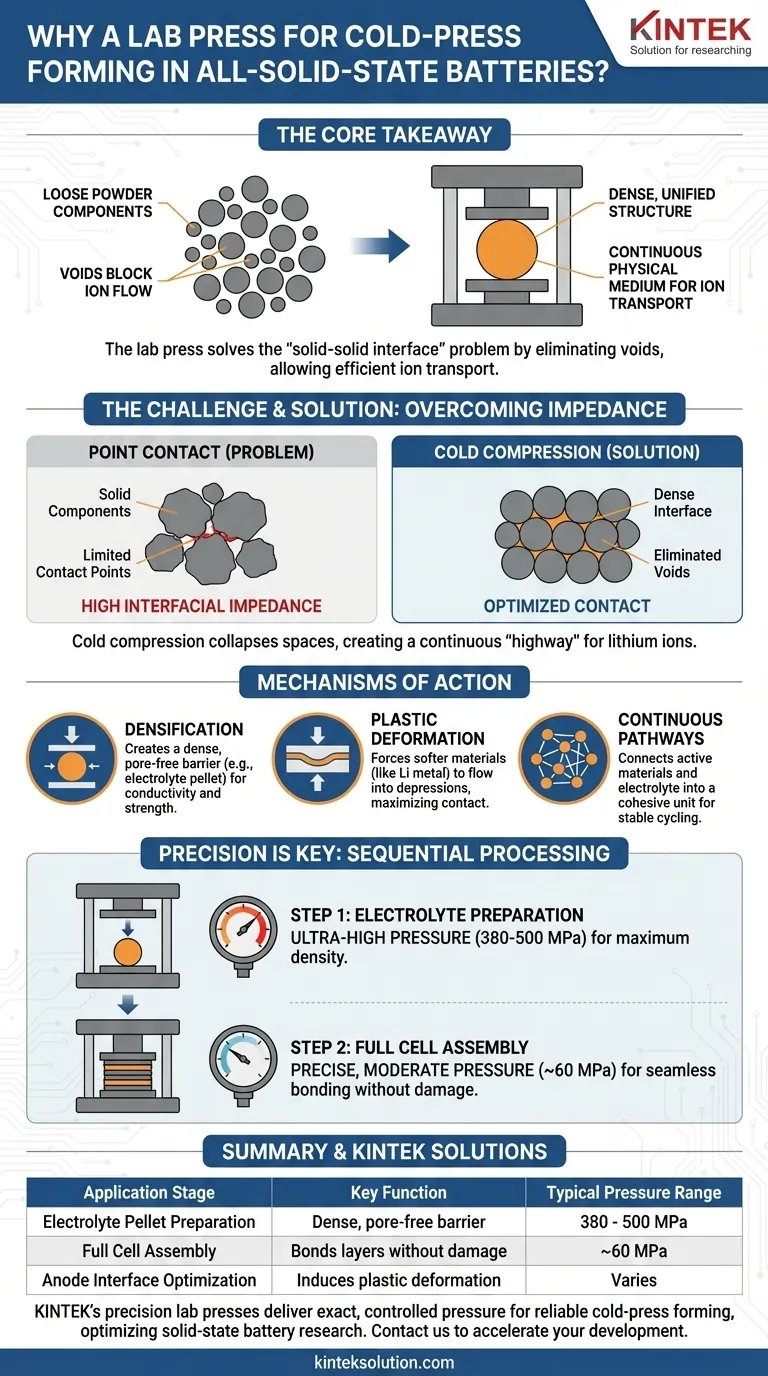
Core Takeaway: In solid-state batteries, ions cannot flow through air gaps; they require a continuous physical medium. The lab press solves the "solid-solid interface" problem by forcing materials into such intimate contact that interfacial resistance drops, creating efficient pathways for ion transport.
The Deep Need: Overcoming Interfacial Impedance
The Challenge of Point Contact
Unlike liquid electrolytes, which naturally flow into pores to wet electrode surfaces, solid electrolytes are rigid.
When solid components (like garnet electrolytes) meet solid electrodes, they naturally touch only at rough, microscopic peaks. This is known as "point contact."
Without external intervention, these limited contact points result in extremely high interfacial impedance, effectively blocking the flow of current and rendering the battery useless.
Eliminating Voids and Porosity
The lab press uses cold compression to collapse the spaces between particles.
References indicate that high pressures (often 100 to 200 MPa, and up to 500 MPa for certain electrolytes) compact the powder components significantly.
This process removes voids and porosity, ensuring that the lithium ions have a continuous "highway" through the material rather than hitting dead ends formed by air pockets.
Mechanisms of Action
Densification of the Electrolyte
The first critical step often involves pressing the solid electrolyte powder (such as Li6PS5Cl) into a standalone pellet.
Applying pressure (e.g., 380 MPa to 500 MPa) creates a dense, pore-free barrier. This density is vital not only for conductivity but also for preventing physical failure during battery cycling.
Plastic Deformation for Seamless Interfaces
Pressure does more than just push items together; it physically alters them.
When pressing softer materials like lithium metal anodes against rigid electrolytes, the machine forces the metal to undergo plastic deformation.
The metal flows into the microscopic depressions of the electrolyte surface, maximizing the effective contact area and ensuring ions can pass through the interface uniformly.
Establishing Continuous Transport Pathways
A successful press connects the active material powders, conductive additives, and electrolyte powders into a cohesive unit.
This "intimate physical contact" reduces the resistance to both ion and electron transport.
It lays the foundation for stable battery cycling by ensuring the internal network remains connected even as the battery charges and discharges.
Understanding the Trade-offs: Precision is Key
While pressure is essential, the application must be precise rather than indiscriminate.
The Risk of Improper Pressure
References highlight the use of specific, precise pressures (e.g., an initial 60 MPa for cell stacks vs. 500 MPa for electrolyte pellets).
Inadequate pressure leaves voids, resulting in high resistance and poor performance. Conversely, excessive pressure on the wrong materials could potentially fracture brittle ceramic electrolytes or damage the structural integrity of the cell components.
Sequential Processing Requirements
The process is rarely a "one-and-done" event.
Effective assembly often requires a multi-step approach: first creating a dense electrolyte pellet at very high pressure, and then applying a second, different pressure to bond the electrodes to that pellet.
Skipping these steps or combining them without regard for the material properties can lead to suboptimal interfaces.
Making the Right Choice for Your Goal
To maximize the effectiveness of your cold-press forming process, consider the specific requirements of your assembly stage.
- If your primary focus is Electrolyte Preparation: Apply ultra-high pressure (380–500 MPa) to achieve maximum density and eliminate porosity in the pellet.
- If your primary focus is Full Cell Assembly: Use precise, moderate pressure (e.g., 60 MPa) to ensure seamless contact between the stack layers without damaging the pre-formed electrolyte.
- If your primary focus is Anode Interface: Ensure sufficient pressure is applied to induce plastic deformation in the lithium metal, filling surface irregularities for maximum contact area.
The lab press is not just a tool for shaping; it is the fundamental enabler of ionic conductivity in solid-state systems.
Summary Table:
| Application Stage | Key Function | Typical Pressure Range |
|---|---|---|
| Electrolyte Pellet Preparation | Creates a dense, pore-free barrier for ion conduction. | 380 - 500 MPa |
| Full Cell Assembly | Bonds electrode layers to the electrolyte without damage. | ~60 MPa |
| Anode Interface Optimization | Induces plastic deformation in lithium metal for maximum contact. | Varies (Material Dependent) |
Ready to optimize your solid-state battery research?
KINTEK's precision lab presses—including automatic, isostatic, and heated models—are engineered to deliver the exact, controlled pressure required for reliable cold-press forming. Whether you are preparing dense electrolyte pellets or assembling full cells, our machines help you achieve the intimate material contact necessary to minimize interfacial resistance and maximize performance.
Contact our experts today to discuss how our lab press solutions can accelerate your development of all-solid-state batteries. Get in touch via our contact form for a personalized consultation.
Visual Guide
Related Products
- Electric Lab Cold Isostatic Press CIP Machine
- Automatic Lab Cold Isostatic Pressing CIP Machine
- Electric Split Lab Cold Isostatic Pressing CIP Machine
- Manual Cold Isostatic Pressing CIP Machine Pellet Press
- Automatic Laboratory Hydraulic Press Lab Pellet Press Machine
People Also Ask
- What are the applications of electric lab cold isostatic presses in research settings? Advance Material R&D with High-Pressure CIPs
- What role do electric lab cold isostatic presses play in industrial contexts? Bridge R&D and Manufacturing with Precision
- How does electrical Cold Isostatic Pressing (CIP) contribute to cost savings? Unlock Efficiency and Reduce Expenses
- What are some research applications of electric lab CIPs? Unlock Uniform Powder Densification for Advanced Materials
- What are the characteristics of standard off-the-shelf electric lab CIP solutions? Achieve Immediate, Cost-Effective Processing



















