
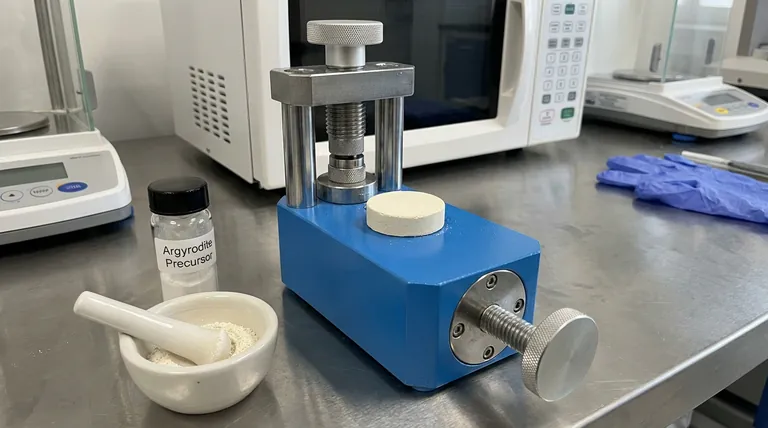
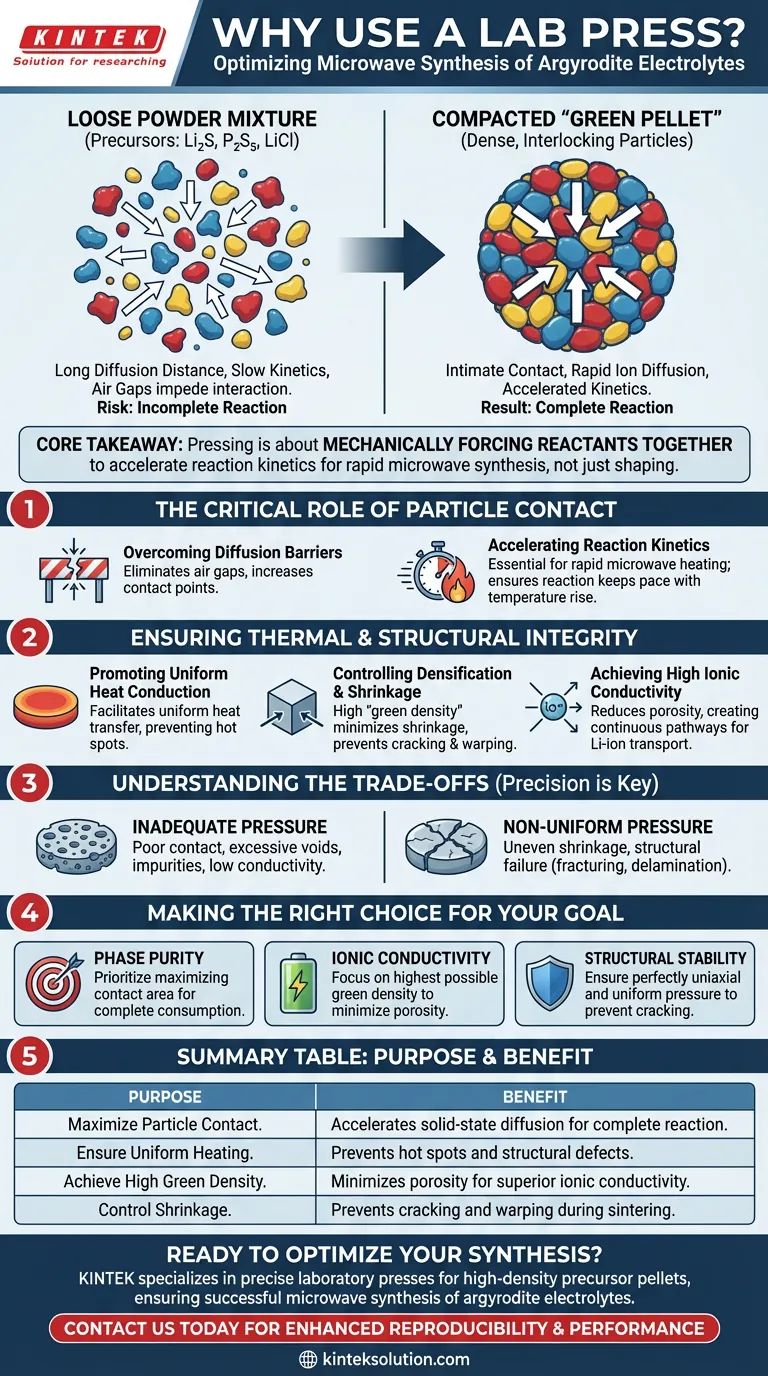
The primary purpose of using a lab press in this context is to maximize the physical contact area between reactant particles by creating a dense "green pellet."
By compacting precursors like Li₂S, P₂S₅, and LiCl prior to synthesis, you minimize the diffusion distance between solids. This intimate contact is strictly necessary to promote rapid ion diffusion and ensure a complete chemical reaction during the short timeframe of microwave synthesis, ultimately yielding a pure, high-conductivity argyrodite phase.
Core Takeaway Microwave synthesis is a rapid, high-energy process that leaves little time for slow material migration. Pressing the powder is less about shaping the material and more about mechanically forcing reactants together to accelerate reaction kinetics and ensure uniform heat distribution, preventing incomplete reactions or structural defects.
The Critical Role of Particle Contact
The synthesis of argyrodite electrolytes (such as Li₆PS₅Cl) is a solid-state reaction. Unlike liquid reactions where mixing is inherent, solid particles must physically touch to react.
Overcoming Diffusion Barriers
In a loose powder mixture, air gaps act as barriers to atomic movement.
A lab press applies uniaxial pressure (e.g., 3 tons or specific MPa) to eliminate these voids. This compaction significantly increases the number of contact points between the individual precursor particles.
Accelerating Reaction Kinetics
Microwave synthesis is prized for its speed, often completing reactions in minutes rather than hours.
Because the heating is so rapid, the reactants must be primed for immediate interaction. The enhanced packing density achieved by pressing allows for highly efficient solid-state diffusion. This ensures the reaction rate keeps pace with the rapid temperature rise, leading to a complete conversion of precursors into the desired crystal phase.
Ensuring Thermal and Structural Integrity
Beyond chemical kinetics, the physical density of the green pellet plays a vital role in how the material handles the stress of high-temperature processing.
Promoting Uniform Heat Conduction
Microwave heating is volumetric, but thermal gradients can still occur if the material is non-uniform.
A densely packed pellet ensures better thermal conductivity between particles. This facilitates uniform heat transfer throughout the sample. Uniform heating is critical for synthesizing a homogeneous product, ensuring that every part of the pellet reaches the necessary activation energy simultaneously.
Controlling Densification and Shrinkage
Transitioning from a powder to a ceramic usually involves volume shrinkage.
Creating a pellet with high "green density" establishes a solid foundation for this densification. By reducing the initial volume of voids, you minimize the severity of shrinkage during sintering. This effectively prevents common physical defects such as cracking, warping, or deformation in the final electrolyte sheet.
Achieving High Ionic Conductivity
The ultimate goal of synthesizing argyrodites is high lithium-ion conductivity.
Pressing effectively reduces porosity in the final product. A dense, low-porosity ceramic provides a continuous, unobstructed pathway for lithium ions. Consequently, proper pressing is directly linked to obtaining the high ionic conductivity required for effective solid-state battery performance.
Understanding the Trade-offs
While pressing is essential, it requires precision. The references highlight the need for "specific mechanical strength" and "uniform pressure."
The Risk of Inadequate Pressure
If the pressure is too low, the "green pellet" will lack mechanical strength.
This leads to poor particle contact and excessive voids. During microwave synthesis, these voids can cause localized hot spots or incomplete reactions, resulting in impurities (secondary phases) that severely hamper ionic conductivity.
The Necessity of Uniformity
Applying pressure unevenly can be just as detrimental as applying too little.
Non-uniform density within the green pellet leads to uneven shrinkage rates during heating. This differential shrinkage is a primary cause of structural failure, such as the pellet fracturing or delaminating during the sintering process.
Making the Right Choice for Your Goal
The pressing parameters should be aligned with your specific synthesis objectives.
- If your primary focus is Phase Purity: Prioritize maximizing the contact area to ensure complete diffusion and total consumption of precursors during the rapid microwave heating.
- If your primary focus is Ionic Conductivity: Focus on achieving the highest possible green density to minimize porosity and create continuous pathways for ion transport.
- If your primary focus is Structural Stability: Ensure the application of pressure is perfectly uniaxial and uniform to prevent cracking or deformation caused by differential shrinkage.
By treating the pressing stage as a critical variable in chemical kinetics rather than just a forming step, you ensure reproducible, high-performance solid-state electrolytes.
Summary Table:
| Purpose of Pressing | Key Benefit |
|---|---|
| Maximize Particle Contact | Accelerates solid-state diffusion for complete reaction |
| Ensure Uniform Heating | Prevents hot spots and structural defects |
| Achieve High Green Density | Minimizes porosity for superior ionic conductivity |
| Control Shrinkage | Prevents cracking and warping during sintering |
Ready to optimize your solid-state electrolyte synthesis?
KINTEK specializes in laboratory press machines, including automatic and heated lab presses, designed to deliver the precise, uniform pressure required for creating high-density precursor pellets. Our equipment helps researchers like you achieve the perfect particle contact and green density necessary for successful microwave synthesis of high-purity, high-conductivity argyrodite electrolytes.
Contact us today using the form below to discuss how our lab presses can enhance your research reproducibility and performance.
Visual Guide
Related Products
- Laboratory Hydraulic Press 2T Lab Pellet Press for KBR FTIR
- 24T 30T 60T Heated Hydraulic Lab Press Machine with Hot Plates for Laboratory
- Manual Heated Hydraulic Lab Press with Integrated Hot Plates Hydraulic Press Machine
- Laboratory Hydraulic Press Lab Pellet Press Button Battery Press
- Laboratory Hydraulic Pellet Press for XRF KBR FTIR Lab Press
People Also Ask
- What is the role of a laboratory pressure machine and KBr in FTIR? Master Sample Preparation for Flame Retardants
- What is the role of a laboratory hydraulic press in high-loading NCM811 cathode prep for solid-state batteries?
- Why is a laboratory hydraulic press necessary for sample preparation? Precise Pelleting for Spiro Heterocyclic Analysis
- What role does a laboratory hydraulic press play in reaction pellets? Optimizing Lunar Soil and Metal Fuel Density
- Why is a laboratory hydraulic press considered essential for DFC solid-state batteries? Unlocking Interface Efficiency



















