
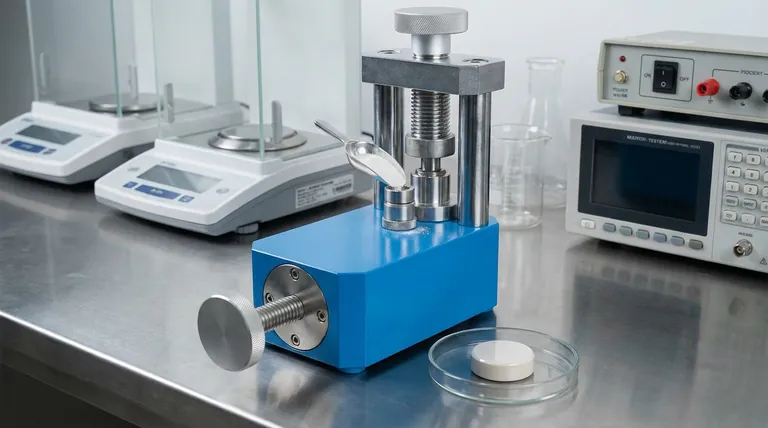
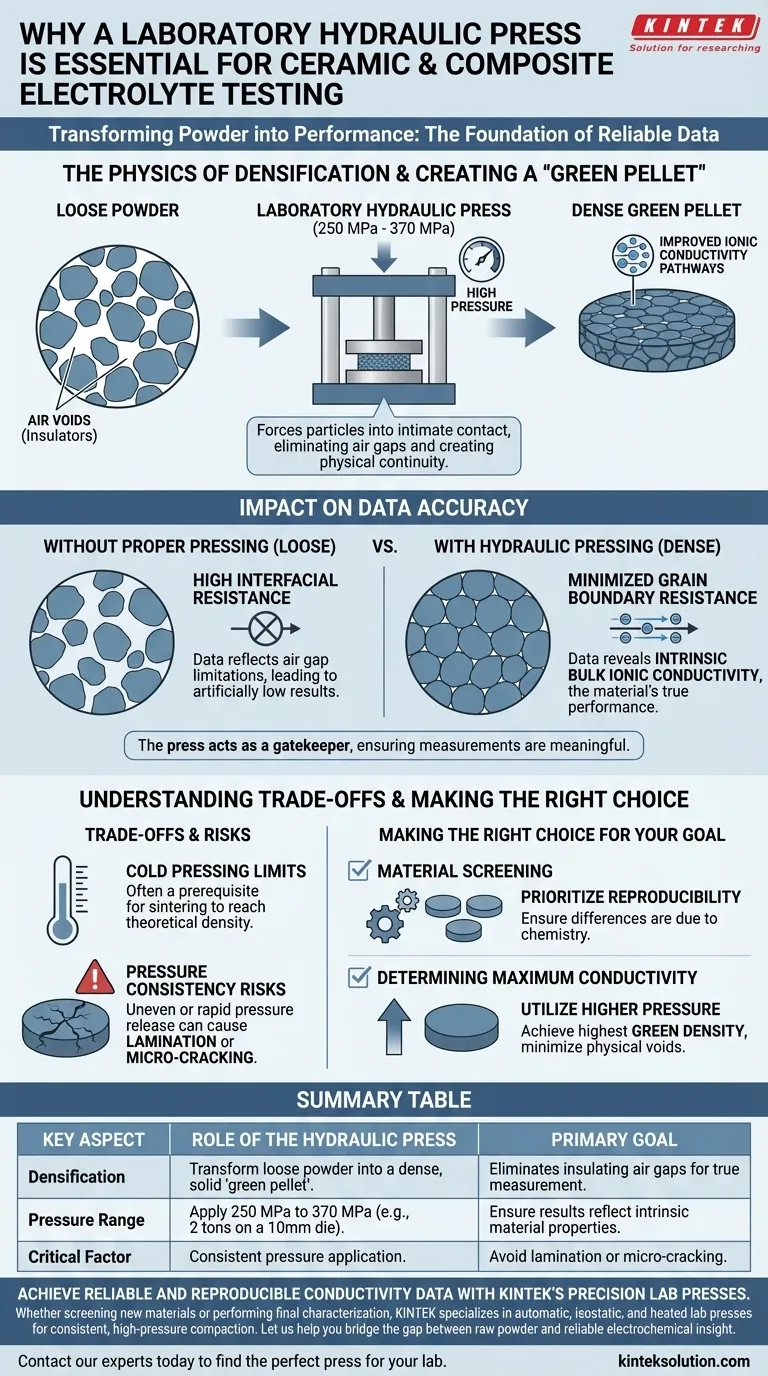
A laboratory hydraulic press is the foundational tool for transforming loose ceramic or composite powders into dense, self-supporting solid discs known as "green pellets." By applying high uniaxial pressure—often ranging from 250 MPa to 370 MPa—the press forces particles into intimate contact, creating the physical continuity required to pass electrical current through the sample. Without this mechanical densification, the material remains too porous to yield meaningful data.
The primary role of the hydraulic press is to eliminate air gaps that act as insulators between material particles. By mechanically forcing particles together, the press minimizes interfacial resistance, ensuring that subsequent conductivity tests measure the material's actual performance rather than the limitations of a loosely packed sample.
The Physics of Densification
Creating a Uniform "Green Pellet"
In its raw state, a ceramic or composite electrolyte is a loose powder. To test it, you must consolidate it into a fixed geometry.
A hydraulic press applies uniaxial compaction to form the powder into a coherent, solid shape. This resulting disc is sufficiently rigid to be handled and loaded into test cells for electrochemical analysis.
Eliminating the Porosity Barrier
Air voids are the enemy of ionic conductivity. Even highly conductive materials will perform poorly if the ions cannot travel physically from one particle to the next.
The hydraulic press exerts tons of force to mechanically squeeze out these voids. This significantly increases the packing density of the sample, turning a disjointed powder into a continuous medium.
Impact on Data Accuracy
Minimizing Grain Boundary Resistance
Conductivity measurements are highly sensitive to the interfaces between particles, known as grain boundaries.
If particles are merely touching loosely, the resistance at these boundaries is high. By applying massive pressure (e.g., 2 tons on a 10mm die), the press maximizes the surface area contact between particles, smoothing the path for ion transport.
Revealing Intrinsic Properties
The goal of your testing is to determine the intrinsic bulk ionic conductivity of the material chemistry.
If a sample retains high porosity, your data will reflect the resistance of the air gaps, leading to artificially low results. A properly pressed pellet ensures the data reflects the true capability of the material, not the flaws of the preparation method.
Understanding the Trade-offs
The Limits of Cold Pressing
While a hydraulic press creates a dense "green" body, mechanical pressure alone may not achieve theoretical maximum density.
For many ceramics, this pressing stage is only a prerequisite for high-temperature sintering. The press sets the structure, but heat is often still required to fuse the particles chemically and fully eliminate voids.
Pressure Consistency Risks
Applying "more pressure" is not always better.
If the pressure is applied unevenly or released too quickly, the pellet may suffer from lamination or micro-cracking. This structural damage can re-introduce resistance into the sample, negating the benefits of the densification process.
Making the Right Choice for Your Goal
Whether you are screening new materials or performing final characterization, the way you utilize the press impacts your results.
- If your primary focus is material screening: Prioritize reproducibility in your pressure settings to ensure that differences in conductivity are due to chemistry, not inconsistent pellet density.
- If your primary focus is determining maximum conductivity: Utilize higher pressure settings (e.g., nearing 370 MPa) to achieve the highest possible green density and minimize the interference of physical voids.
Ultimately, the laboratory hydraulic press is the gatekeeper of your data quality, bridging the gap between raw powder and reliable electrochemical insight.
Summary Table:
| Key Aspect | Role of the Hydraulic Press |
|---|---|
| Primary Goal | Transform loose powder into a dense, solid "green pellet" for handling and testing. |
| Key Benefit | Eliminates insulating air gaps, minimizing interfacial resistance for true conductivity measurement. |
| Typical Pressure Range | 250 MPa to 370 MPa (e.g., 2 tons on a 10mm die). |
| Impact on Data | Ensures results reflect the material's intrinsic ionic conductivity, not preparation flaws. |
| Critical Consideration | Pressure must be applied consistently to avoid lamination or micro-cracking in the pellet. |
Achieve reliable and reproducible conductivity data with KINTEK's precision lab presses.
Whether you are screening new solid electrolyte materials or performing final characterization, the quality of your pellet is paramount. KINTEK specializes in laboratory press machines—including automatic, isostatic, and heated lab presses—designed to deliver the consistent, high-pressure compaction your research demands.
Let us help you bridge the gap between raw powder and reliable electrochemical insight.
Contact our experts today to find the perfect press for your lab and ensure your data reflects your material's true potential.
Visual Guide
Related Products
- Laboratory Hydraulic Press Lab Pellet Press Button Battery Press
- Laboratory Hydraulic Press 2T Lab Pellet Press for KBR FTIR
- Laboratory Hydraulic Press Lab Pellet Press Machine for Glove Box
- 24T 30T 60T Heated Hydraulic Lab Press Machine with Hot Plates for Laboratory
- Automatic Laboratory Hydraulic Press Lab Pellet Press Machine
People Also Ask
- How is a laboratory hydraulic press used for HAP composite gels? Master Mineral Substrate Standardization
- What role does a laboratory hydraulic press play in the preparation of piezoelectric ceramic discs for DC-PG? | KINTEK
- What role does a laboratory hydraulic press play in reaction pellets? Optimizing Lunar Soil and Metal Fuel Density
- Why is a laboratory hydraulic press required for PBAT and PLA sample preparation? Achieve Flawless Characterization
- What role does a laboratory hydraulic press play in the assembly of all-solid-state battery test cells? Expert Guide



















