
High-pressure consolidation is the fundamental mechanism for activating the electrochemical potential of solid-state batteries. A laboratory press capable of 380 MPa is necessary to cold-press loose cathode and electrolyte powders into a single, cohesive bilayer pellet. This immense pressure forces particles into intimate contact, eliminating the microscopic voids that otherwise block ion flow and degrade battery performance.
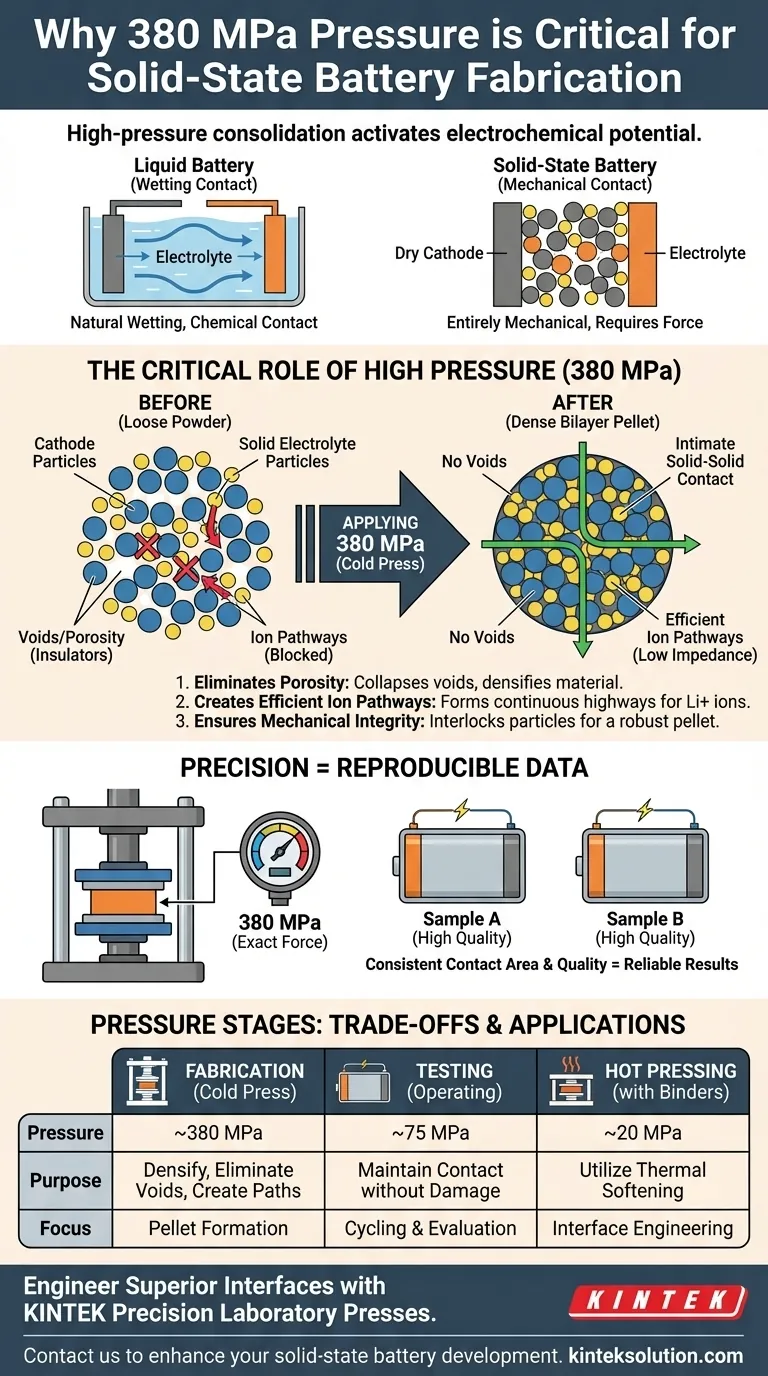
In liquid batteries, the electrolyte naturally wets the electrode to create contact; in solid-state batteries, contact is entirely mechanical. Applying 380 MPa eliminates insulating air gaps and porosity, ensuring the continuous solid-solid interface required for low impedance and efficient lithium-ion transport.
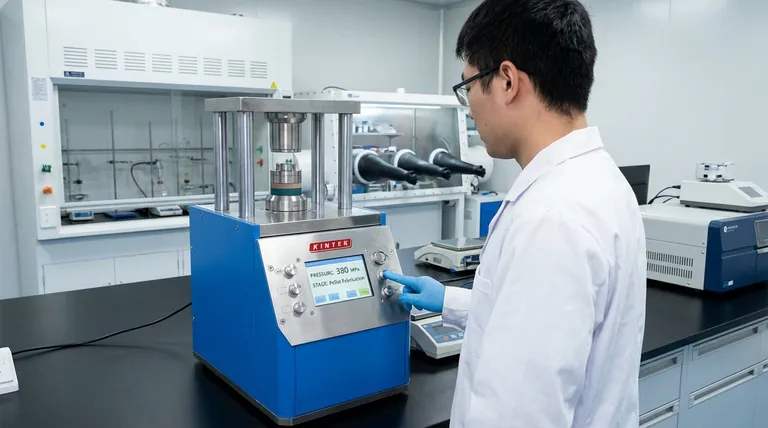
The Critical Role of High Pressure in Fabrication
Eliminating Porosity and Voids
Loose powders naturally contain significant air gaps and porosity. These voids act as insulators, preventing ionic movement.
By applying 380 MPa, you mechanically collapse these voids, densifying the material. This transforms a mixture of separate particles into a dense, non-porous solid sheet essential for a functional battery.
Creating Efficient Ion Pathways
Lithium ions cannot jump across open spaces; they require a continuous physical medium to travel.
The high-pressure treatment forces the cathode active material and the solid electrolyte (such as Li5.5PS4.5Cl1.5) into an "intimate solid-solid contact." This physical connection creates the necessary highways for ions to move from the cathode to the electrolyte, directly lowering interfacial impedance.
Ensuring Mechanical Integrity
Beyond electrochemical performance, the bilayer structure must be mechanically stable to withstand handling and cell assembly.
Pressing at 380 MPa acts as a binder-free consolidation method, interlocking the particles to form a robust pellet. This mechanical stability prevents the layers from delaminating or crumbling during the subsequent stacking of the anode.
The Importance of Precision and Consistency
Reproducibility of Data
In battery research, variations in fabrication pressure lead to erratic results.
A hydraulic press allows researchers to apply the exact same pressure (e.g., 380 MPa) to every sample. This consistency ensures that the contact area and quality are identical across all cells, meaning any difference in performance is due to the material chemistry, not fabrication errors.
Minimizing Variable Resistance
Interfacial resistance is often the primary bottleneck in solid-state batteries.
By strictly controlling the forming pressure, you standardize the internal resistance of your cells. This allows for accurate evaluation of electrochemical data, such as impedance spectra and cycling performance.
Understanding the Trade-offs: Pressure Stages
While 380 MPa is critical for fabrication, it is not the only pressure parameter you must manage. It is vital to distinguish between forming pressure and operating pressure to avoid damaging your cell or equipment.
Forming vs. Stacking Pressure
The 380 MPa figure specifically refers to the initial cold-pressing of the pellet to densify the materials.
However, once the cell is assembled (with the anode added), a lower "stacking pressure" or "operating pressure" is typically used. References suggest around 74 to 75 MPa for this stage. This lower pressure is sufficient to maintain contact during testing without crushing delicate components or shorting the cell.
Thermal Considerations
If your process involves a hot press (heating to ~70°C), you may require significantly less pressure, often around 20 MPa.
Heat softens polymer binders, facilitating particle flow without the need for extreme force. Applying 380 MPa in a hot press scenario could lead to over-compression or material extrusion, highlighting the need to match pressure to your specific processing temperature.
Making the Right Choice for Your Goal
To maximize the performance of your solid-state cells, you must apply the correct pressure at the correct stage of development.
- If your primary focus is fabricating the electrolyte/cathode pellet: Apply approximately 380 MPa to maximize density, eliminate porosity, and establish the initial solid-solid conduction pathways.
- If your primary focus is electrochemical testing and cycling: Maintain a constant holding pressure of roughly 75 MPa to ensure stable physical contact between layers without over-compressing the active cell.
- If your primary focus is interface engineering with binders: Consider using a hot press at lower pressures (e.g., 20 MPa) to utilize thermal softening for improved contact rather than brute mechanical force.
Ultimately, the laboratory press is not just a tool for compaction; it is the primary instrument for engineering the low-resistance interfaces that make solid-state energy storage possible.
Summary Table:
| Stage | Purpose | Recommended Pressure |
|---|---|---|
| Pellet Fabrication | Densify materials, eliminate voids, create ion pathways | ~380 MPa |
| Electrochemical Testing | Maintain contact during cycling without damage | ~75 MPa |
| Hot Pressing (with binders) | Utilize thermal softening for improved contact | ~20 MPa |
Engineer superior solid-state battery interfaces with KINTEK's precision laboratory presses.
Achieve the critical 380 MPa of pressure required to fabricate dense, high-performance electrolyte and cathode bilayers. Our automatic lab presses, isostatic presses, and heated lab presses are engineered to provide the precise, consistent force necessary for eliminating porosity and creating the low-resistance interfaces essential for your research.
Contact us today to discuss how our specialized equipment can enhance your solid-state battery development and ensure reproducible, high-quality results.
Visual Guide
Related Products
- Warm Isostatic Press for Solid State Battery Research Warm Isostatic Press
- Laboratory Hydraulic Press Lab Pellet Press Button Battery Press
- Lab Infrared Press Mold for Laboratory Applications
- Button Battery Sealing Press Machine for Lab
- Lab Cylindrical Press Mold for Laboratory Use
People Also Ask
- Why must composite cathodes be sealed in vacuum lamination bags for WIP? Ensure Battery Stability and Density
- What is the function of elastic molds in warm isostatic pressing? Achieve Uniform Density in Composite Particles
- How do sacrificial volume materials (SVM) maintain microchannels in isostatic pressing? Ensure Structural Integrity
- What is the significance of temperature control in Warm Isostatic Pressing? Unlock Uniform Densification and Process Stability
- How does Warm Isostatic Pressing differ from traditional pressing methods? Unlock Uniform Density for Complex Parts



















