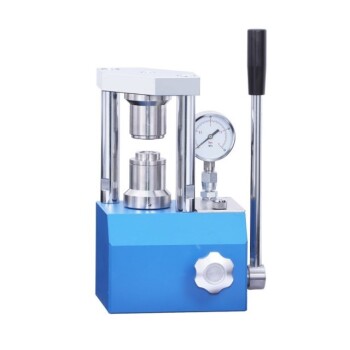
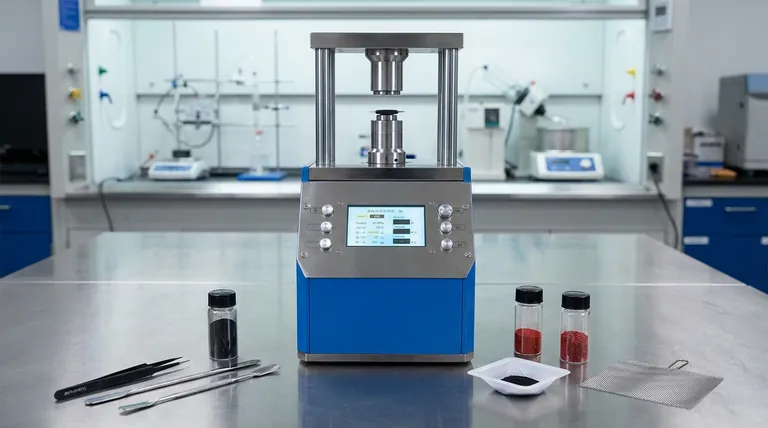
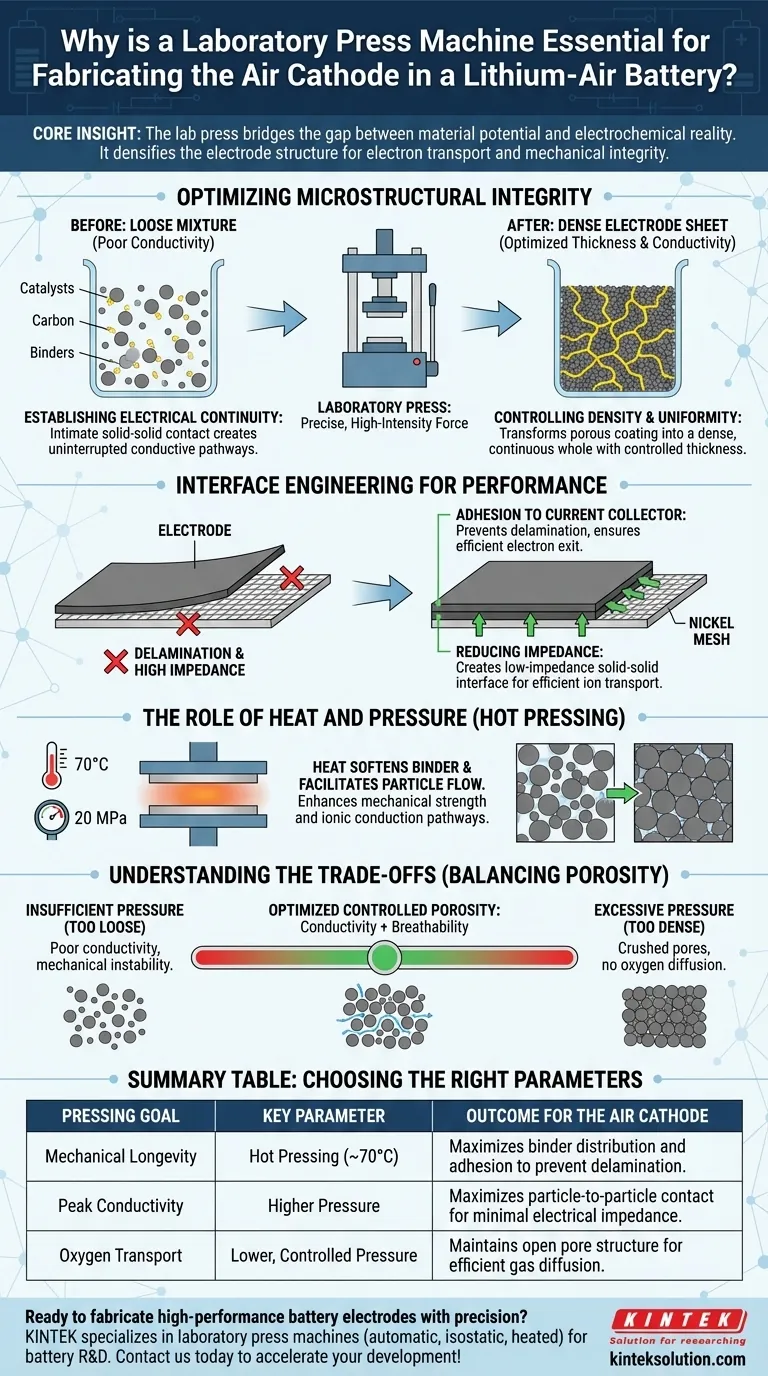
A laboratory press machine is the critical enabler that transforms a loose mixture of chemicals into a functional, high-performance battery component. It applies precise, high-intensity force to compact catalysts, conductive carbon, and binders into a dense, mechanically stable electrode sheet with optimized thickness and conductivity.
Core Insight: The laboratory press bridges the gap between material potential and electrochemical reality. By densifying the electrode structure, it creates the intimate particle-to-particle contact necessary for electron transport while establishing the mechanical integrity required for the battery to survive repeated cycling.
Optimizing Microstructural Integrity
To create a functional air cathode, you must manipulate the physical arrangement of microscopic particles. The press machine allows you to control this architecture with high precision.
Establishing Electrical Continuity
In a loose powder mixture, gaps between particles act as insulators.
The press machine forces the conductive carbon and catalyst (such as La0.6Sr0.4CoO3-δ) into intimate solid-solid contact. This creates a clear, uninterrupted conductive pathway, which is a fundamental requirement for efficient electrochemical reactions.
Controlling Density and Uniformity
Without compression, coated structures are often loose and porous.
Applying pressure transforms this porous coating into a dense, continuous, and uniform whole. This process ensures the electrode has a specific, controlled thickness, reducing variations that could lead to hot spots or uneven reaction rates across the cathode surface.
Interface Engineering for Performance
The performance of a lithium-air battery is often dictated by its interfaces. The press machine is the primary tool used to engineer these boundaries for low resistance.
Adhesion to the Current Collector
The electrode sheet must be physically and electrically connected to the external circuit.
Pressure promotes a strong bond between the electrode sheet and the current collector (typically a nickel mesh). This prevents delamination during operation and ensures the electrons generated during discharge can exit the battery efficiently.
Reducing Impedance
Internal resistance (impedance) is a major energy loss factor in batteries.
By creating a highly densified structure with minimal internal porosity, the press creates a low-impedance solid-solid interface. This facilitates efficient ion transport within the battery, directly impacting the power density and overall efficiency.
The Role of Heat and Pressure (Hot Pressing)
Advanced fabrication often utilizes "hot pressing," typically around 70°C at 20 MPa. This technique offers advantages beyond simple mechanical compaction.
Binder Activation and Particle Flow
Heat softens the polymer binder within the mixture.
Combined with pressure, this facilitates the rearrangement and flow of particles. The binder can deform to fill voids more effectively, significantly enhancing both the mechanical strength of the cathode and the ionic conduction pathways.
Understanding the Trade-offs
While compression is essential, it must be applied with extreme precision. The relationship between pressure and performance is not linear.
The Balance of Porosity
In a lithium-air battery, the cathode acts as the "lungs" of the system—it needs to breathe oxygen.
If you apply insufficient pressure, the electrode remains too loose, resulting in poor conductivity and mechanical instability.
However, excessive pressure can crush the necessary pores. You must maintain a specific "controlled porosity" to allow oxygen to diffuse into the cathode and reach the reaction sites. The laboratory press provides the control necessary to hit this narrow window between conductivity and breathability.
Making the Right Choice for Your Goal
The specific parameters you choose for your press machine will dictate the characteristics of your final cell.
- If your primary focus is mechanical longevity: Prioritize hot pressing to maximize binder distribution and adhesion to the nickel mesh, preventing delamination over time.
- If your primary focus is peak conductivity: Focus on higher pressure settings to maximize particle-to-particle contact and minimize interfacial impedance.
- If your primary focus is oxygen transport: Utilize lower, strictly controlled pressure to maintain an open pore structure for gas diffusion.
Ultimately, the laboratory press turns a chemical recipe into a structurally sound engineering component capable of sustaining efficient energy storage.
Summary Table:
| Pressing Goal | Key Parameter | Outcome for the Air Cathode |
|---|---|---|
| Mechanical Longevity | Hot Pressing (~70°C) | Maximizes binder distribution and adhesion to prevent delamination. |
| Peak Conductivity | Higher Pressure | Maximizes particle-to-particle contact for minimal electrical impedance. |
| Oxygen Transport | Lower, Controlled Pressure | Maintains open pore structure for efficient gas diffusion. |
Ready to fabricate high-performance battery electrodes with precision?
KINTEK specializes in laboratory press machines, including automatic, isostatic, and heated lab presses, designed to meet the exacting demands of battery research and development. Our equipment provides the precise control over pressure and temperature you need to optimize cathode density, conductivity, and porosity for your specific application.
Contact us today using the form below to discuss how our lab press solutions can accelerate your development of next-generation energy storage systems.
Visual Guide
Related Products
- Laboratory Hydraulic Press Lab Pellet Press Button Battery Press
- Button Battery Sealing Press Machine for Lab
- Lab Infrared Press Mold for Laboratory Applications
- Lab Cylindrical Press Mold for Laboratory Use
- Carbide Lab Press Mold for Laboratory Sample Preparation
People Also Ask
- How is a laboratory hydraulic press used for HAP composite gels? Master Mineral Substrate Standardization
- What role does a laboratory hydraulic press play in the preparation of piezoelectric ceramic discs for DC-PG? | KINTEK
- What role does a laboratory hydraulic press play in reaction pellets? Optimizing Lunar Soil and Metal Fuel Density
- Why is a laboratory hydraulic press required for PBAT and PLA sample preparation? Achieve Flawless Characterization
- What role does a laboratory hydraulic press play in the assembly of all-solid-state battery test cells? Expert Guide