The primary necessity for a laboratory press in solid-state battery assembly is to overcome the inherent physical limitations of solid-solid interfaces. Unlike liquid electrolytes that naturally wet electrodes, solid materials make poor initial contact, relying on massive mechanical force—often between 60 and 240 MPa—to physically merge distinct layers into a unified, conductive stack.
The core challenge in solid-state batteries is interfacial impedance. Without precise, high-pressure compaction, the microscopic gaps between the electrode and electrolyte act as insulators, preventing lithium-ion transport and rendering the battery non-functional.

The Physics of Solid-Solid Interfaces
To understand why a press is non-negotiable, one must look at the microscopic interaction between the battery layers.
Eliminating the "Point Contact" Problem
When two solid surfaces touch, they naturally contact only at their highest microscopic peaks. This is known as "point contact."
In a battery, this creates extremely high interfacial resistance because ions have very few pathways to travel. A laboratory press applies sufficient force to flatten these peaks, maximizing the surface area where materials touch.
Densification of Components
Solid-state batteries are often assembled from powders. Without compression, these powder layers are full of voids and air pockets.
Applying pressures in the range of 100 to 200 MPa compacts active material and electrolyte powders into high-density pellets. This densification is critical for creating continuous percolation networks—unbroken highways for ions and electrons to traverse the cell.
Inducing Plastic Deformation
Materials like lithium metal are soft, while ceramic electrolytes (such as LLZO) are rigid and hard.
The press forces the soft lithium metal to undergo plastic deformation. The metal physically flows into the microscopic depressions and surface irregularities of the hard ceramic electrolyte. This fills gaps that would otherwise impede performance, ensuring a tight, seamless bond.
The Critical Role of Pressure During Operation
The need for pressure extends beyond the initial assembly; it is also a dynamic requirement for battery longevity.
Counteracting Volume Changes
Battery materials expand and contract during charge and discharge cycles. In a liquid battery, the fluid adapts to this; in a solid battery, this movement can cause layers to physically separate (delaminate).
Applying a controlled, constant pressure (often lower, around 3.2 MPa) creates a mechanical constraint. This holds the stack together during volume changes, preventing the "contact loss" that leads to rapid capacity decay.
Suppressing Dendrite Growth
Lithium dendrites are needle-like structures that can puncture electrolytes and cause short circuits.
Tight physical contact and improved wettability, achieved through pressure, help homogenize the current distribution at the interface. This uniformity suppresses the localized hotspots where dendrites tend to form, significantly improving safety and stability.
Understanding the Trade-offs
While pressure is essential, the references highlight that the application must be precise, not just forceful.
The Risk of Imprecision
Applying pressure blindly is not effective. The pressure must be tailored to the specific stage of assembly (e.g., extremely high for powder compaction vs. moderate for cycling).
Insufficient vs. Excessive Force
If pressure is too low (e.g., spring pressure under 0.2 MPa), the interface remains resistive, and the battery fails at high rates. Conversely, the equipment must deliver pressure uniformly; uneven force can lead to cracking in brittle ceramic electrolytes or uneven current density.
Making the Right Choice for Your Goal
The specific pressure requirements depend heavily on which stage of the battery lifecycle you are addressing.
- If your primary focus is Cell Fabrication (Assembly): You require a press capable of delivering high pressure (60–240 MPa) to compact powders and deform lithium metal for maximum densification.
- If your primary focus is Cycling Stability (Testing): You need a fixture or press capable of maintaining a constant, lower pressure (approx. 3.2 MPa) to prevent delamination during charge/discharge cycles.
Summary: The laboratory press transforms a collection of loose powders and rigid sheets into a cohesive electrochemical system, creating the dense physical pathways required for energy to flow.
Summary Table:
| Application Goal | Required Pressure | Key Function |
|---|---|---|
| Cell Fabrication (Assembly) | 60 – 240 MPa | Compacts powders, deforms lithium metal for maximum densification. |
| Cycling Stability (Testing) | ~3.2 MPa | Maintains contact to prevent delamination during charge/discharge cycles. |
Ready to build reliable all-solid-state batteries?
Achieving the precise, high pressures required for densification and stable cycling is non-negotiable for performance. KINTEK specializes in laboratory press machines—including automatic lab presses, isostatic presses, and heated lab presses—designed to meet the exacting demands of battery research and development.
Our presses ensure uniform pressure application, helping you eliminate interfacial resistance and create high-performance cells. Let us help you accelerate your development timeline.
Contact KINTEK today to discuss your specific battery assembly needs!
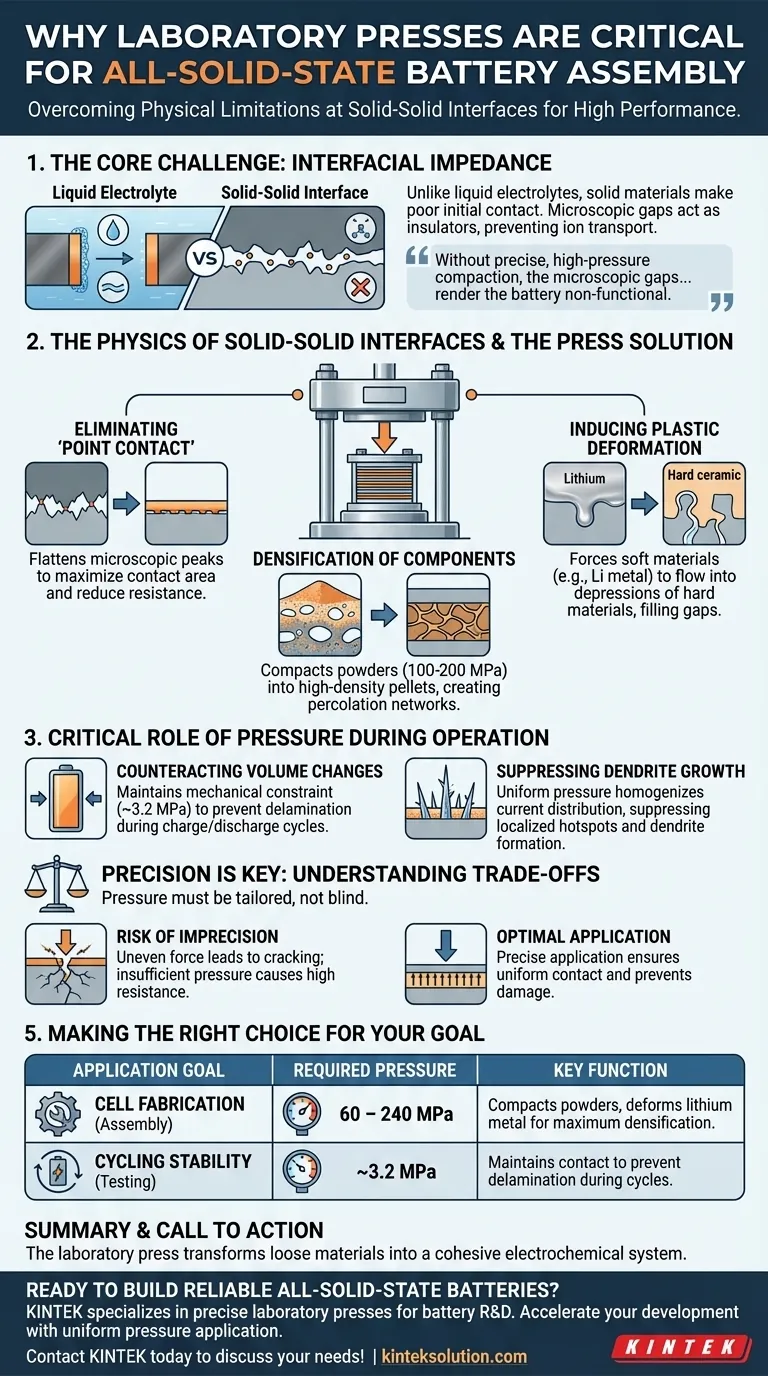
Visual Guide
Related Products
- Warm Isostatic Press for Solid State Battery Research Warm Isostatic Press
- Laboratory Hydraulic Press Lab Pellet Press Button Battery Press
- Lab Infrared Press Mold for Laboratory Applications
- Button Battery Sealing Press Machine for Lab
- Carbide Lab Press Mold for Laboratory Sample Preparation
People Also Ask
- Why must composite cathodes be sealed in vacuum lamination bags for WIP? Ensure Battery Stability and Density
- What is the function of elastic molds in warm isostatic pressing? Achieve Uniform Density in Composite Particles
- How do sacrificial volume materials (SVM) maintain microchannels in isostatic pressing? Ensure Structural Integrity
- What are the advantages of using a Warm Isostatic Press (WIP) for batteries? Achieve Superior Interface Contact
- What is the function of hydraulic pressure in warm isostatic pressing? Achieve Uniform Material Density