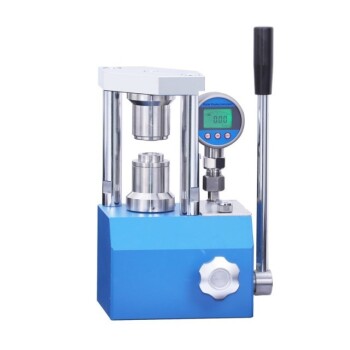
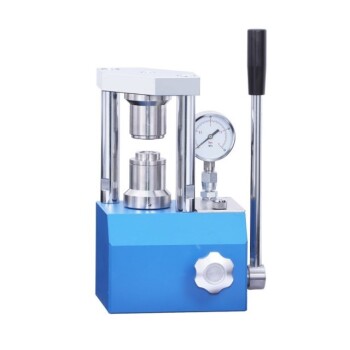
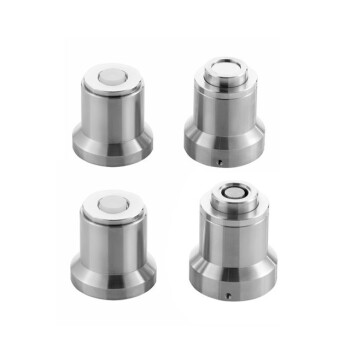
The precision sealing machine is the critical final step in the assembly of aqueous zinc-ion coin cells, serving as the guarantor of the battery's structural and chemical integrity. It applies controlled mechanical pressure to the cell casing—specifically formats like the CR2032—to create a hermetic, airtight seal. This mechanical deformation isolates the internal electrochemical environment from the outside world, preventing the leakage of liquid electrolytes and blocking the ingress of external contaminants.
Core Insight: The sealing machine does more than just close the casing; it establishes a constant internal pressure that is mandatory for minimizing electrical contact resistance and preventing electrolyte evaporation, ensuring that your long-term cycling data reflects true battery performance rather than assembly failure.
The Imperative of Environmental Isolation
Preventing Electrolyte Volatilization
In aqueous zinc-ion batteries, the electrolyte contains water, making it susceptible to evaporation. A precision seal ensures the liquid electrolyte remains contained within the cell.
Without this hermetic barrier, the electrolyte would volatilize (dry out) over time. This loss of solvent directly alters the concentration of the electrolyte, leading to inevitable failure during long-cycle stability testing.
Blocking External Interference
The sealing process creates a rigorous barrier against the ambient environment. This prevents external moisture or air from infiltrating the cell.
Contamination from the outside can trigger unwanted side reactions with the zinc anode or the electrolyte. Complete isolation is the only way to attribute test results solely to your specific battery chemistry.
Optimizing Electrical Performance via Pressure
Minimizing Contact Resistance
A laboratory sealing press applies precise radial pressure to the casing, which compresses the internal stack (current collectors, electrodes, and separators).
This compression forces these layers into tight physical contact. By eliminating gaps between components, the machine significantly minimizes ohmic internal resistance, allowing electrons to flow efficiently through the battery.
Ensuring Uniform Component Bonding
The mechanical pressure must be uniform to ensure the electrolyte sufficiently wets the porous structures of the separator and electrodes.
Proper bonding between the MnO₂ cathode, the separator, and the anode is vital. If the layers are not pressed tightly and uniformly, the interfacial resistance increases, compromising rate performance evaluations and data repeatability.
Understanding the Trade-offs
The Risks of Imprecise Pressure
While pressure is necessary, it must be carefully calibrated. A machine that lacks precision cannot guarantee the "constant" pressure required for reproducible science.
If the pressure is too low, the seal will fail, leading to high impedance and leakage. Conversely, uncontrolled high pressure can crush internal components or puncture the separator, causing immediate short circuits.
Equipment Variability
Not all sealing machines provide the same level of radial force control. Manual hydraulic presses may introduce human error and inconsistency compared to automated precision electric crimpers.
Reliance on low-precision equipment often results in "noisy" data where the variance is caused by the assembly process, not the electrochemical properties of the materials being tested.
Making the Right Choice for Your Research
To ensure your data is publishable and your cells are reliable, consider your specific testing goals when evaluating sealing protocols:
- If your primary focus is long-term cycling stability: Prioritize a machine known for achieving a perfect hermetic seal to prevent electrolyte dry-out over weeks or months of testing.
- If your primary focus is rate capability and conductivity: Focus on the machine's ability to apply consistent, high internal pressure to minimize contact resistance between electrode layers.
Ultimately, the precision sealing machine converts a stack of raw materials into a unified electrochemical system, acting as the primary safeguard for the accuracy of your experimental data.
Summary Table:
| Key Function | Impact on Battery Performance | Importance for Research |
|---|---|---|
| Hermetic Sealing | Prevents electrolyte evaporation and air ingress | Ensures long-term cycling stability and data accuracy |
| Mechanical Compression | Minimizes internal ohmic contact resistance | Vital for accurate rate capability and conductivity tests |
| Component Bonding | Ensures uniform wetting of electrodes/separators | Improves interfacial resistance and data repeatability |
| Pressure Calibration | Prevents internal shorts or seal failure | Guarantees reproducible science and minimizes assembly error |
Elevate Your Battery Research with KINTEK Precision Solutions
Don't let inconsistent assembly compromise your research data. KINTEK specializes in comprehensive laboratory pressing solutions, offering a versatile range of manual, automatic, heated, and glovebox-compatible models, as well as high-performance cold and warm isostatic presses.
Whether you are focusing on long-term cycling stability or high-rate performance for aqueous zinc-ion batteries, our precision crimpers and sealing machines ensure the structural and chemical integrity your work demands. From minimizing contact resistance to achieving perfect hermetic seals, we provide the tools necessary for publishable, reliable results.
Ready to optimize your coin cell assembly process?
Contact KINTEK Today to Find Your Ideal Pressing Solution
References
- Ginny Ke. Design of Next-Generation Dendrite-Free Eco-Electrolytes for High-Voltage Aqueous Zn-Metal Batteries. DOI: 10.54254/2755-2721/2025.gl25783
This article is also based on technical information from Kintek Solution Knowledge Base .
Related Products
- Lab Button Battery Tablet Press Sealing Mold
- Button Battery Sealing Press Machine for Lab
- Button Battery Sealing Machine for Button Batteries
- Manual Button Battery Sealing Machine for Battery Sealing
- Lab Button Battery Disassembly and Sealing Mold
People Also Ask
- How does a sealed battery mold facilitate the assembly and testing of asymmetric supercapacitors using VO2?
- Why use standardized CR2032 components & high-precision presses? Ensure reliability in lithium metal battery research.
- Why is a laboratory battery sealing press essential for desolvation energy testing? Ensure Reliable Kinetic Data
- What is the function of specialized battery molds and sealing consumables? Optimize Your In-situ XRD Testing Today
- What role does a laboratory sealing press play in thermal analysis of solid dispersion films? Ensure Data Integrity