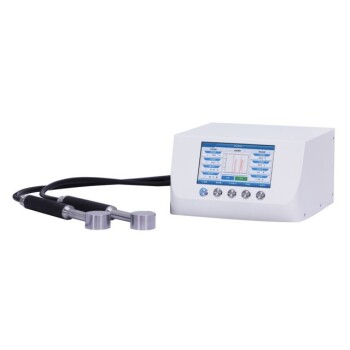
Precision thermal control is indispensable in high-pressure mantle studies because mineral phase transitions are driven by a coupled relationship between pressure and temperature, not pressure alone. By integrating a heating system with high-pressure presses, researchers can simulate realistic mantle geothermal gradients. This accuracy is required to quantify how factors like moisture content displace transition boundaries and to determine the specific dehydration melting temperatures of deep-earth minerals.
To accurately model the Earth's deep interior, high-pressure environments must be paired with exact temperature regulation. This allows for the precise observation of how moisture broadens transition boundaries and influences the stability of minerals at critical depths.
Simulating the Mantle Environment
Replicating Geothermal Gradients
Pressure is only half of the equation when modeling the Earth's interior. To create a valid simulation, you must reproduce the geothermal gradient—the specific rate at which temperature increases with depth.
Without a precision heating system, high-pressure equipment can only model "cold" compression. This fails to capture the thermodynamic reality of the mantle, rendering data regarding mineral behavior effectively useless for geological modeling.
Analyzing Phase Transition Boundaries
The 410km and 660km Discontinuities
The mantle is defined by distinct seismic discontinuities where minerals undergo structural changes. Key examples include the olivine-to-wadsleyite transition at 410 km and the ringwoodite-to-bridgmanite transition at 660 km.
These transitions do not occur at fixed pressures; they slide based on thermal conditions. Precise temperature control allows researchers to map exactly where these boundaries occur under realistic Earth-like heat.
The Influence of Moisture
The presence of water (moisture) in mantle minerals significantly complicates these transitions. Moisture can cause the boundary between phases to displace or broaden rather than remaining sharp.
If the temperature fluctuates during an experiment, it becomes impossible to distinguish between a boundary shift caused by moisture and one caused by thermal error. Constant, precise heat is the control variable that isolates the effect of water.
Determining Material Limits
Dehydration Melting Temperatures
Beyond structural changes, researchers must understand when hydrated minerals break down. This is known as dehydration melting, a process where minerals release water and melt at specific thermal thresholds.
Accurate determination of these melting points requires stable heating. Even slight deviations can lead to incorrect data regarding the stability fields of hydrated mantle minerals.
The Risks of Thermal Inaccuracy
Data Noise vs. Physical broadening
When studying how moisture broadens a transition boundary, the signal can be subtle. Poor temperature control introduces "thermal noise" into the data.
This noise mimics the physical broadening caused by moisture. Without high-precision control, you risk interpreting experimental error as a geological phenomenon.
Mismapping Depth
Phase boundaries are highly temperature-sensitive (the Clapeyron slope). A temperature error of just a few degrees can correspond to a depth calculation error of several kilometers.
To build accurate models of the Earth's structure, the temperature input must be as rigorous as the pressure input.
Making the Right Choice for Your Research
When configuring your high-pressure experimental setup, align your thermal control requirements with your specific research objectives.
- If your primary focus is Seismic Modeling: Prioritize stability to accurately map the depth and sharpness of the 410km and 660km discontinuities.
- If your primary focus is Volatiles and Hydration: Ensure your system can maintain precise set-points to isolate the subtle effects of moisture on boundary displacement and dehydration melting.
Precision heating transforms a high-pressure press from a simple crushing device into a true simulator of the Earth's dynamic interior.
Summary Table:
| Research Variable | Importance of Thermal Precision | Impact of Precision Heating |
|---|---|---|
| Geothermal Gradient | Replicates depth-specific heat | Prevents unrealistic "cold" compression models |
| Phase Transitions | Maps Clapeyron slopes | Accurately identifies 410km and 660km discontinuities |
| Moisture Content | Isolates hydration effects | Distinguishes physical broadening from thermal noise |
| Dehydration Melting | Determines stability fields | Precisely identifies mineral breakdown thresholds |
Elevate Your Geochemical Research with KINTEK
Precision is the difference between experimental noise and geological discovery. KINTEK specializes in comprehensive laboratory pressing solutions designed to meet the rigorous demands of deep-earth simulation. Whether you are conducting high-pressure battery research or studying mantle mineralogy, our range of manual, automatic, heated, and multifunctional presses—including advanced cold and warm isostatic models—provides the stability you need.
Don't let thermal fluctuations compromise your depth calculations or mineral stability data. Our glovebox-compatible and precision-heated systems ensure your high-pressure environments are truly Earth-like.
Ready to refine your laboratory pressing capabilities? Contact KINTEK today to find the perfect precision-controlled solution for your research goals.
References
- Eiji Ohtani. Hydration and Dehydration in Earth's Interior. DOI: 10.1146/annurev-earth-080320-062509
This article is also based on technical information from Kintek Solution Knowledge Base .
Related Products
- Infrared Heating Quantitative Flat Plate Mold for Precise Temperature Control
- Automatic High Temperature Heated Hydraulic Press Machine with Heated Plates for Lab
- Automatic Heated Hydraulic Press Machine with Heated Plates for Laboratory
- Lab Polygon Press Mold
- Automatic Heated Hydraulic Press Machine with Hot Plates for Laboratory
People Also Ask
- How do precision temperature-controlled heating plates function in electrolyte thermal stability storage experiments?
- What is the importance of a precision temperature-controlled heating module? Ensure Aluminum-Cadmium Thermal Stability
- How does heating platen precision affect rubber specimens? Achieve uniform density and reliable testing results.
- How are thin polymer films produced for spectroscopic analysis? Expert Guide to Heat and Low-Pressure Methods
- What accessories and field services can be used to optimize the capabilities of presses? Maximize Your Lab Performance