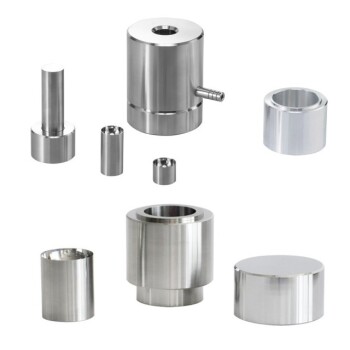
Applying a saturated lubricant to mold surfaces is a critical protective measure. It creates a continuous thin film that acts as a physical barrier between the aluminum metal powder and the steel walls of the mold. This barrier drastically reduces friction during the high-pressure pressing phase and prevents the aluminum from adhering to the die, ensuring the part remains intact upon ejection.
The Core Insight Wall lubrication is not just about smoothing movement; it is a structural necessity for aluminum powder metallurgy. By preventing metal-on-metal adhesion, it preserves the surface integrity of the fragile "green" compact and significantly extends the lifespan of expensive tooling.
The Mechanics of Mold Protection
Reducing Frictional Resistance
When pressing powder, friction is the enemy of density. As the punch compresses the powder, friction against the mold walls resists the downward force.
Applying a saturated lubricant significantly reduces this sidewall friction. This allows the pressing pressure to transmit more effectively through the powder column. The result is a more uniform density throughout the part, preventing soft spots or structural weaknesses.
Prevention of Adhesion (Galling)
Aluminum powder is naturally ductile and can be "sticky" under high pressure. Without a barrier, the powder tends to cold-weld or adhere to the steel walls of the mold.
The saturated lubricant film isolates the powder from the steel. This eliminates the risk of the aluminum sticking to the mold, a defect that ruins the surface finish of the part and requires machine downtime to clean the tool.
Ensuring Integrity During Demolding
The most dangerous moment for a pressed part (the "green compact") is ejection. If there is high friction or adhesion, the force required to push the part out can tear it apart.
Lubrication minimizes this demolding resistance. By allowing the part to slide easily out of the cavity, it prevents the formation of laminar cracks or surface layers that can occur when the outer skin of the part drags against the mold wall.
Impact on Manufacturing Efficiency
Extending Tool Life
Mold tooling acts as a consumable asset in manufacturing. Direct contact with abrasive metal powders accelerates wear and tear.
By maintaining a constant lubricant film, the process protects the upper and lower punches and the die cavity from direct abrasion. This significantly extends the overall service life of the mold, reducing tooling costs over time.
Critical Distinctions and Trade-offs
Wall Lubrication vs. Internal Lubrication
It is vital to distinguish between lubricating the mold walls and mixing lubricant into the powder.
Lubricant mixed internally (between particles) aids in rearrangement but burns off during sintering to create controlled pores. However, relying only on internal lubricant can result in higher ejection forces. Wall lubrication is specifically targeted at protecting the interface between the tool and the part, rather than modifying the internal structure of the material.
Managing Lubricant Saturation
While lubrication is essential, the application must be controlled. The goal is a "thin film."
If the lubricant is applied too heavily, it can occupy volume within the die that should be filled by powder, potentially distorting the final dimensions. Conversely, insufficient saturation leads to immediate sticking and potential die seizure.
Making the Right Choice for Your Goal
When optimizing your aluminum powder pressing process, consider where your lubricant is applied to achieve specific outcomes:
- If your primary focus is Surface Finish and Integrity: Prioritize mold wall lubrication to prevent sticking and cracking during ejection.
- If your primary focus is Tool Longevity: Ensure the lubricant film is saturated and continuous to eliminate abrasive metal-on-metal contact.
- If your primary focus is Controlled Porosity: Focus on adjusting the ratio of internal lubricants mixed with the powder, rather than altering the wall lubrication.
Mastering the application of saturated lubricants ensures a repeatable process where high-quality parts are produced without sacrificing the lifespan of your equipment.
Summary Table:
| Benefit | Mechanism | Impact on Production |
|---|---|---|
| Friction Reduction | Creates a physical barrier between powder and steel | Ensures uniform part density and effective pressure transfer |
| Adhesion Prevention | Prevents cold-welding/galling of aluminum to die | Maintains superior surface finish and eliminates machine downtime |
| Smooth Ejection | Minimizes resistance during demolding | Protects fragile 'green' compacts from laminar cracks and tearing |
| Tool Longevity | Eliminates direct metal-on-metal abrasion | Significantly extends the service life of expensive mold tooling |
Optimize Your Powder Metallurgy with KINTEK
Precision in aluminum powder pressing requires more than just high-quality lubricants—it demands reliable equipment. KINTEK specializes in comprehensive laboratory pressing solutions tailored for advanced material science and battery research.
Our extensive range includes:
- Manual & Automatic Presses for consistent pressure application.
- Heated & Multifunctional Models for complex material behaviors.
- Glovebox-Compatible & Isostatic Presses (CIP/WIP) for specialized environments.
Whether you are refining surface integrity or extending tool life, KINTEK provides the technical expertise and hardware to elevate your lab's efficiency. Contact our experts today to find the perfect pressing solution for your research needs.
References
- Muhammad Irfan Ab Kadir, Abd Khalil Abd Rahim. The Effect of Microstructures and Hardness Characteristics of Recycling Aluminium Chip AA6061/Al Powder On Various Sintering Temperatures. DOI: 10.30880/ijie.2018.10.03.009
This article is also based on technical information from Kintek Solution Knowledge Base .
Related Products
- XRF KBR Plastic Ring Lab Powder Pellet Pressing Mold for FTIR
- XRF KBR Steel Ring Lab Powder Pellet Pressing Mold for FTIR
- Lab Polygon Press Mold
- Lab XRF Boric Acid Powder Pellet Pressing Mold for Laboratory Use
- Lab Round Bidirectional Press Mold
People Also Ask
- What is the purpose of making KBr pellets for FTIR? Achieve Precise Molecular Analysis with Solid Samples
- What factors should be considered when choosing a lab press for XRF pellet preparation? Ensure Accurate and Consistent Results
- Why are pellets used in XRF analysis, and what is their limitation? Boost Accuracy and Speed in Your Lab
- How are pellets prepared for XRF analysis and what is a potential drawback? Master XRF Sample Prep and Accuracy
- What should be included in a checklist for making XRF pellets? Ensure Accurate and Repeatable XRF Analysis