
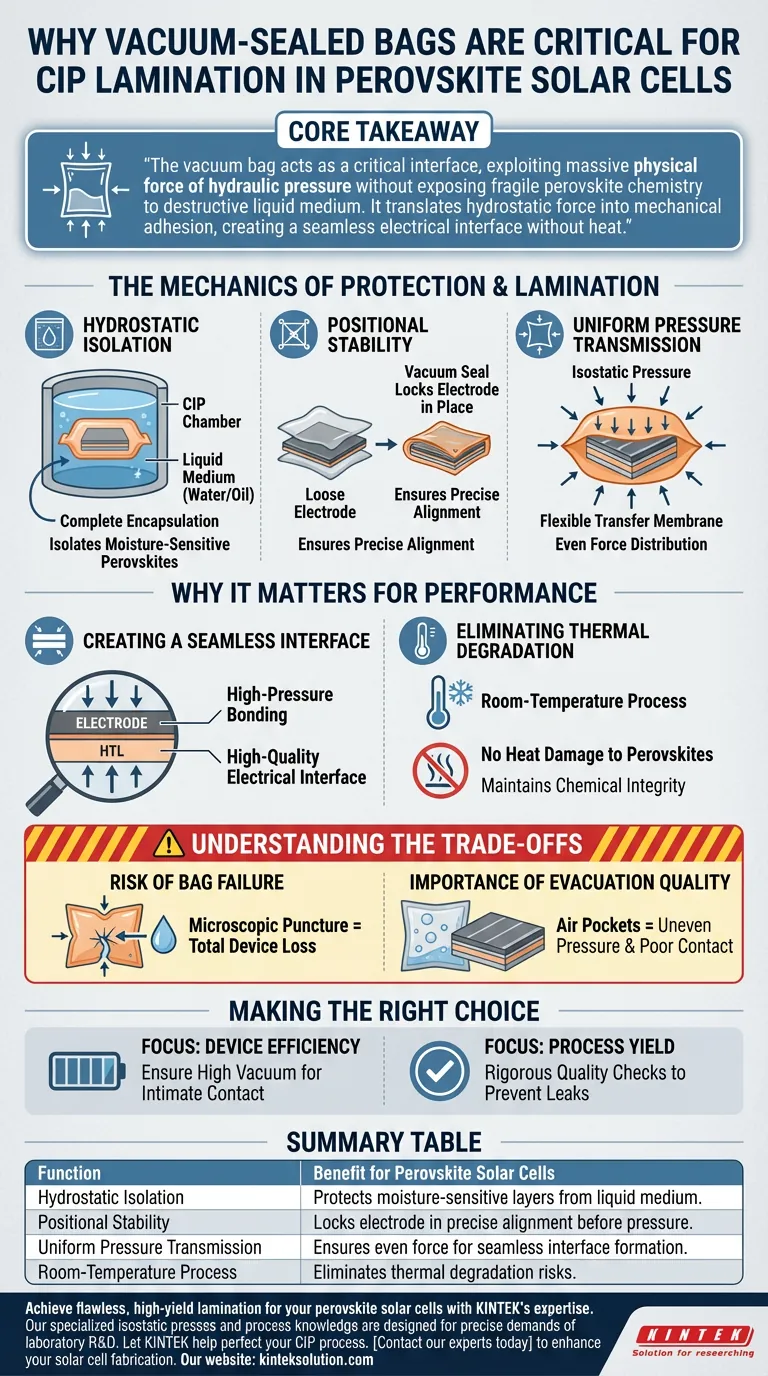
The primary necessity of a vacuum-sealed bag in Cold Isostatic Pressing (CIP) is to act as an impermeable barrier between the device and the liquid medium used to generate pressure. Because CIP chambers typically utilize water or oil to apply force, and perovskite layers are highly sensitive to moisture and solvents, the bag prevents immediate chemical degradation. Simultaneously, the vacuum sealing process mechanically fixes the loose electrode in place, ensuring precise alignment before the lamination begins.
Core Takeaway The vacuum bag acts as a critical interface that allows you to exploit the massive physical force of hydraulic pressure without exposing fragile perovskite chemistry to the destructive liquid medium. It translates hydrostatic force into mechanical adhesion, creating a seamless electrical interface without heat.
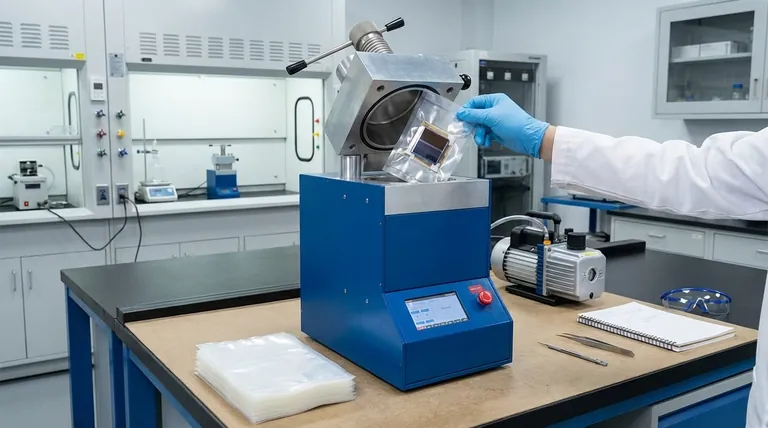
The Mechanics of Protection and Lamination
To understand why the bag is non-negotiable, you must understand the conflict between the CIP mechanism and perovskite chemistry.
Hydrostatic Isolation
The CIP process functions by filling a chamber with a liquid medium—often water or oil—and pressurizing it.
Perovskite materials are notoriously moisture-sensitive and will degrade rapidly upon contact with water. The vacuum-sealed bag provides complete encapsulation, isolating the solar cell stack from the liquid environment while submerged.
Positional Stability
Before pressure is applied, the top electrode (often a carbon/silver bilayer) is placed loosely onto the solar cell stack.
Without the vacuum seal, this electrode would likely shift during the handling or pressurization phases. The vacuum removes air and collapses the bag tight against the stack, effectively locking the electrode in the correct position prior to the application of high pressure.
Uniform Pressure Transmission
Reference data indicates that the bag must be flexible.
This flexibility allows the external isostatic pressure from the liquid to be transmitted uniformly and without loss to the sample. The bag acts as a transfer membrane, ensuring that the pressure densifies the electrode interface rather than crushing the device unevenly.
Why This Process Matters for Performance
The use of the bag enables the CIP process to achieve results that other lamination methods cannot.
Creating a Seamless Interface
The goal of CIP in this context is to press the carbon layer into "intimate contact" with the underlying hole transport layer (HTL).
The high pressure transmitted through the bag physically forces these layers together, creating a high-quality electrical interface. This mechanical bonding yields performance comparable to expensive vacuum-evaporated metal electrodes.
Eliminating Thermal Degradation
Because the bag allows for mechanical lamination via pressure rather than heat, the process remains at room temperature.
This eliminates the risk of thermal degradation to the heat-sensitive perovskite materials. Unlike methods requiring high-temperature sintering or solvent evaporation, the bag-enabled CIP process maintains the chemical integrity of the organic functional layers.
Understanding the Trade-offs
While the vacuum bag is essential, it introduces specific variables that must be managed to ensure yield consistency.
The Risk of Bag Failure
The reliability of this process is entirely dependent on the integrity of the bag. Even a microscopic puncture or seal failure will lead to immediate liquid ingress, resulting in the total loss of the device.
Importance of Evacuation Quality
If the vacuum seal is incomplete, air pockets may remain between the bag and the sample.
Because air is compressible and water is not, these pockets can lead to uneven pressure distribution. This can cause the ceramic or glass substrates to crack or result in areas of poor electrode contact, compromising the device's fill factor.
Making the Right Choice for Your Goal
To maximize the effectiveness of the CIP lamination process, focus on the following operational priorities:
- If your primary focus is Device Efficiency: Ensure the vacuum level is high enough to remove all air voids, guaranteeing the intimate contact required for optimal charge extraction.
- If your primary focus is Process Yield: Implement rigorous quality checks on the sealing bags to prevent liquid leaks, as moisture ingress is the single most common failure mode in this step.
The vacuum bag is not just a container; it is the active transmission tool that allows you to combine the physics of high pressure with the delicate chemistry of perovskites.
Summary Table:
| Function | Benefit for Perovskite Solar Cells |
|---|---|
| Hydrostatic Isolation | Protects moisture-sensitive perovskite layers from the liquid pressure medium (water/oil). |
| Positional Stability | Locks the top electrode in precise alignment before pressure is applied. |
| Uniform Pressure Transmission | Ensures even force distribution for seamless electrical interface formation. |
| Room-Temperature Process | Eliminates thermal degradation risks associated with other lamination methods. |
Achieve flawless, high-yield lamination for your perovskite solar cells with KINTEK's expertise.
Our specialized isostatic presses and process knowledge are designed to meet the precise demands of laboratory research and development. We understand the critical role of the vacuum bag interface in protecting sensitive materials while delivering the uniform pressure needed for optimal device performance.
Let KINTEK help you perfect your CIP process. Contact our experts today to discuss how our lab press solutions can enhance your solar cell fabrication.
Visual Guide
Related Products
- Manual Cold Isostatic Pressing CIP Machine Pellet Press
- Electric Split Lab Cold Isostatic Pressing CIP Machine
- Electric Lab Cold Isostatic Press CIP Machine
- Automatic Lab Cold Isostatic Pressing CIP Machine
- Lab Isostatic Pressing Molds for Isostatic Molding
People Also Ask
- Why is Cold Isostatic Pressing (CIP) necessary for SBN ceramics? Achieve High-Density and Crack-Free Sintering
- What are the process advantages of using Cold Isostatic Pressing (CIP) for LSMO? Achieve Defect-Free Density
- Why is Cold Isostatic Pressing (CIP) applied after uniaxial pressing? Optimize Superconductor Precursor Density
- What types of equipment are available for cold isostatic pressing? Explore CIP Solutions for Labs and Production
- What are the technical advantages of cold isostatic pressing equipment compared to uniaxial compression equipment? Learn More!









