
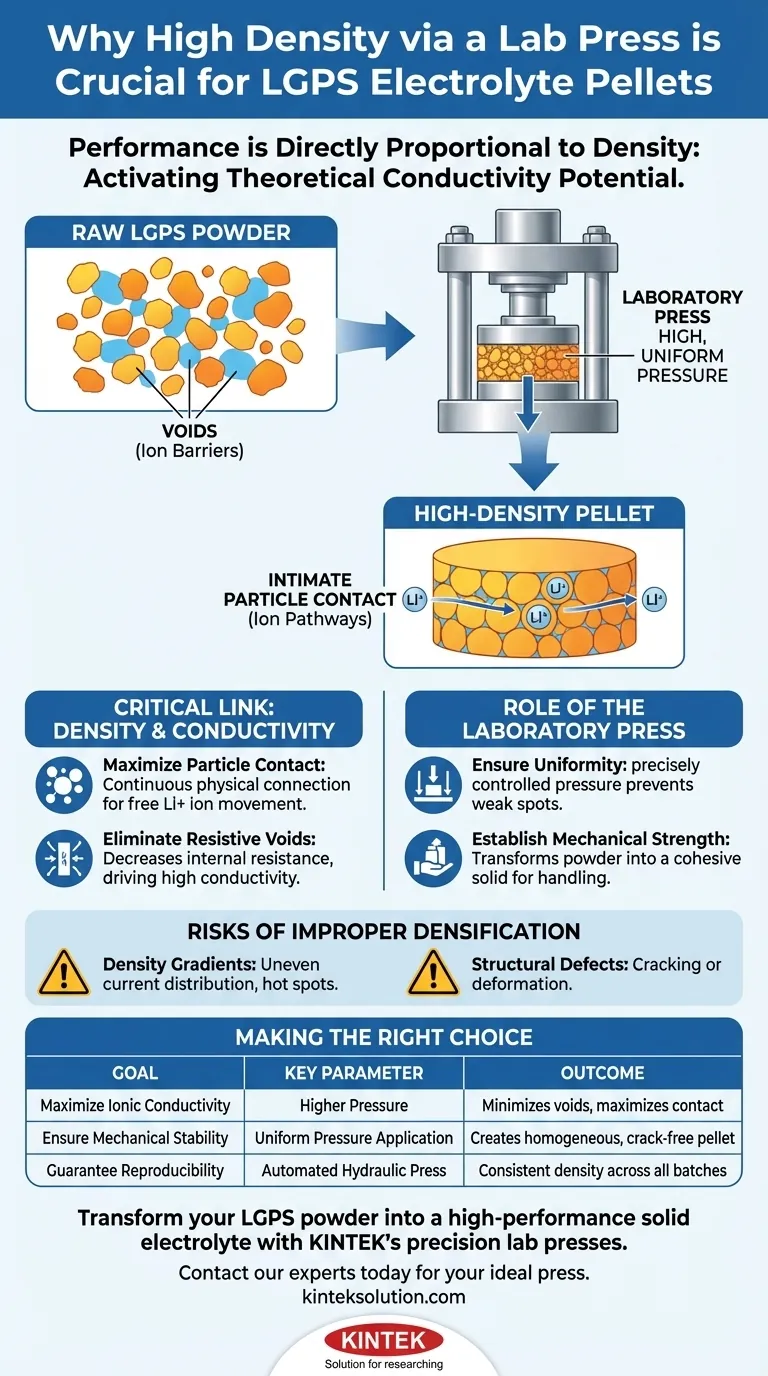
Achieving high density in Li10GeP2S12 (LGPS) electrolyte pellets is the fundamental prerequisite for enabling the material's high ionic conductivity. By utilizing a laboratory press to apply uniform and sufficient pressure, you force individual powder particles into intimate contact, effectively eliminating the voids that act as barriers to lithium-ion transport. Without this mechanical densification, the electrolyte lacks both the conductive pathways and the structural integrity required for a functional solid-state battery.
The Core Takeaway The performance of an LGPS solid electrolyte is directly proportional to its density. Pressing is not merely a shaping step; it is a functional activation step that minimizes internal porosity and maximizes particle-to-particle contact, allowing the material to reach its theoretical conductivity potential.
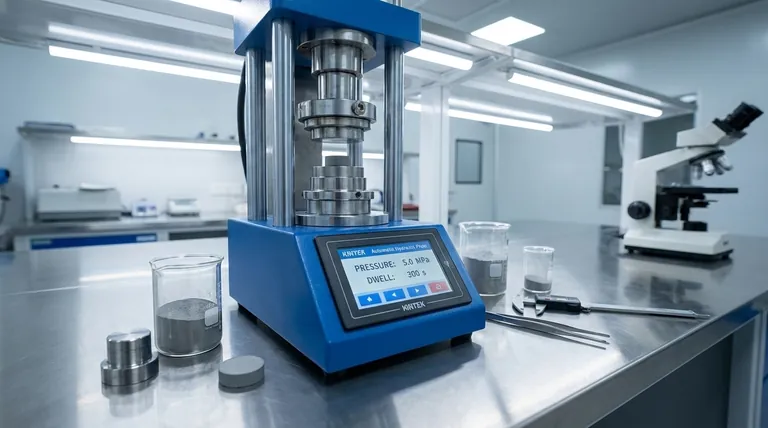
The Critical Link Between Density and Conductivity
Maximizing Particle Contact
In its raw powder form, LGPS consists of loose particles separated by air gaps. Ions cannot travel through these gaps.
High-pressure compaction forces these particles together, creating intimate contact boundaries. This continuous physical connection allows lithium ions to move freely from one particle to the next.
Eliminating Resistive Voids
Any internal porosity acts as a "dead zone" for ionic current.
By using a hydraulic press to significantly reduce these voids, you decrease the overall internal resistance of the pellet. This is the primary driver for high lithium-ion conductivity in the final cell.
The Role of the Laboratory Press
Ensuring Uniformity
Manual compaction is rarely sufficient or consistent enough for high-performance electrolytes.
A laboratory hydraulic press provides precisely controlled pressure. This ensures that the densification is uniform across the entire geometry of the pellet, preventing weak spots or areas of low conductivity.
Establishing Mechanical Strength
Beyond conductivity, the electrolyte must serve as a physical separator in the battery stack.
Cold-pressing LGPS powder transforms it from a loose aggregate into a cohesive solid. This process imparts the mechanical strength necessary for the pellet to withstand subsequent assembly steps without crumbling.
Understanding the Risks of Improper Densification
The Danger of Density Gradients
If pressure is applied unevenly, or if the die geometry is poor, the pellet may develop a density gradient.
This results in a pellet that is dense in some areas and porous in others. In a battery, this leads to uneven current distribution, which can cause localized hot spots or premature failure.
Structural Defects
While high pressure is necessary, the application must be controlled to prevent defects.
As noted in comparable ceramic processing (such as with LLZO), precise control is required to prevent cracking or deformation. A pellet that is dense but cracked offers no utility as an electrolyte separator.
Making the Right Choice for Your Goal
To optimize your LGPS pellet fabrication, consider your specific experimental needs:
- If your primary focus is Ionic Conductivity: Prioritize higher pressure settings to maximize particle-to-particle contact and minimize total pore volume.
- If your primary focus is Mechanical Stability: Focus on the uniformity of the pressure application to create a homogeneous pellet that will not delaminate during handling.
- If your primary focus is Reproducibility: Utilize an automated hydraulic press rather than manual systems to ensure identical density values across every batch.
High density is not just a physical characteristic; it is the enabling factor that turns LGPS powder into a high-performance solid electrolyte.
Summary Table:
| Goal | Key Pressing Parameter | Outcome |
|---|---|---|
| Maximize Ionic Conductivity | Higher Pressure | Minimizes voids, maximizes particle contact |
| Ensure Mechanical Stability | Uniform Pressure Application | Creates a homogeneous, crack-free pellet |
| Guarantee Reproducibility | Automated Hydraulic Press | Consistent density across all batches |
Transform your LGPS powder into a high-performance solid electrolyte with KINTEK's precision lab presses.
Achieving the critical high density for your Li10GeP2S12 pellets is non-negotiable for unlocking their full potential. KINTEK specializes in laboratory press machines—including automatic, isostatic, and heated lab presses—designed to deliver the precise, uniform pressure required for superior ionic conductivity and mechanical strength.
Our equipment ensures your research is built on a foundation of reproducibility and reliability, helping you avoid density gradients and structural defects that compromise battery performance.
Ready to press for perfection? Contact our experts today to find the ideal press for your laboratory's solid-state battery development needs.
Visual Guide
Related Products
- Laboratory Hydraulic Split Electric Lab Pellet Press
- Manual Laboratory Hydraulic Pellet Press Lab Hydraulic Press
- Automatic Laboratory Hydraulic Press Lab Pellet Press Machine
- Laboratory Hydraulic Press Lab Pellet Press Button Battery Press
- Laboratory Hydraulic Press Lab Pellet Press Machine for Glove Box
People Also Ask
- What are the emerging trends in the design and materials of lab pellet presses? Modernize Your Lab Efficiency
- How do lab pellet presses support customization and flexibility? Optimize Your Sample Prep for Any Material
- What are common lab pellet press issues? Expert Troubleshooting Guide for Reliable Material Research
- What are the common operational types of lab pellet presses? Choosing the Right Manual, Automatic, or Hydraulic System
- Why use a laboratory pellet press for solid-state battery evaluation? Ensure Accuracy in Interface Stability Testing



















