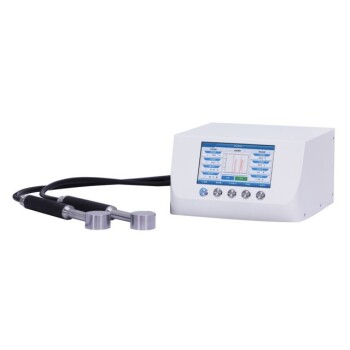
An industrial drying oven serves as a critical preparation tool to establish a baseline of dryness in terrestrial rocks used for space simulations. Specifically, it subjects basalt specimens to a constant temperature of 105 °C for a minimum of 24 hours to eliminate residual moisture trapped within the rock's pores.
The primary function of this process is to replicate the anhydrous (water-free) conditions of the Moon. Without this step, the presence of moisture would distort data regarding the rock's dielectric response and thermodynamic behavior during microwave weakening experiments.
The Physics of Lunar Simulation
Eliminating Residual Moisture
Terrestrial basalt is chemically similar to lunar rock, but it naturally absorbs water from Earth's atmosphere. This pore water creates a significant variable that does not exist on the Moon.
To simulate the lunar environment accurately, this moisture must be removed. The drying oven ensures that the specimen is physically dry before any testing begins.
Ensuring Accurate Dielectric Response
The ultimate goal of preparing these specimens is often to test microwave weakening—using energy to break down rock. Water absorbs microwave energy much more efficiently than rock does.
If moisture remains in the basalt, the microwaves will heat the water rather than the rock matrix. This would yield false data regarding the rock's natural resistance to microwave radiation.
The Standardized Procedure
Precise Temperature Control
The industry standard for drying geological specimens is typically 105 °C. This temperature is high enough to boil off water but generally low enough to avoid altering the mineral structure of the basalt itself.
Duration for Deep Penetration
Heat takes time to penetrate the core of a dense rock specimen. The reference protocol requires a duration of at least 24 hours.
This sustained heating ensures that moisture is driven out from the deepest pores, not just the surface. This guarantees a uniform state of dryness throughout the specimen.
Understanding the Trade-offs
Pore Water vs. Chemically Bound Water
It is important to recognize the limits of an industrial drying oven. While 105 °C removes free moisture (pore water), it does not remove chemically bound water (hydroxyls) within the mineral lattice.
The Risk of Re-absorption
Dried basalt is highly hygroscopic; it wants to absorb water from the air. Once the 24-hour cycle is complete, specimens must be tested immediately or stored in a desiccator.
Failing to isolate the dried sample will render the 24-hour heating process useless within minutes as humidity re-enters the pores.
Making the Right Choice for Your Goal
To ensure your experimental data is valid, you must strictly adhere to the preparation protocols.
- If your primary focus is Thermodynamic Accuracy: Ensure the oven maintains a stable 105 °C to prevent thermal gradients that could crack the specimen before testing.
- If your primary focus is Microwave Efficiency: Verify the 24-hour duration is met or exceeded to guarantee that any heating observed is due to the rock's dielectric loss, not water vaporization.
Strict adherence to the drying protocol is the only way to separate terrestrial contamination from true lunar rock mechanics.
Summary Table:
| Feature | Protocol Detail | Purpose in Lunar Simulation |
|---|---|---|
| Temperature | 105 °C | Eliminates pore water without altering mineral structure |
| Duration | Minimum 24 Hours | Ensures deep heat penetration and uniform dryness |
| Environment | Anhydrous (Water-free) | Replicates the Moon's moisture-free conditions |
| Key Variable | Dielectric Response | Prevents water from distorting microwave energy data |
| Post-Process | Immediate Testing | Prevents hygroscopic re-absorption of Earth's moisture |
Optimize Your Geological Simulations with KINTEK Precision
Achieving the perfect anhydrous state for basalt specimens requires rigorous thermal stability and reliability. KINTEK specializes in comprehensive laboratory solutions, providing the high-performance industrial drying ovens and pressing equipment necessary for advanced material research.
Whether you are conducting battery research, lunar simulations, or material stress tests, our range of manual, automatic, and isostatic presses—along with our precision heating solutions—ensures your data remains untainted by terrestrial variables.
Ready to elevate your laboratory’s efficiency and accuracy? Contact KINTEK today to discover the ideal equipment for your specific research needs!
References
- Tae Young Ko. Microwave-Assisted Tunnel Boring for Lunar Subsurface Development: Integration of Rock Weakening and Strength Prediction. DOI: 10.3390/aerospace12080733
This article is also based on technical information from Kintek Solution Knowledge Base .
Related Products
- Heated Hydraulic Press Machine with Heated Plates for Vacuum Box Laboratory Hot Press
- Split Automatic Heated Hydraulic Press Machine with Heated Plates
- Lab Double Plate Heating Mold for Laboratory Use
- Cylindrical Lab Electric Heating Press Mold for Laboratory Use
- Automatic High Temperature Heated Hydraulic Press Machine with Heated Plates for Lab
People Also Ask
- How does a laboratory heated hydraulic press facilitate PBN sample prep for WAXS? Achieve Precise X-Ray Scattering
- What are the requirements for electrode pressing with high-viscosity ionic liquids like EMIM TFSI? Optimize Performance
- What are the industrial applications of heated hydraulic presses? Master Heat & Force for Precision Manufacturing
- Function of a Laboratory Hydraulic Press with Heated Platens in SSE? Enhance Battery Density & Conductivity
- How are heated hydraulic presses utilized in the preparation of thin films? Key Mechanisms and Applications