
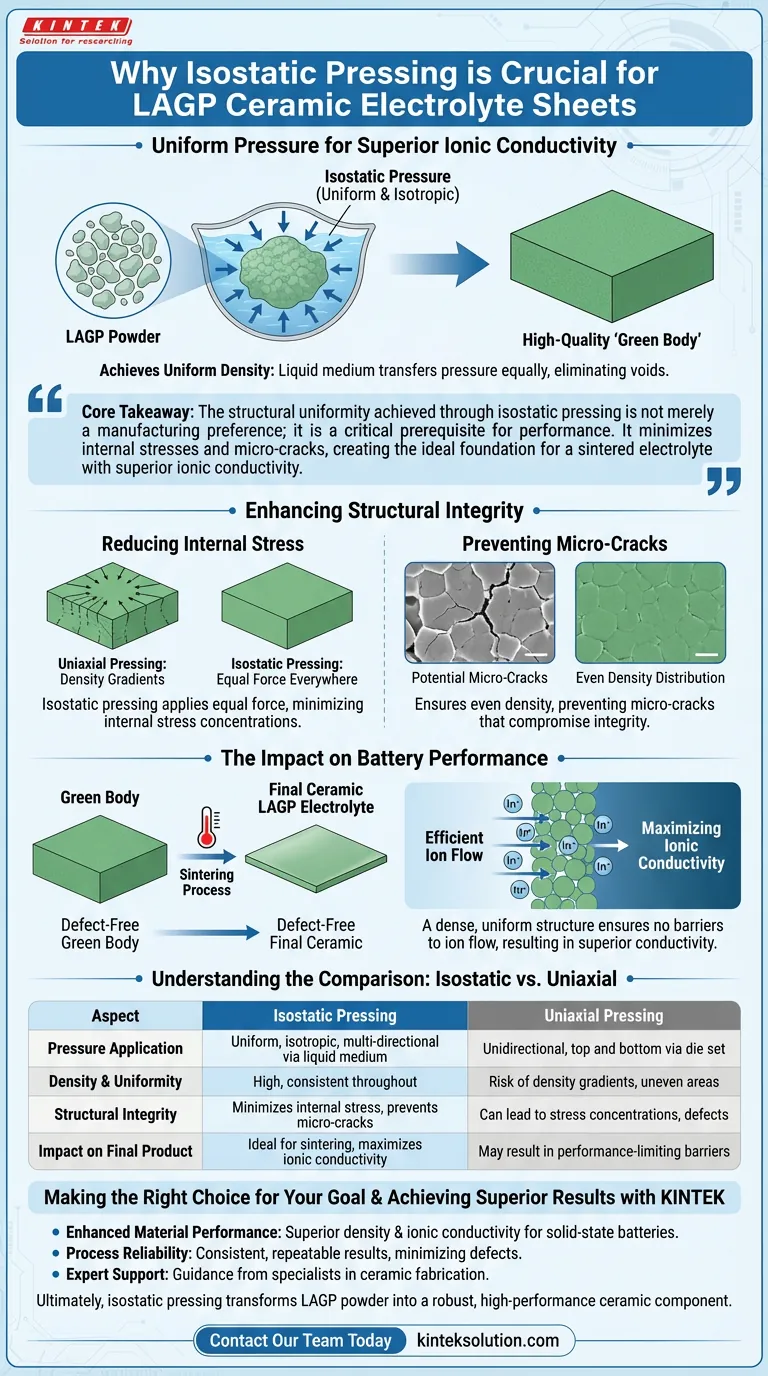
Isostatic pressing is the preferred method for forming LAGP ceramic sheets because it applies uniform, isotropic pressure to the powder through a liquid medium, ensuring consistent density from every direction. Unlike standard mechanical pressing, which can leave gaps or uneven areas, this technique effectively eliminates voids between particles to create a high-quality "green body."
Core Takeaway: The structural uniformity achieved through isostatic pressing is not merely a manufacturing preference; it is a critical prerequisite for performance. It minimizes internal stresses and micro-cracks, creating the ideal foundation for a sintered electrolyte with superior ionic conductivity.
Achieving Uniform Density
The Mechanics of Isotropic Pressure
An isostatic press utilizes a liquid medium to exert pressure on the LAGP powder.
Because fluids transfer pressure equally in all directions, the powder is compressed uniformly from every angle, rather than just from the top and bottom.
Eliminating Particle Voids
This multi-directional compression is highly effective at packing particles together.
It forces the LAGP powder into a tight configuration, significantly reducing or eliminating the voids that typically exist between loose particles.
Enhancing Structural Integrity
Reducing Internal Stress
Standard uniaxial pressing often results in density gradients, where the edges or corners of a sheet are denser than the center.
Isostatic pressing avoids this by applying equal force everywhere, which significantly minimizes internal stress concentrations within the material.
Preventing Micro-Cracks
The uniformity of the green body is essential for the mechanical stability of the ceramic.
By ensuring even density distribution, the process prevents the formation of micro-cracks that could compromise the sheet's integrity during handling or subsequent processing.
The Impact on Battery Performance
The Foundation for Sintering
The pressing stage creates a "green body"—the unfired ceramic shape.
The quality of this green body directly dictates the success of the high-temperature sintering process. A defect-free green body leads to a defect-free final ceramic.
Maximizing Ionic Conductivity
For an LAGP electrolyte, the ultimate goal is the efficient movement of ions.
A dense, uniform structure created by isostatic pressing ensures there are no physical barriers to ion flow, resulting in superior ionic conductivity in the final product.
Understanding the Comparison: Isostatic vs. Uniaxial
The Limits of Uniaxial Pressing
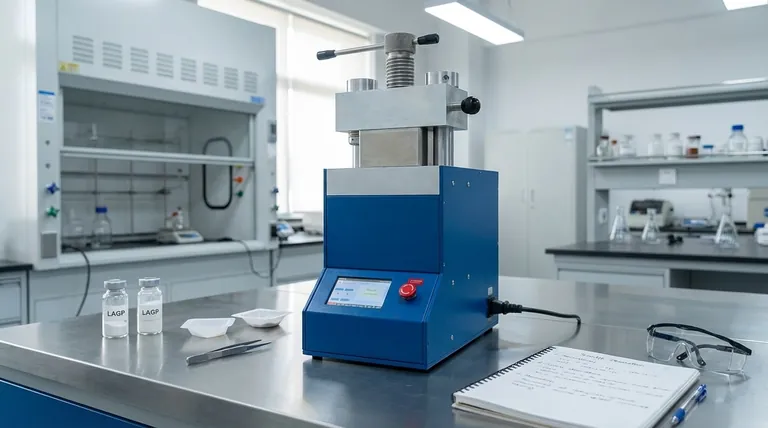
A laboratory press machine typically applies uniaxial pressure (pressure from one axis) using a die set.
While this creates a basic pellet shape, it often struggles to achieve the perfect homogeneity required for high-performance electrolytes.
Why Isostatic is Superior for LAGP
Uniaxial pressing is sometimes used as a preliminary step to form an initial shape.
However, to achieve the exceptionally high and evenly distributed density required for top-tier LAGP sheets, the isotropic pressure of an isostatic press is superior to the unidirectional force of a standard press.
Making the Right Choice for Your Goal
To determine the best processing method for your LAGP electrolyte project, consider your performance requirements.
- If your primary focus is maximizing battery efficiency: Prioritize isostatic pressing to ensure the highest possible ionic conductivity and lowest defect rate.
- If your primary focus is initial sample shaping: A uniaxial laboratory press may suffice for creating the initial green pellet shape before further densification.
Ultimately, isostatic pressing transforms LAGP powder from a loose aggregate into a robust, high-performance ceramic component essential for solid-state batteries.
Summary Table:
| Aspect | Isostatic Pressing | Uniaxial Pressing |
|---|---|---|
| Pressure Application | Uniform, isotropic pressure from all directions via liquid medium | Unidirectional pressure from top and bottom |
| Density & Uniformity | High, consistent density throughout the green body | Risk of density gradients and uneven areas |
| Structural Integrity | Minimizes internal stress and prevents micro-cracks | Can lead to stress concentrations and defects |
| Impact on Final Product | Creates ideal foundation for sintering, maximizing ionic conductivity | May result in performance-limiting barriers to ion flow |
Ready to achieve superior results in your ceramic electrolyte research?
KINTEK specializes in high-performance laboratory press machines, including isostatic presses designed to deliver the uniform, isotropic pressure essential for creating defect-free LAGP and other advanced ceramic materials.
By choosing KINTEK, you gain:
- Enhanced Material Performance: Produce ceramic sheets with superior density and ionic conductivity for your solid-state battery projects.
- Process Reliability: Our equipment ensures consistent, repeatable results, minimizing defects and maximizing research efficiency.
- Expert Support: Get guidance from specialists who understand the precise demands of ceramic electrolyte fabrication.
Transform your powder into high-performance components. Contact our team today to discuss how our isostatic presses can meet your laboratory's specific needs.
Visual Guide
Related Products
- Lab Isostatic Pressing Molds for Isostatic Molding
- Automatic Lab Cold Isostatic Pressing CIP Machine
- Warm Isostatic Press for Solid State Battery Research Warm Isostatic Press
- Electric Lab Cold Isostatic Press CIP Machine
- Manual Cold Isostatic Pressing CIP Machine Pellet Press
People Also Ask
- What is the purpose of incorporating cartridge heaters into a lab press mold for MLCC block compression? Optimize Results
- What is the function of an isostatic lab press in energy storage research? Achieve Superior Material Standardization
- How do laboratory press machines resolve increased impedance in solid-state batteries? Achieve Low-Resistance Interfaces
- How does controlling the parameters of a laboratory isostatic press contribute to reducing deformation in LTCC channels?
- What is the role of a laboratory isostatic press in the preparation of ablative insulation materials? Ensure Density.









