
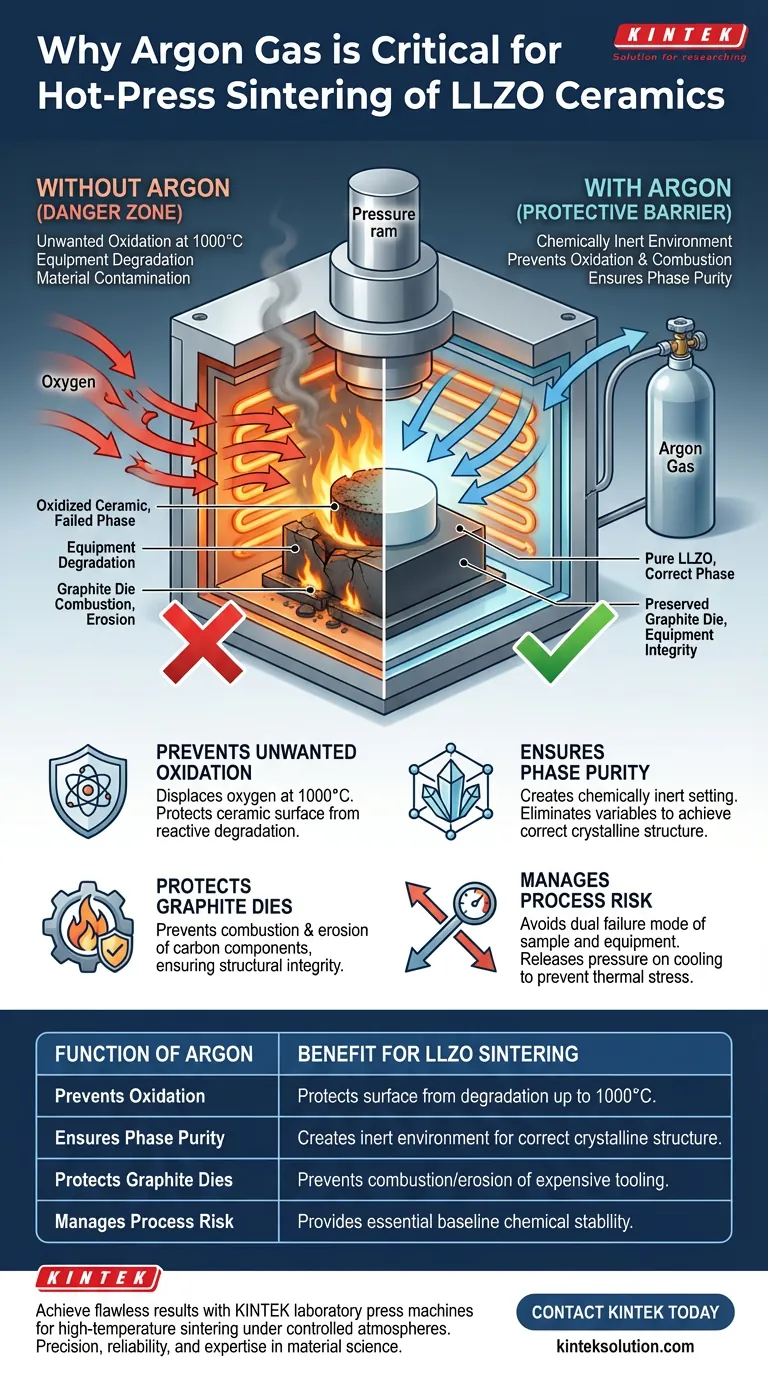
Argon gas serves as a critical inert barrier during the high-temperature hot-press sintering of LLZO ceramics. By displacing oxygen within the furnace, it prevents detrimental chemical reactions that would otherwise degrade the ceramic material and destroy the pressing equipment.
Core Insight: Successful sintering is not just about heat and pressure; it requires chemical isolation. Argon provides a stable, inert environment that prevents oxidation, ensuring the LLZO achieves its correct phase while simultaneously stopping the graphite tooling from combusting at 1000°C.
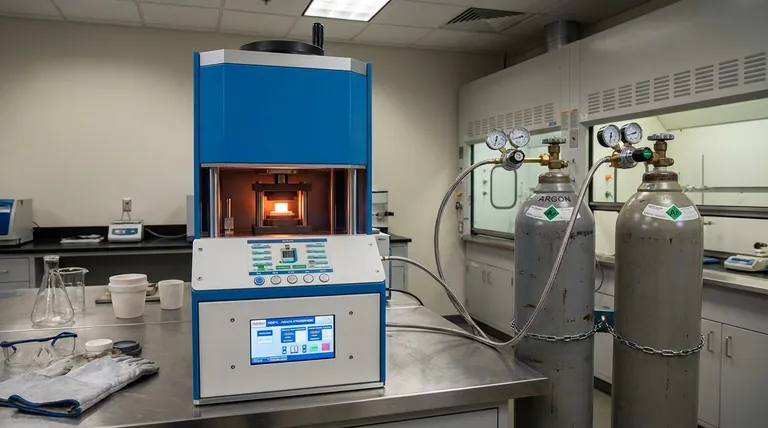
The Chemistry of Protection
Preventing Unwanted Oxidation
Sintering processes for LLZO often reach temperatures as high as 1000°C. At these thermal extremes, materials become highly reactive.
The presence of ambient oxygen would trigger immediate, unwanted oxidation reactions on the surface of the ceramic. Argon, being an inert gas, effectively displaces oxygen from the chamber. This creates a chemically neutral setting that is mandatory for processing.
Ensuring Phase Purity
The performance of LLZO ceramics relies heavily on achieving a specific crystalline structure, or "target phase."
Chemical instability in the furnace atmosphere can alter the material's composition. By maintaining an argon atmosphere, you eliminate variables that could shift the stoichiometry of the material. This ensures the final product meets the necessary performance characteristics.
Protecting the Graphite Die
The Vulnerability of Carbon Components
Hot-press sintering utilizes graphite dies to contain the powder and apply pressure. Graphite is an excellent material for this application, but it has a significant weakness: it burns in the presence of oxygen.
Without a protective atmosphere, the graphite die would oxidize rapidly at sintering temperatures.
Preserving Equipment Integrity
The argon atmosphere is as much for the tool as it is for the sample. By preventing the graphite from oxidizing, you ensure the die maintains its structural integrity.
This prevents premature equipment failure and ensures that pressure is applied consistently throughout the densification process.
Understanding Process Risks
The Consequence of Atmosphere Compromise
Attempting to sinter without a high-quality protective atmosphere is a critical failure point.
If oxygen infiltrates the system, you face a dual failure mode: the LLZO surface degrades, and the die components erode. This results in contaminated samples and costly tooling replacement.
Thermal Stress Management
While argon solves the chemical stability problem, it does not solve mechanical incompatibility.
The LLZO ceramic and the graphite die have different coefficients of thermal expansion. As the system cools, they contract at different rates.
Even in a perfect argon atmosphere, maintaining pressure during the cooling phase will generate internal thermal stress. This leads to microcracks or complete fractures. Pressure must be released at the onset of cooling to preserve the densified ceramic.
Making the Right Choice for Your Process
The use of argon is not an optional variable; it is a fundamental requirement for hot-press sintering.
- If your primary focus is Material Performance: Ensure a continuous, high-purity argon flow to prevent oxidation from altering the LLZO target phase.
- If your primary focus is Equipment Longevity: rigorous atmosphere control is required to prevent the combustion and erosion of expensive graphite dies.
Ultimately, argon provides the baseline chemical stability required to turn raw powder into a high-performance ceramic.
Summary Table:
| Function of Argon | Benefit for LLZO Sintering |
|---|---|
| Prevents Oxidation | Protects ceramic surface from degradation at high temperatures (up to 1000°C). |
| Ensures Phase Purity | Creates a chemically inert environment for achieving the correct crystalline structure. |
| Protects Graphite Dies | Prevents combustion and erosion of expensive tooling, ensuring equipment longevity. |
| Manages Process Risk | Provides baseline chemical stability essential for successful densification. |
Achieve flawless results in your lab's sintering processes with KINTEK.
Your research on advanced ceramics like LLZO demands precision and reliability. KINTEK specializes in laboratory press machines, including heated lab presses and isostatic presses, designed to meet the exacting requirements of high-temperature sintering under controlled atmospheres.
We understand that consistent results depend on robust equipment and proper technique. Let our expertise support your work in material science.
Contact KINTEK today to discuss how our lab press solutions can enhance your sintering outcomes and protect your valuable research.
Visual Guide
Related Products
People Also Ask
- Function of a Laboratory Hydraulic Press with Heated Platens in SSE? Enhance Battery Density & Conductivity
- What are the requirements for electrode pressing with high-viscosity ionic liquids like EMIM TFSI? Optimize Performance
- How does a laboratory heated hydraulic press facilitate PBN sample prep for WAXS? Achieve Precise X-Ray Scattering
- What are the industrial applications of heated hydraulic presses? Master Heat & Force for Precision Manufacturing
- Why is a laboratory hydraulic press with heating plates required for PLA/TEC films? Achieve Precise Sample Integrity
