
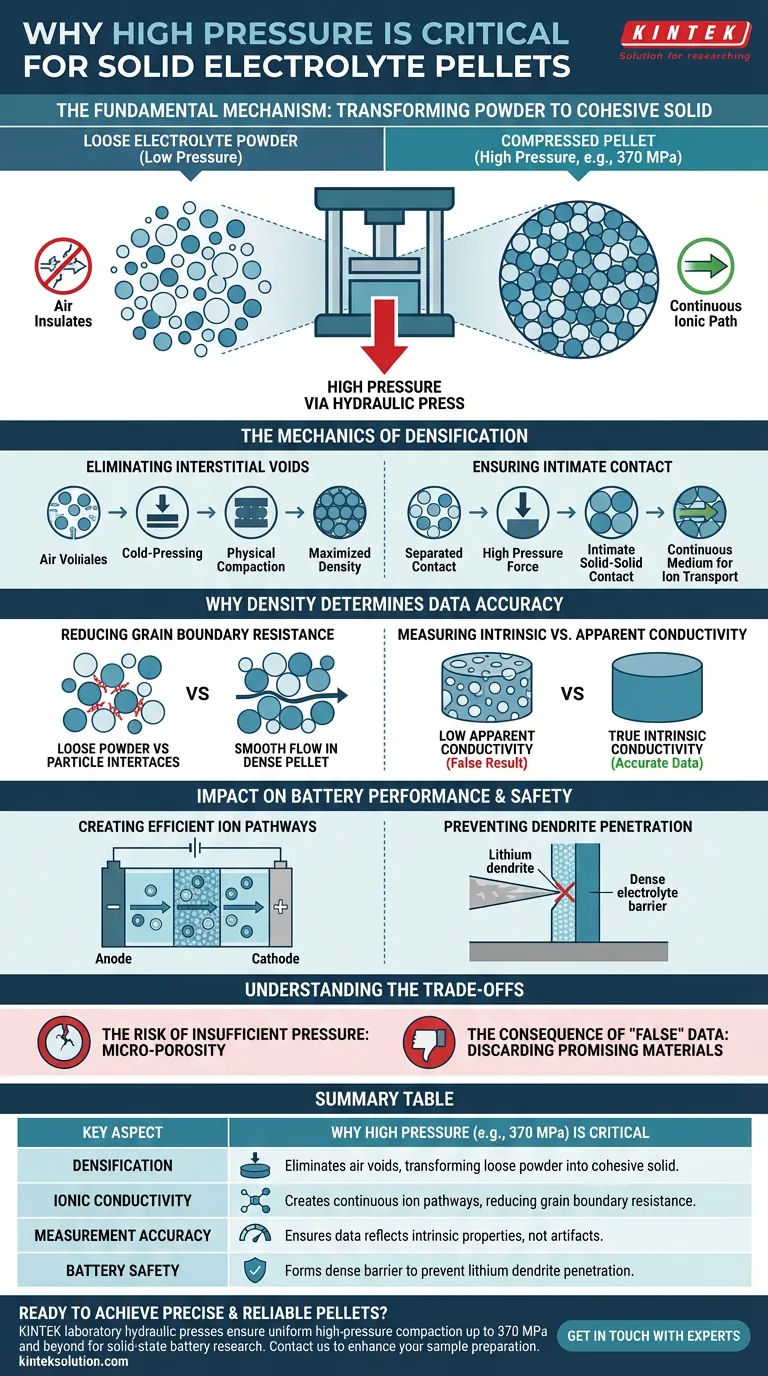
Applying high pressure, such as 370 MPa, is the fundamental mechanism for transforming loose electrolyte powder into a cohesive, functional solid. By exerting this force via a laboratory hydraulic press, you mechanically eliminate the air voids between particles and force them into intimate physical contact. This densification is not merely a shaping step; it is a prerequisite for creating the continuous ionic pathways required for valid conductivity measurements.
The application of high pressure minimizes porosity and grain boundary resistance, ensuring that measurement data reflects the material's intrinsic bulk capability rather than the artifacts of a loosely packed structure.
The Mechanics of Densification
Eliminating Interstitial Voids
Solid electrolyte powders inherently contain significant air gaps, or "voids," between individual particles. Air is an electrical insulator that effectively blocks ion movement.
A laboratory hydraulic press applies massive force to collapse these voids. This process, often referred to as cold-pressing, physically compacts the material to maximize its density.
Ensuring Intimate Contact
Conductivity relies on the ability of ions to "hop" from one particle to the next. Without pressure, particles may barely touch, creating a broken path.
High pressure forces particles together, creating intimate solid-solid contact. This mechanical bonding is necessary to form a continuous medium for ion transport.
Why Density Determines Data Accuracy
Reducing Grain Boundary Resistance
In a loose powder, the resistance occurs mostly at the interfaces between particles, known as grain boundary resistance.
If the pressure is insufficient, this interfacial resistance dominates the measurement. High pressure significantly lowers this resistance, allowing the current to flow freely.
Measuring Intrinsic vs. Apparent Conductivity
Your goal is usually to measure the intrinsic bulk conductivity of the material chemistry itself.
If the sample retains porosity, your results will be artificially low. A dense pellet ensures the data accurately reflects the material's true performance, rather than the quality of the packing.
Impact on Battery Performance and Safety
Creating Efficient Ion Pathways
For a solid-state battery to function, ions must travel from the anode to the cathode with minimal obstruction.
High-pressure compaction creates continuous pathways for this transport. This is the physical basis for achieving low internal resistance and high-rate performance in the final cell.
Preventing Dendrite Penetration
Beyond conductivity, density plays a critical structural role.
A dense, low-porosity electrolyte layer acts as a physical barrier. It helps prevent lithium dendrite penetration, a phenomenon that can cause short circuits, making densification vital for battery safety.
Understanding the Trade-offs
The Risk of Insufficient Pressure
The primary pitfall in this process is applying too little pressure or applying it non-uniformly.
If the pressure is below the necessary threshold (e.g., significantly lower than 370 MPa for certain materials), the pellet will retain micro-porosity.
The Consequence of "False" Data
When porosity remains, the measured conductivity will be significantly lower than the theoretical maximum.
This leads to "false negatives," where a promising material chemistry might be discarded because the sample preparation—not the material itself—was flawed.
Making the Right Choice for Your Goal
To ensure your conductivity measurements are valid, you must match your pressing parameters to your specific research objectives.
- If your primary focus is Material Characterization: Prioritize maximizing density to eliminate grain boundary interference and isolate the material's intrinsic bulk conductivity.
- If your primary focus is Battery Prototyping: Focus on achieving a density that balances high ionic conductivity with the structural integrity needed to block dendrites.
Ultimately, the hydraulic press is not just a forming tool, but a critical instrument for bridging the gap between theoretical chemistry and real-world performance.
Summary Table:
| Key Aspect | Why High Pressure (e.g., 370 MPa) is Critical |
|---|---|
| Densification | Eliminates air voids and porosity, transforming loose powder into a cohesive solid. |
| Ionic Conductivity | Creates continuous ion pathways by forcing intimate particle contact, reducing grain boundary resistance. |
| Measurement Accuracy | Ensures data reflects intrinsic material properties, not preparation artifacts. |
| Battery Safety | Forms a dense barrier to prevent lithium dendrite penetration and short circuits. |
Ready to achieve precise and reliable solid electrolyte pellets for your research?
KINTEK specializes in laboratory hydraulic presses, including automatic, isostatic, and heated lab presses, designed to meet the exacting demands of solid-state battery development and material characterization. Our equipment ensures uniform high-pressure compaction up to 370 MPa and beyond, enabling you to eliminate porosity, maximize ionic conductivity, and obtain accurate data.
Contact us today to discuss how our lab press solutions can enhance your sample preparation and accelerate your research. Get in touch with our experts now!
Visual Guide
Related Products
- Laboratory Hydraulic Press Lab Pellet Press Machine for Glove Box
- Laboratory Hydraulic Press 2T Lab Pellet Press for KBR FTIR
- 24T 30T 60T Heated Hydraulic Lab Press Machine with Hot Plates for Laboratory
- Laboratory Hydraulic Press Lab Pellet Press Button Battery Press
- Laboratory Hydraulic Pellet Press for XRF KBR FTIR Lab Press
People Also Ask
- How does a laboratory hydraulic press contribute to the preparation of Li3-3xScxSb samples? Optimize Ionic Conductivity
- What is the function of a laboratory hydraulic press in FT-IR of curcumin-coated MWCNTs? Achieve Optical Clarity.
- Why is a laboratory hydraulic press required for compression molding boron-siloxane? Solve High-Loading Density Challenges
- What role does a laboratory hydraulic press play in reaction pellets? Optimizing Lunar Soil and Metal Fuel Density
- What role does a laboratory hydraulic press play in the preparation of piezoelectric ceramic discs for DC-PG? | KINTEK



















