
Applying high pressure, such as 500 MPa, is the primary mechanical lever used to maximize ionic conductivity in solid-state electrolytes.
While loose powder is naturally porous and resistant to ion flow, applying this magnitude of pressure via a hydraulic press forces individual particles into intimate contact. This process effectively eliminates air voids to transform a collection of loose grains into a single, dense, and continuous material capable of efficient lithium-ion transport.
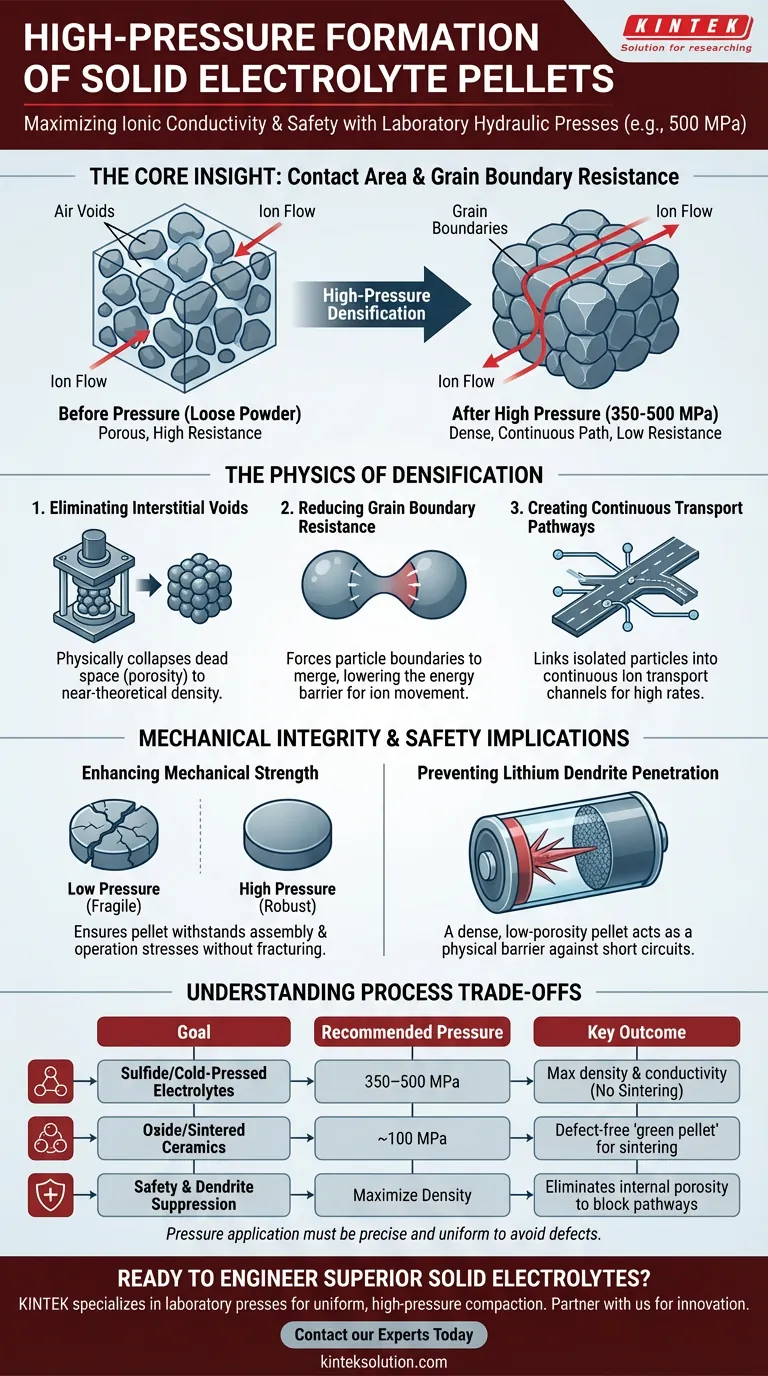
The Core Insight The performance of a solid-state battery is directly limited by the contact area between electrolyte particles. High-pressure densification minimizes grain boundary resistance, ensuring that lithium ions face a continuous path rather than a series of insulating gaps.
The Physics of Densification
To understand why 500 MPa is necessary, one must look beyond the macroscopic shape of the pellet and focus on the microscopic interactions between particles.
Eliminating Interstitial Voids
In its raw state, solid electrolyte powder contains significant "dead space" or porosity.
These voids act as insulators, blocking the movement of ions. Applying extreme pressure (350–500 MPa) physically collapses these voids, compacting the material to near-theoretical density.
Reducing Grain Boundary Resistance
The interface where two powder particles meet is called a grain boundary.
If this contact is loose, it creates high resistance, acting as a bottleneck for energy flow. High-pressure compaction forces these boundaries to merge, significantly reducing the energy barrier ions must overcome to move from one particle to the next.
Creating Continuous Transport Pathways
For a battery to function at high rates, ions need a highway, not an obstacle course.
The densification process links isolated particles into continuous ion transport channels. This connectivity is the fundamental requirement for achieving high ionic conductivity in materials like Li-argyrodite and sulfides.
Mechanical Integrity and Safety Implications
Beyond conductivity, the structural integrity of the electrolyte pellet is vital for the longevity and safety of the battery cell.
Enhancing Mechanical Strength
A pellet formed under low pressure is fragile and prone to crumbling.
High-pressure consolidation ensures the separator membrane has adequate mechanical strength to withstand the stresses of cell assembly and operation without fracturing.
Preventing Lithium Dendrite Penetration
One of the greatest risks in batteries is the formation of lithium dendrites—needle-like structures that can pierce the electrolyte and cause short circuits.
A highly dense, low-porosity pellet acts as a physical barrier. By eliminating the pores that dendrites typically grow through, high-pressure formation is crucial for preventing failure and ensuring device safety.
Understanding Process Trade-offs
While high pressure is critical, it is not a "more is always better" variable. The application must be tailored to the specific material chemistry and processing stage.
Cold Pressing vs. Green Body Formation
For sulfide electrolytes (like Li-argyrodite), high pressure (e.g., 500 MPa) is often the final step to achieve density via cold pressing.
However, for oxide ceramics (like LLZO), the press is used to form a "green pellet" (often at lower pressures like 98 MPa). This pellet is merely a precursor that achieves its final density through high-temperature sintering.
Pressure Distribution and Defects
Applying pressure requires precision.
If pressure is unstable or non-uniform, density gradients can occur within the pellet. This leads to localized weak spots where ionic conductivity drops or where mechanical cracking is more likely to initiate.
Making the Right Choice for Your Goal
The specific pressure you apply should be dictated by the material chemistry and the intended next steps in your workflow.
- If your primary focus is Sulfide/Cold-Pressed Electrolytes: Apply high pressure (350–500 MPa) to achieve maximum density and ionic conductivity immediately, as there is no subsequent sintering step.
- If your primary focus is Oxide/Sintered Ceramics: Apply moderate, uniform pressure (approx. 100 MPa) to form a defect-free "green pellet" that will densify further during heat treatment.
- If your primary focus is Safety and Dendrite Suppression: Prioritize maximizing pellet density to eliminate internal porosity, as voids are the primary pathway for dendrite propagation.
Ultimately, the hydraulic press is not just shaping the material; it is engineering the internal microstructure that defines the battery's total efficiency.
Summary Table:
| Goal | Recommended Pressure | Key Outcome |
|---|---|---|
| Sulfide/Cold-Pressed Electrolytes | 350–500 MPa | Achieves maximum density and ionic conductivity without sintering. |
| Oxide/Sintered Ceramics | ~100 MPa | Forms a defect-free 'green pellet' for subsequent high-temperature sintering. |
| Safety & Dendrite Suppression | Maximize Density | Eliminates internal porosity to block dendrite pathways and prevent short circuits. |
Ready to Engineer Superior Solid Electrolytes?
The precise application of high pressure is not just a step—it's a critical determinant of your battery's performance, safety, and efficiency. KINTEK specializes in laboratory press machines, including automatic lab presses and isostatic presses, designed to deliver the uniform, high-pressure compaction your research on sulfide or oxide electrolytes demands.
Let KINTEK be your partner in innovation. Our expertise ensures you can achieve the perfect pellet density for maximum ionic conductivity and robust mechanical integrity.
Contact our experts today to discuss how our lab press solutions can accelerate your development of safer, higher-performing solid-state batteries.
Visual Guide
References
- Seung Ho Choi, Jang Wook Choi. Silver exsolution from Li-argyrodite electrolytes for initially anode-free all-solid-state batteries. DOI: 10.1038/s41467-025-61074-9
This article is also based on technical information from Kintek Solution Knowledge Base .
Related Products
- Automatic Laboratory Hydraulic Press for XRF and KBR Pellet Pressing
- Automatic Laboratory Hydraulic Press Lab Pellet Press Machine
- Manual Laboratory Hydraulic Press Lab Pellet Press
- Laboratory Hydraulic Pellet Press for XRF KBR FTIR Lab Press
- Manual Laboratory Hydraulic Pellet Press Lab Hydraulic Press
People Also Ask
- Why is pressing powder into a pellet critical before sintering? Ensure Dense, Conductive Solid-State Electrolytes
- What is the role of a laboratory pressure machine and KBr in FTIR? Master Sample Preparation for Flame Retardants
- What are the advantages of using a laboratory automatic hydraulic press for HEA green compact forming?
- What are the advantages of using a lab automatic hydraulic press for HEA green body molding? Ensure Material Integrity
- How does an automatic laboratory hydraulic press improve KBr pellet preparation? Achieve Precision IR Spectroscopy



















