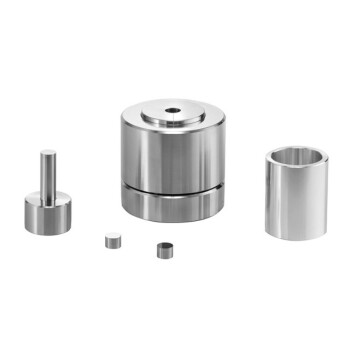
High-strength graphite is the material of choice because it uniquely withstands the rigorous mechanical and thermal extremes of the pressure infiltration process. It is specifically selected to endure extrusion loads exceeding 10 MPa while maintaining structural integrity at processing temperatures up to 1250°C.
The success of preparing Wf/Cu82Al10Fe4Ni4 composites relies on graphite's ability to act as a robust pressure vessel at high heat while simultaneously providing a self-lubricating surface that prevents the final composite from seizing inside the mold.
The Mechanical and Thermal Requirements
Withstanding Extreme Extrusion Loads
The pressure infiltration process relies on forcing liquid metal into a reinforcement preform. This creates significant internal stress.
High-strength graphite is utilized because it can safely bear extrusion loads exceeding 10 MPa. Standard materials would likely fracture or deform under this specific pressure threshold.
Ensuring High-Temperature Stability
The preparation of these composites occurs at extreme temperatures to ensure proper metal fluidity.
Graphite possesses excellent high-temperature resistance, allowing it to function effectively up to 1250°C. This ensures the mold does not soften, warp, or chemically degrade during the critical infiltration phase.
Maintaining Assembly Integrity
The mold is not a single block; it is a complex assembly consisting of an inner mold, a sleeve, and an outer mold.
The structural stability of high-strength graphite is required to keep this multi-part assembly aligned. It ensures the components work together to bear the high pressure without shifting or separating.
Operational Advantages
Simplifying the Demolding Process
A common point of failure in composite manufacturing is the inability to remove the finished part without damaging it.
Graphite offers distinct self-lubricating properties. This characteristic prevents the metal composite from bonding to the mold walls, significantly simplifying the demolding process and reducing the risk of damaging the final product.
Understanding the Operational Limits
The Necessity of "High-Strength" Designation
It is critical to distinguish between standard graphite and the high-strength variant specified here.
While generic graphite has thermal resistance, it often lacks the tensile and compressive strength to survive the 10 MPa pressure requirement. Using a lower grade of graphite in this specific application would likely result in catastrophic mold failure or dangerous blowouts during the extrusion phase.
Making the Right Choice for Your Goal
When designing a pressure infiltration setup for metal matrix composites, your material selection dictates both safety and yield.
- If your primary focus is Process Safety: Prioritize graphite grades explicitly rated for loads above 10 MPa to prevent structural failure of the mold assembly.
- If your primary focus is Product Quality: Leverage graphite’s self-lubricating properties to ensure the composite surface remains defect-free during extraction.
High-strength graphite is the definitive solution for bridging the gap between extreme structural demands and ease of manufacturing.
Summary Table:
| Property | Requirement for Wf/Cu82Al10Fe4Ni4 Preparation | Benefit of High-Strength Graphite |
|---|---|---|
| Pressure Resistance | > 10 MPa Extrusion Load | Prevents mold fracture/deformation under stress |
| Thermal Stability | Up to 1250°C Operating Temp | Resists warping and chemical degradation |
| Surface Friction | Easy composite removal | Self-lubricating properties simplify demolding |
| Structural Design | Multi-part assembly (inner/outer) | Maintains alignment under high mechanical pressure |
Elevate Your Composite Research with KINTEK Precision
Achieving flawless pressure infiltration requires equipment that survives extreme mechanical and thermal thresholds. KINTEK specializes in comprehensive laboratory pressing solutions, offering a versatile range of manual, automatic, heated, and multifunctional models, alongside advanced cold and warm isostatic presses perfectly suited for battery research and material science.
Whether you are managing high-strength graphite molds or developing next-generation metal matrix composites, our experts provide the technical support and high-performance hardware you need to ensure process safety and maximum yield.
Ready to optimize your laboratory workflow? Contact KINTEK today for a tailored solution.
References
- Zhe Wu, Qingnan Wang. Microstructure Evolution Mechanism of Wf/Cu82Al10Fe4Ni4 Composites under Dynamic Compression at Different Temperatures and Strain Rates. DOI: 10.3390/ma14195563
This article is also based on technical information from Kintek Solution Knowledge Base .
Related Products
- Lab XRF Boric Acid Powder Pellet Pressing Mold for Laboratory Use
- Lab Infrared Press Mold for No Demolding
- Special Shape Lab Press Mold for Laboratory Applications
- Lab Infrared Press Mold for Laboratory Applications
- Lab Anti-Cracking Press Mold
People Also Ask
- Why are pellets used in XRF analysis, and what is their limitation? Boost Accuracy and Speed in Your Lab
- What are the primary factors to consider when deciding between a manual and an automatic XRF pellet press? Optimize Your Lab's Efficiency
- What are the differences between manual and automatic XRF pellet presses? Choose the Right Press for Your Lab's Needs
- What are the different pellet pressing options for XRF sample preparation? Choose the Best Method for Accurate Analysis
- What are specialized XRF pellet preparation presses designed for? Boost Lab Efficiency with High-Throughput Automation