
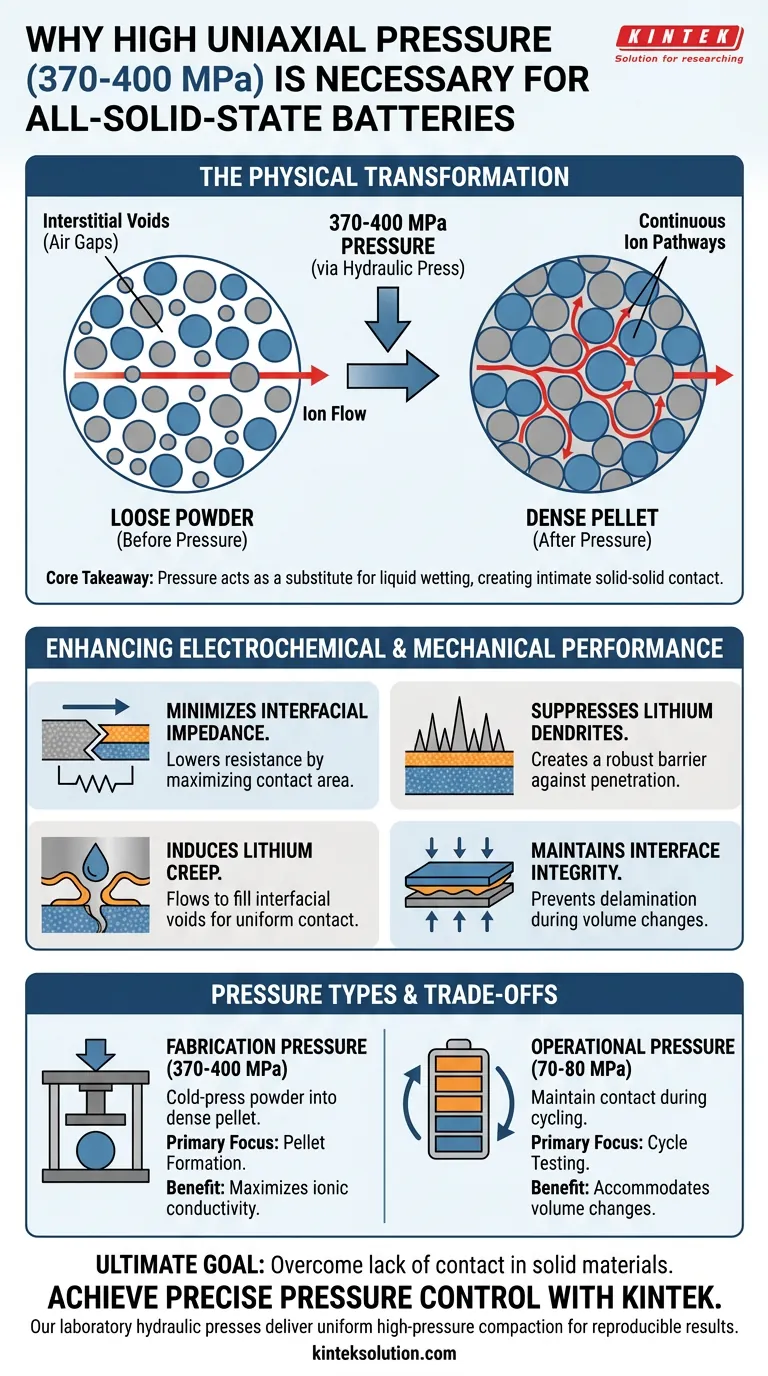
Applying high uniaxial pressure is the fundamental mechanism required to transform loose electrolyte and cathode powders into a cohesive, functional solid-state battery component. Pressures in the range of 370–400 MPa are specifically necessary to crush interstitial voids and create the high-density, low-porosity pellet required for efficient ion movement.
Core Takeaway In solid-state batteries, ions cannot travel through air gaps; they require continuous physical matter to move. Applying extreme pressure (cold-pressing) acts as a substitute for the "wetting" action of liquid electrolytes, forcing particles into intimate contact to minimize resistance and create a physical barrier against lithium dendrite penetration.
The Physical Transformation of the Electrolyte
To understand the need for 370–400 MPa, you must look at the physical state of your raw materials. You are starting with distinct powder particles that naturally have gaps between them.
Eliminating Interstitial Voids
At lower pressures, solid-state electrolyte powders retain significant interstitial voids (air gaps) between particles. These voids act as insulators, blocking the flow of ions.
Applying high pressure (referenced as 360 MPa in literature for materials like Li7P3S11) compacts the powder to near-theoretical density. This process effectively squeezes out porosity, ensuring the electrolyte layer is solid rather than granular.
Establishing Continuous Ion Pathways
For a battery to function, lithium ions need a continuous road to travel from the anode to the cathode.
High-pressure compaction forces the individual powder particles to deform and bond. This creates intimate solid-solid contact, transforming isolated particles into a continuous network of ion conduction pathways.
Enhancing Electrochemical Performance
The structural density achieved through this pressure directly correlates to the electrochemical metrics of the battery.
Minimizing Interfacial Impedance
The greatest challenge in solid-state batteries is interfacial impedance—the resistance ions face when moving between materials.
Poor contact results in high resistance, which kills battery performance. By applying immense pressure, you maximize the contact area between the solid electrolyte and the electrode materials, significantly lowering this resistance.
Suppressing Lithium Dendrites
A dense, low-porosity electrolyte pellet serves a critical safety function.
High compaction creates a physically robust barrier. This density is fundamental for effectively preventing lithium dendrite penetration, a phenomenon where metallic lithium grows through the electrolyte, potentially causing short circuits.
Ensuring Mechanical Stability
Beyond simple conductivity, the pressure dictates how the materials interact mechanically at the interface.
Inducing Lithium Creep
When working with lithium metal anodes, high pressure serves a unique mechanical purpose.
Appropriate pressure induces creep in the lithium metal. This allows the lithium to flow and actively fill interfacial voids, ensuring uniform contact is maintained even as the battery operates.
Maintaining Interface Integrity
Electrode materials often change volume during charge and discharge cycles.
Without sufficient initial compaction and maintained pressure, these volume changes can cause interfacial separation (delamination). High pressure ensures the layers remain bonded, preventing the battery from physically falling apart internally.
Understanding the Trade-offs
While high pressure is necessary for fabrication, it is important to distinguish between fabrication pressure and operating pressure.
Fabrication vs. Operational Pressure
The 370–400 MPa range is typically a cold-pressing fabrication pressure used to form the pellet initially.
However, during actual battery testing and cycling, the required stack pressure is often lower (typically 70–80 MPa). Sustaining the extreme fabrication pressure during operation is practically difficult and may not be necessary once the dense pellet structure is formed.
Complexity of Precise Control
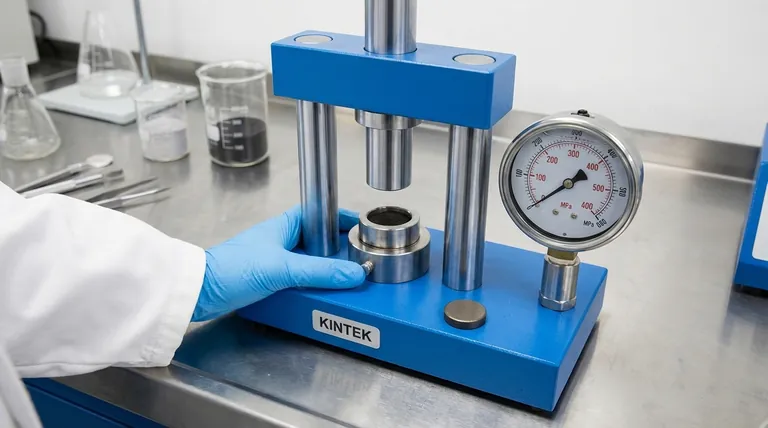
Applying this pressure is not a blunt instrument; it requires precise control via a laboratory hydraulic press.
Uneven pressure distribution can lead to cracking or density gradients within the pellet. The equipment must be capable of delivering uniform uniaxial force to ensure the electrochemical data derived from the cell is stable and reliable.
Making the Right Choice for Your Goal
The amount of pressure you apply should be dictated by the specific stage of your assembly process and your material requirements.
- If your primary focus is Fabrication (Pellet Formation): Apply the high range (approx. 360–400 MPa) to cold-press the electrolyte powder into a dense, low-porosity layer to maximize ionic conductivity.
- If your primary focus is Cycle Testing (Operation): Utilize a lower, continuous stack pressure (approx. 70–80 MPa) to maintain interfacial contact and accommodate volumetric changes without crushing the cell components.
Ultimately, the application of high pressure is the only way to overcome the inherent lack of contact in solid materials, making it a non-negotiable step for high-performance solid-state batteries.
Summary Table:
| Pressure Range | Primary Function | Key Benefit |
|---|---|---|
| 370-400 MPa (Fabrication) | Cold-press powder into dense pellet | Maximizes ionic conductivity by eliminating voids |
| 70-80 MPa (Operation) | Maintain interfacial contact during cycling | Prevents delamination and accommodates volume changes |
Need precise pressure control for your solid-state battery research? KINTEK's laboratory hydraulic presses deliver the uniform, high-pressure compaction (370-400 MPa) required to fabricate dense, high-performance pellets. Our automatic lab presses, isostatic presses, and heated lab presses ensure reproducible results for laboratories developing next-generation batteries. Contact us today to enhance your battery assembly process!
Visual Guide
Related Products
- Laboratory Hydraulic Press Lab Pellet Press Button Battery Press
- Laboratory Hydraulic Press 2T Lab Pellet Press for KBR FTIR
- Laboratory Hydraulic Press Lab Pellet Press Machine for Glove Box
- 24T 30T 60T Heated Hydraulic Lab Press Machine with Hot Plates for Laboratory
- Automatic Laboratory Hydraulic Press Lab Pellet Press Machine
People Also Ask
- How is a laboratory hydraulic press used for HAP composite gels? Master Mineral Substrate Standardization
- What role does a laboratory hydraulic press play in reaction pellets? Optimizing Lunar Soil and Metal Fuel Density
- What role does a laboratory hydraulic press play in the preparation of piezoelectric ceramic discs for DC-PG? | KINTEK
- Why is a laboratory hydraulic press required for PBAT and PLA sample preparation? Achieve Flawless Characterization
- What role does a laboratory hydraulic press play in the assembly of all-solid-state battery test cells? Expert Guide



















