
Applying constant pressure is the fundamental requirement for converting loose, insulative powder into a conductive, densified solid capable of accurate measurement. By mechanically forcing particles together, you eliminate air voids and ensure intimate physical contact, which provides a continuous path for ions to travel. Without this sustained pressure, your testing equipment measures the high resistance of the gaps between particles rather than the intrinsic ionic conductivity of the material itself.
Core Insight: The application of pressure is an isolation technique. It separates the fundamental chemical performance of your electrolyte from the physical limitations of the sample's form. High pressure minimizes "grain boundary resistance"—the barrier to ion flow between particles—ensuring your data reflects the material's true potential, not its packing density.
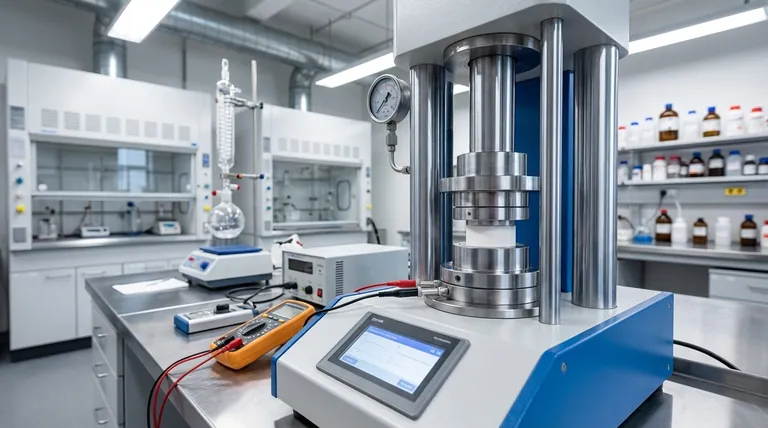
The Physics of Densification
To understand why pressure is non-negotiable, you must look at the microscopic environment of the sample. The goal is to simulate a solid bulk material using disjointed powder.
Eliminating Insulating Voids
Loose powder contains significant empty space, known as voids or pores. These air gaps act as electrical insulators that block ion movement.
By applying high pressure (often ranging from 60 MPa to over 600 MPa), you physically collapse these voids. This densification process creates a compact pellet where ions can move freely without encountering dead ends.
Overcoming Grain Boundary Resistance
Even when particles are touching, the interface between them—the grain boundary—introduces resistance. If the contact is weak, this resistance dominates the measurement.
High pressure maximizes the contact area between particles, significantly lowering this grain boundary resistance. This ensures that the measured impedance is derived from the bulk material properties, not poor inter-particle connections.
Mechanisms of Microstructural Change
Pressure does more than just push particles closer; it actively alters the microstructure of the test sample to facilitate ion transport.
Inducing Plastic Deformation
In many solid-state electrolytes, particularly sulfide-based materials, high pressure causes the particles to undergo plastic deformation.
The particles physically change shape, flattening against one another to fill microscopic gaps. This creates a continuous, efficient pathway for lithium or sodium ions to traverse solid-phase interfaces.
Optimizing the Electrode Interface
The resistance is not limited to the powder itself; it also exists where the electrolyte meets the measurement electrodes (such as stainless steel or lithium foil).
A specialized fixture or laboratory press ensures uniform contact at this critical junction. Minimizing this interfacial resistance is essential for obtaining repeatable cycling stability and conductivity data.
Understanding the Trade-offs
While pressure is necessary, the application of that pressure introduces variables that must be managed to ensure data integrity.
The Risk of Variable Pressure
If the pressure is not constant or uniform, the physical contact between particles will shift during the test. This leads to noisy, unrepeatable data that makes it impossible to compare different material batches.
Distinguishing Intrinsic vs. Extrinsic Properties
A common pitfall is measuring a sample at insufficient pressure and concluding the material has low conductivity.
In reality, the material chemistry might be excellent, but the extrinsic factor (poor densification) is masking the intrinsic performance. You must apply sufficient pressure to reach a "conductivity plateau" where the reading stabilizes, confirming you are measuring the material, not the voids.
Making the Right Choice for Your Goal
To obtain meaningful data from Electrochemical Impedance Spectroscopy (EIS), tailor your pressing strategy to your specific objective.
- If your primary focus is Material Characterization: Apply the highest safe pressure (e.g., >300 MPa) to maximize density and identify the absolute theoretical limit of the material's ionic conductivity.
- If your primary focus is Quality Control: Establish a strict, standardized pressure protocol (e.g., exactly 250 MPa for 2 minutes) to ensure that any variance in data is due to chemical changes, not sample preparation.
Success in solid-state testing relies on the certainty that you have built a continuous ion highway, not a road full of potholes.
Summary Table:
| Aspect | Purpose of Constant Pressure | Benefit |
|---|---|---|
| Densification | Eliminates insulating air voids between powder particles. | Creates a continuous pathway for ion transport. |
| Grain Boundary Resistance | Maximizes contact area between particles. | Measures intrinsic material conductivity, not poor contact. |
| Interfacial Contact | Ensures uniform contact with measurement electrodes. | Provides repeatable and stable EIS data. |
| Data Integrity | Isolates chemical performance from physical limitations. | Enables accurate comparison of different material batches. |
Achieve Precise and Reliable Solid-State Electrolyte Testing
Accurate ionic conductivity data starts with perfect sample preparation. KINTEK specializes in laboratory press machines, including automatic lab presses, isostatic presses, and heated lab presses, designed to deliver the constant, uniform pressure required for your research.
Our lab presses help you:
- Eliminate experimental uncertainty caused by variable pressure.
- Achieve true material characterization by reaching the conductivity plateau.
- Ensure repeatable results for both R&D and quality control workflows.
Stop letting sample preparation variables mask your material's true performance. Let our expertise in lab press technology support your breakthrough discoveries.
Contact KINTEK today to discuss your specific solid-state electrolyte testing needs and find the ideal pressing solution for your laboratory.
Visual Guide

Related Products
- Warm Isostatic Press for Solid State Battery Research Warm Isostatic Press
- Lab Ball Press Mold
- XRF KBR Plastic Ring Lab Powder Pellet Pressing Mold for FTIR
- Automatic Laboratory Hydraulic Press for XRF and KBR Pellet Pressing
- Lab XRF Boric Acid Powder Pellet Pressing Mold for Laboratory Use
People Also Ask
- Why must composite cathodes be sealed in vacuum lamination bags for WIP? Ensure Battery Stability and Density
- What is the function of elastic molds in warm isostatic pressing? Achieve Uniform Density in Composite Particles
- How do sacrificial volume materials (SVM) maintain microchannels in isostatic pressing? Ensure Structural Integrity
- What is the function of hydraulic pressure in warm isostatic pressing? Achieve Uniform Material Density
- What is the role of the flexible material in warm isostatic pressing? Key to Uniform Density & Precision



















