
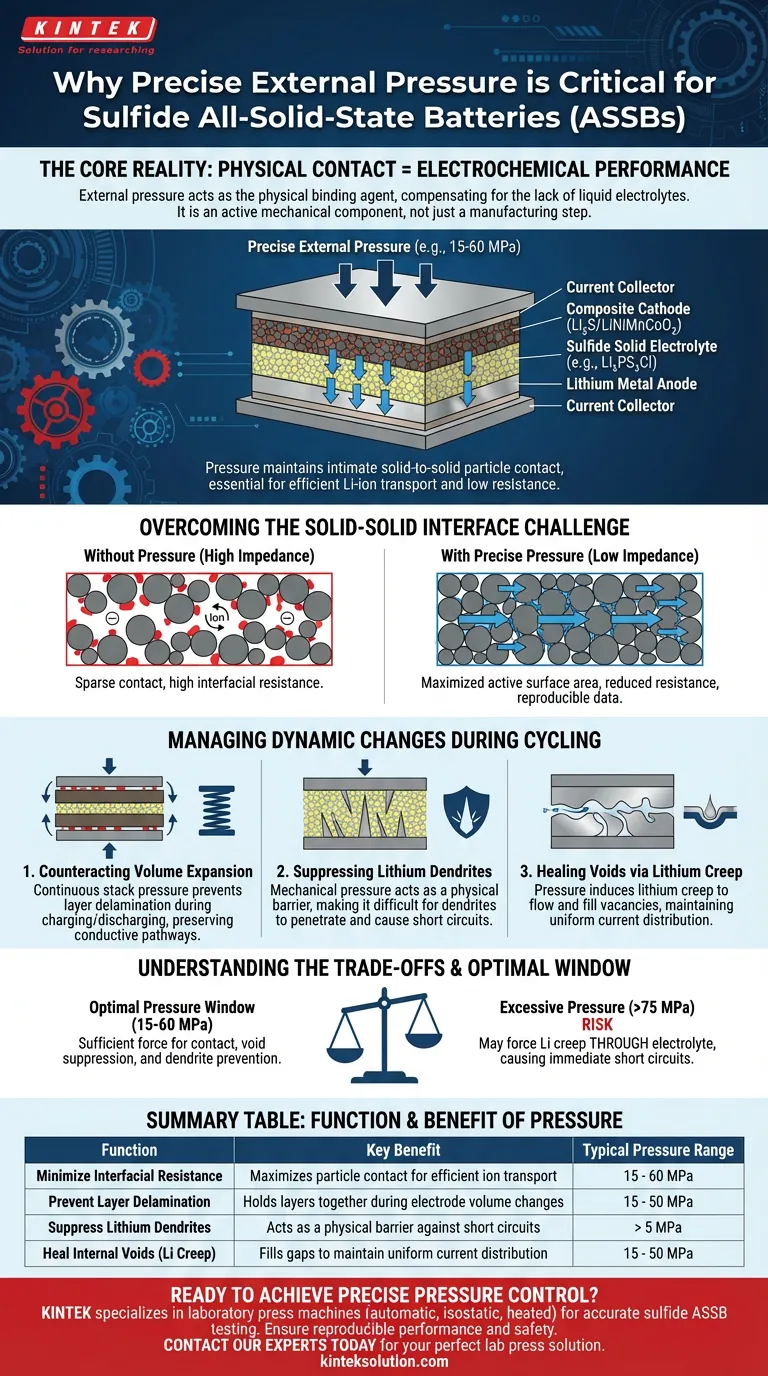
Precise external pressure acts as the physical binding agent in sulfide all-solid-state batteries, compensating for the absence of liquid electrolytes that usually "wet" the surface. Because the internal interfaces are rigid solid-to-solid connections, applying substantial force (often between 15 MPa and 60 MPa) is the only way to establish and maintain the intimate particle contact required for efficient lithium-ion transport and low interfacial resistance.
The Core Reality In solid-state systems, physical contact equals electrochemical performance. External pressure is not merely a manufacturing step; it is an active mechanical component that prevents layer delamination during volume changes, suppresses dangerous dendrite growth, and induces lithium creep to heal internal voids.
Overcoming the Solid-Solid Interface Challenge
The fundamental hurdle in solid-state batteries is the lack of fluidity. Unlike liquid electrolytes that naturally fill gaps, solid sulfide electrolytes and electrodes form rigid, rough interfaces that require mechanical intervention to function.
Minimizing Interfacial Resistance
At the microscopic level, electrode and electrolyte particles must touch to transfer ions. Without pressure, these contact points are sparse, leading to high impedance. Applying high initial pressure (e.g., 60 MPa) forces these particles together, maximizing the active surface area and reducing resistance.
Ensuring Reproducible Data
Testing requires consistency. If pressure fluctuates or is applied unevenly, contact area changes, leading to erratic performance data. Precise pressure control ensures that observed changes in performance are due to material chemistry, not mechanical looseness.
Managing Dynamic Changes During Cycling
A battery is a dynamic system that changes shape physically as it charges and discharges. The "Deep Need" for pressure is to manage these structural changes over time.
Counteracting Volume Expansion
Electrode materials expand and contract significantly during cycling. Without a clamping force, this "breathing" causes the layers to separate physically (delamination). Continuous stack pressure effectively holds the layers together, preserving the conductive pathways despite volumetric shifts.
Suppressing Lithium Dendrites
Lithium dendrites are needle-like structures that grow during charging and can pierce the electrolyte, causing short circuits. Mechanical pressure acts as a physical barrier against this growth. By compressing the stack, the dense electrolyte structure makes it physically difficult for dendrites to penetrate.
Healing Voids via Lithium Creep
When lithium is stripped from the anode, it can leave behind vacancies or "voids." These voids create dead spots where current cannot flow, leading to localized stress. Appropriate pressure induces lithium creep, effectively pushing the soft lithium metal to flow and fill these gaps, maintaining uniform current distribution.
Understanding the Trade-offs
While pressure is vital, it is not a case of "the more, the better." There is a delicate mechanical balance that must be maintained to avoid inducing failure.
The Risk of Short Circuits
Excessive pressure can backfire. If the pressure is too high (e.g., pushing towards 75 MPa in certain contexts), it may force lithium to creep through the electrolyte rather than just filling surface voids. This pressure-induced infiltration creates immediate short circuits, destroying the cell.
Determining the Optimal Window
Research indicates an optimal operating window exists. For example, while 5 MPa might be sufficient to maintain contact in some designs, higher pressures might be needed for others. The goal is to apply enough force to ensure contact and suppress voids, but not enough to mechanically degrade the electrolyte or trigger shorts.
Making the Right Choice for Your Goal
The application of pressure must be tailored to the specific stage of battery development and the specific materials used.
- If your primary focus is Initial Assembly: Apply high initial pressure (e.g., 60 MPa) to mash particles together and establish the lowest possible starting impedance.
- If your primary focus is Long-Term Cycle Life: Maintain a constant, moderate pressure (e.g., 15-50 MPa) to compensate for volume expansion and prevent delamination over hundreds of cycles.
- If your primary focus is Safety Research: Utilize a precise control system to test lower pressure limits (e.g., 5 MPa) to find the minimum force required to stop dendrites without inducing pressure-based short circuits.
Success in sulfide solid-state batteries depends on treating external pressure as a critical, active parameter that must be tuned as precisely as voltage or current.
Summary Table:
| Function of Pressure | Key Benefit | Typical Pressure Range |
|---|---|---|
| Minimize Interfacial Resistance | Maximizes particle contact for efficient ion transport | 15 - 60 MPa |
| Prevent Layer Delamination | Holds layers together during electrode volume changes | 15 - 50 MPa |
| Suppress Lithium Dendrites | Acts as a physical barrier against short circuits | > 5 MPa |
| Heal Internal Voids (Li Creep) | Fills gaps to maintain uniform current distribution | 15 - 50 MPa |
Ready to achieve precise pressure control for your solid-state battery research?
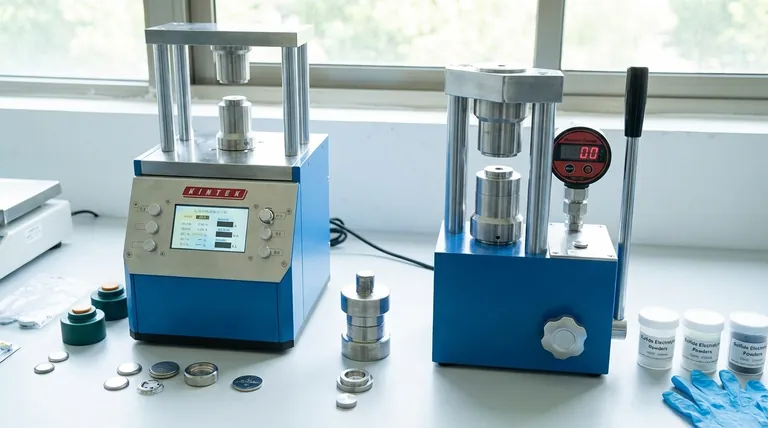
KINTEK specializes in laboratory press machines, including automatic lab presses, isostatic presses, and heated lab presses, designed to deliver the accurate and consistent pressure your sulfide all-solid-state battery testing demands. Our equipment helps you maintain the critical pressure parameters needed for reliable performance, safety, and reproducible data.
Contact our experts today to find the perfect lab press solution for your laboratory's needs.
Visual Guide
References
- Dabing Li, Li‐Zhen Fan. Challenges and Developments of High Energy Density Anode Materials in Sulfide‐Based Solid‐State Batteries. DOI: 10.1002/celc.202200923
This article is also based on technical information from Kintek Solution Knowledge Base .
Related Products
- Warm Isostatic Press for Solid State Battery Research Warm Isostatic Press
- Laboratory Hydraulic Press Lab Pellet Press Button Battery Press
- Button Battery Sealing Press Machine for Lab
People Also Ask
- Why must composite cathodes be sealed in vacuum lamination bags for WIP? Ensure Battery Stability and Density
- How do sacrificial volume materials (SVM) maintain microchannels in isostatic pressing? Ensure Structural Integrity
- What is the function of elastic molds in warm isostatic pressing? Achieve Uniform Density in Composite Particles
- What is the process involved in warm isostatic pressing? Mastering Uniform Density with WIP Technology
- What are the advantages of using a Warm Isostatic Press (WIP) for batteries? Achieve Superior Interface Contact


