Applying approximately 25 MPa of pressure is a critical mechanical requirement to overcome the inherent physical limitations of joining two solid materials. This pressure forces the soft, pliable lithium metal to undergo plastic deformation, causing it to "creep" and flow into the microscopic surface irregularities of the rigid solid electrolyte. Without this step, the interface remains discontinuous and void-filled, resulting in prohibitively high resistance that prevents the battery from functioning effectively.
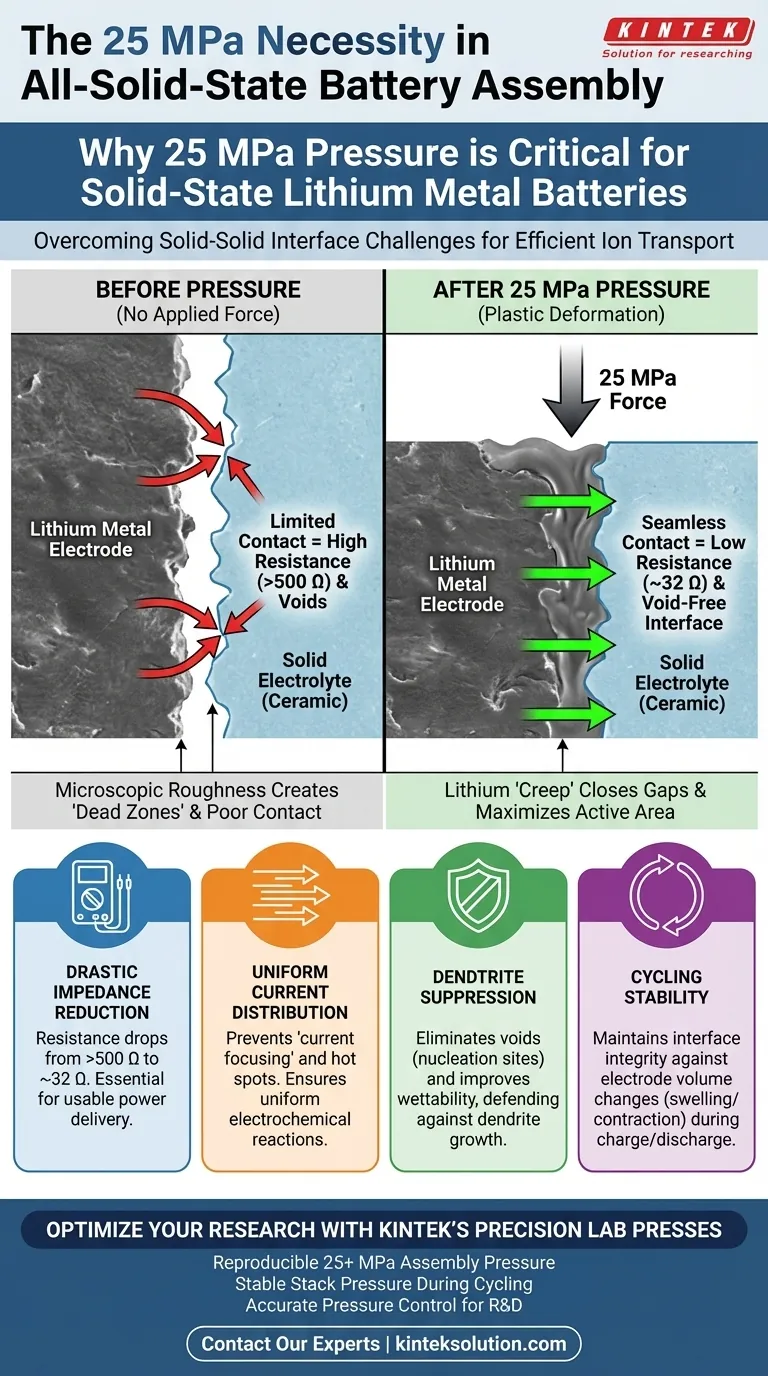
Core Takeaway Unlike liquid electrolytes that naturally wet electrode surfaces, solid electrolytes require mechanical force to establish ionic pathways. The application of 25 MPa drives the interfacial impedance down by orders of magnitude (e.g., from >500 Ω to ~32 Ω), creating the intimate physical contact required for efficient ion transport.

The Physics of the Solid-Solid Interface
Overcoming Microscopic Roughness
On a microscopic level, even polished solid electrolyte surfaces are rough and uneven. When a lithium electrode is placed against a solid electrolyte without pressure, they only touch at a few discrete high points.
This lack of contact creates vast "dead zones" where ions cannot travel. The application of pressure is the only way to close these gaps and maximize the active surface area.
Leveraging the Plasticity of Lithium
Lithium metal is unique among battery materials because it is soft and possesses high plasticity. When subjected to 25 MPa, the metal acts less like a rigid solid and more like a viscous fluid.
This pressure induces creep, forcing the lithium to physically flow into the pores and voids of the ceramic electrolyte (such as LLZO). This creates a "void-free" interface that mimics the seamless contact found in liquid systems.
Critical Performance Implications
Drastic Reduction in Impedance
The primary metric for the success of this assembly step is interfacial impedance. Before pressure is applied, resistance can exceed 500 Ω, acting as a bottleneck for energy flow.
After applying 25 MPa, this resistance drops to approximately 32 Ω. This reduction is not merely an improvement; it is a fundamental prerequisite for the battery to deliver usable power.
Uniform Current Distribution
Voids at the interface do not just block ions; they force the current to crowd into the few points of actual contact. This phenomenon, known as "current focusing," creates hot spots and uneven electrochemical reactions.
By flattening the lithium against the electrolyte, pressure ensures current flows uniformly across the entire surface. This uniformity is vital for maximizing the critical current density of the cell.
Suppression of Dendrite Growth
Voids and surface irregularities are primary nucleation sites for lithium dendrites (needle-like structures that cause short circuits).
By eliminating these voids through plastic deformation, the assembly process improves the wettability of lithium on the electrolyte. A tight, gap-free interface is a primary defense mechanism against dendrite propagation.
Understanding the Operational Constraints
The Challenge of Volume Expansion
While initial pressure creates the interface, maintaining it is equally difficult. Electrodes undergo significant volume changes (swelling and contracting) during charge and discharge cycles.
If pressure is removed or insufficient after assembly, the interface can delaminate or separate. This physical detachment breaks the ionic pathway, leading to immediate capacity fade.
Complexity of Test Setup
The requirement for high pressure necessitates robust in-situ compression setups or laboratory hydraulic presses during testing.
Standard battery casings (like coin cells) used for liquid batteries are often insufficient for maintaining these pressures. Specialized hardware is required to apply continuous stack pressure (often 70-80 MPa during operation) to accommodate volume fluctuations and maintain the bond formed during assembly.
Making the Right Choice for Your Goal
To optimize the performance of all-solid-state batteries, you must view pressure as an active component of the cell design, not just an assembly step.
- If your primary focus is Initial Electrochemical Performance: Ensure your hydraulic press delivers sufficient force to induce lithium creep, verifying the interface by measuring impedance drops below 50 Ω.
- If your primary focus is Long-Term Cycling Stability: Transition from initial assembly pressure to a fixture that maintains continuous stack pressure to counteract electrode volume changes and prevent delamination.
Success in solid-state batteries depends on treating mechanical pressure as a fundamental thermodynamic variable, as vital to the system as voltage or temperature.
Summary Table:
| Key Function | Impact of 25 MPa Pressure |
|---|---|
| Interface Contact | Forces lithium to fill electrolyte surface voids, creating seamless ion pathways |
| Impedance Reduction | Drops interfacial resistance from >500 Ω to ~32 Ω, enabling efficient ion transport |
| Current Distribution | Ensures uniform current flow across entire surface, preventing hot spots |
| Dendrite Suppression | Eliminates void nucleation sites that trigger lithium dendrite growth |
| Cycling Stability | Maintains interface integrity during electrode volume changes during charge/discharge |
Optimize Your Solid-State Battery Research with KINTEK's Precision Lab Presses
Struggling to achieve consistent 25 MPa pressure for your all-solid-state battery assembly? KINTEK's hydraulic lab presses deliver the precise, uniform pressure required to create void-free lithium-solid electrolyte interfaces. Our automatic lab presses and heated lab presses enable researchers to:
- Reproducibly achieve 25+ MPa assembly pressure for low-impedance interfaces
- Maintain stable stack pressure during cycling tests to prevent delamination
- Accurately control pressure parameters for dendrite suppression studies
Designed specifically for laboratory battery R&D, KINTEK presses help you overcome the critical mechanical challenges in solid-state battery development. Contact our experts today to discuss how our lab press solutions can enhance your battery research outcomes!
Visual Guide
Related Products
- Warm Isostatic Press for Solid State Battery Research Warm Isostatic Press
- Laboratory Hydraulic Press Lab Pellet Press Button Battery Press
- Lab Button Battery Tablet Press Sealing Mold
- Automatic Laboratory Hydraulic Press for XRF and KBR Pellet Pressing
- Laboratory Hydraulic Press 2T Lab Pellet Press for KBR FTIR
People Also Ask
- Why must composite cathodes be sealed in vacuum lamination bags for WIP? Ensure Battery Stability and Density
- What is the function of elastic molds in warm isostatic pressing? Achieve Uniform Density in Composite Particles
- How do sacrificial volume materials (SVM) maintain microchannels in isostatic pressing? Ensure Structural Integrity
- What is the function of hydraulic pressure in warm isostatic pressing? Achieve Uniform Material Density
- What is the mechanism of a Warm Isostatic Press (WIP) on cheese? Master Cold Pasteurization for Superior Safety