
Pre-pressing LLZO powder is the foundational step that determines the success of the entire sintering process. It transforms loose, disjointed particles into a cohesive "green body" capable of withstanding the rigors of high-temperature processing. This initial compaction at 10 MPa eliminates macroscopic voids and establishes the essential physical contact required for uniform heat distribution and solid-state diffusion.
The Core Insight High-temperature sintering techniques like Hot Pressing or SPS cannot correct the defects of a poorly prepared sample. Pre-pressing is not merely about shaping the powder; it is about establishing the initial particle-to-particle connectivity necessary to facilitate the chemical reactions and densification that generate high ionic conductivity.
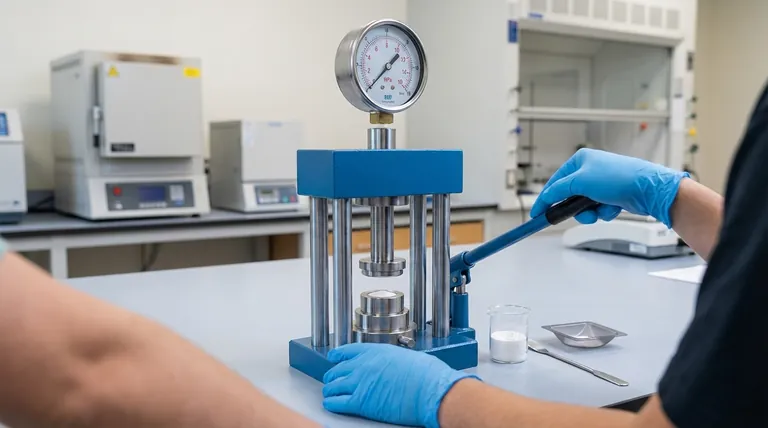
Establishing the "Green Body"
Creating Mechanical Integrity
Loose ceramic powder behaves like a fluid; it lacks structure and cannot be handled. Applying 10 MPa of pressure uniaxially consolidates the LLZO powder into a self-supporting pellet, known as a green body.
This initial mechanical strength is vital. It allows the sample to be transferred into the SPS or Hot Press die without crumbling, ensuring the material geometry is preserved prior to the application of extreme heat.
Minimizing Macroscopic Voids
Before sintering, the "empty space" between particles acts as a barrier to densification. Pre-pressing drastically reduces the porosity of the raw material.
By forcing particles closer together, you minimize the volume of air trapped within the sample. This reduction in initial void volume is a prerequisite for achieving a final product with high relative density.
Optimizing Thermodynamics and Kinetics
Ensuring Uniform Heat Transfer
Loose powder acts as a thermal insulator due to the air gaps between particles. This creates a significant problem for sintering: uneven heating.
Compacted pellets possess significantly higher thermal conductivity. This ensures that when heat is applied during the sintering phase, it conducts uniformly throughout the sample, preventing localized hot spots or incomplete reactions in the core of the pellet.
Facilitating Solid-State Diffusion
Sintering is driven by atomic diffusion across particle boundaries. This process cannot occur if the particles are not physically touching.
Pre-pressing maximizes the contact area (contact points) between individual LLZO particles. By reducing the distance atoms must travel, you accelerate the kinetics of the solid-state reaction, leading to a more complete and efficient phase transformation.
Impact on Final Electrochemical Performance
Reducing Grain Boundary Resistance
The performance of a solid-state electrolyte is defined by how easily ions move through it. Gaps between grains create high resistance.
By maximizing particle contact early in the process, you minimize the formation of resistive grain boundaries in the final ceramic. This ensures that subsequent Electrochemical Impedance Spectroscopy (EIS) data reflects the intrinsic capability of the material rather than artifacts caused by poor processing.
Promoting Homogeneity
A consistent electrolyte is a safe electrolyte. Variations in density can lead to dendritic growth and battery failure.
The uniform contact achieved through pre-pressing leads to a homogeneous microstructure. This uniformity improves the mechanical strength of the final electrolyte membrane and ensures consistent ionic conductivity across the entire surface.
Understanding the Trade-offs
The Risk of Density Gradients
While uniaxial pressing at 10 MPa is necessary, it is not perfect. Friction between the powder and the die walls can create density gradients, where the edges of the pellet are denser than the center.
If not managed, these gradients can lead to warping or cracking during the final sintering stage.
The Limits of "Green" Strength
It is important to remember that a green body is fragile. While 10 MPa provides enough strength for handling, the particles are only held together by mechanical interlocking and weak Van der Waals forces.
The green body has not yet formed chemical bonds. Rough handling or uneven pressure application during the transfer to the sintering furnace can introduce micro-cracks that will propagate and ruin the final ceramic.
Making the Right Choice for Your Goal
Whether you are conducting fundamental research or aiming for high-performance cell assembly, the pre-pressing stage sets the trajectory for your results.
- If your primary focus is High Ionic Conductivity: Ensure sufficient dwell time during pre-pressing to maximize particle contact area, as this directly lowers grain boundary resistance.
- If your primary focus is Mechanical Stability: Focus on the uniformity of the applied pressure to prevent density gradients that could lead to cracking during the transfer to the SPS system.
Ultimately, the 10 MPa pre-press is the bridge between raw chemical potential and a functional, conductive ceramic electrolyte.
Summary Table:
| Pre-Pressing Benefit | Impact on Sintering & Final Product |
|---|---|
| Creates Mechanical Green Body | Enables safe transfer to sintering furnace without crumbling. |
| Minimizes Macroscopic Voids | Reduces initial porosity, a prerequisite for high final density. |
| Ensures Uniform Heat Transfer | Prevents hot spots and allows for consistent reactions throughout the pellet. |
| Maximizes Particle Contact Area | Accelerates solid-state diffusion, leading to more efficient densification. |
| Reduces Grain Boundary Resistance | Directly contributes to higher ionic conductivity in the final electrolyte. |
Achieve consistent, high-performance solid-state electrolytes with KINTEK's precision lab presses.
Your research on materials like LLZO demands flawless sample preparation. The 10 MPa pre-pressing step you've read about is foundational, and its success hinges on the precision and uniformity of your lab press.
KINTEK specializes in hydraulic lab presses—including automatic, heated, and isostatic models—designed specifically for the controlled compaction needs of advanced battery materials research. Our equipment helps you create uniform green bodies with minimal density gradients, setting the stage for successful sintering and reliable electrochemical data.
Ready to optimize your solid-state battery development? Contact our experts today to find the perfect lab press for your specific LLZO processing requirements.
Visual Guide

References
- Mikihisa Fukuda, Eric Jianfeng Cheng. High‐Temperature Sintering of Garnet Solid Electrolyte Li<sub>7</sub>La<sub>3</sub>Zr<sub>2</sub>O<sub>12</sub>: A Comparative Study of Induction Hot Pressing and Spark Plasma Sintering. DOI: 10.1002/smll.202506257
This article is also based on technical information from Kintek Solution Knowledge Base .
Related Products
People Also Ask
- Why must composite cathodes be sealed in vacuum lamination bags for WIP? Ensure Battery Stability and Density
- What is the function of elastic molds in warm isostatic pressing? Achieve Uniform Density in Composite Particles
- How do sacrificial volume materials (SVM) maintain microchannels in isostatic pressing? Ensure Structural Integrity
- What is the mechanism of a Warm Isostatic Press (WIP) on cheese? Master Cold Pasteurization for Superior Safety
- What is the role of the flexible material in warm isostatic pressing? Key to Uniform Density & Precision
