
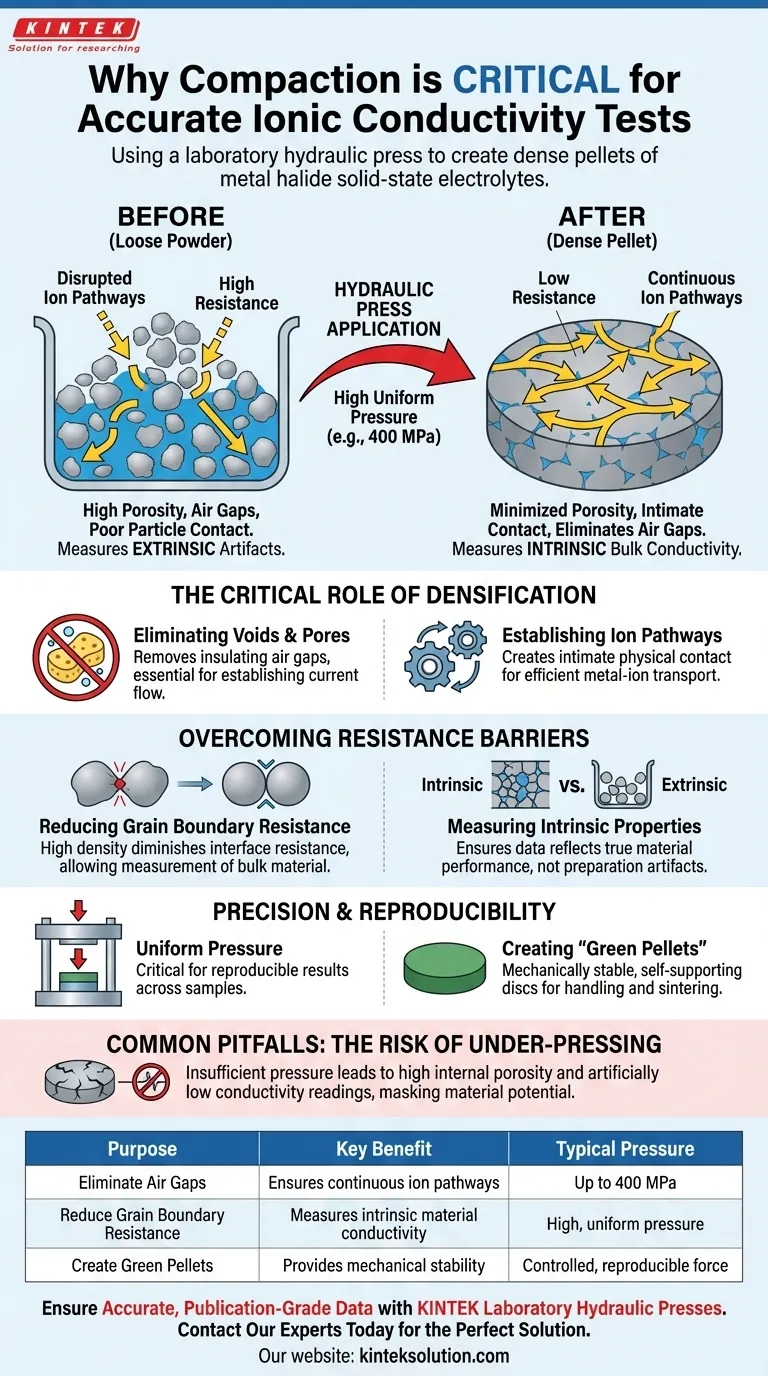
To accurately measure ionic conductivity, using a laboratory hydraulic press is not optional; it is a fundamental requirement for data validity. This equipment applies uniform high pressure—often reaching hundreds of megapascals—to transform loose powder into a dense, solid pellet. This densification eliminates air gaps and forces particles into intimate contact, establishing the continuous pathways necessary for ions to travel through the material.
Core Takeaway The primary purpose of the hydraulic press is to distinguish the material's capability from the sample's physical limitations. By minimizing porosity and grain boundary resistance, you ensure that your data reflects the intrinsic bulk conductivity of the metal halide electrolyte, rather than the poor connectivity of a loose powder.
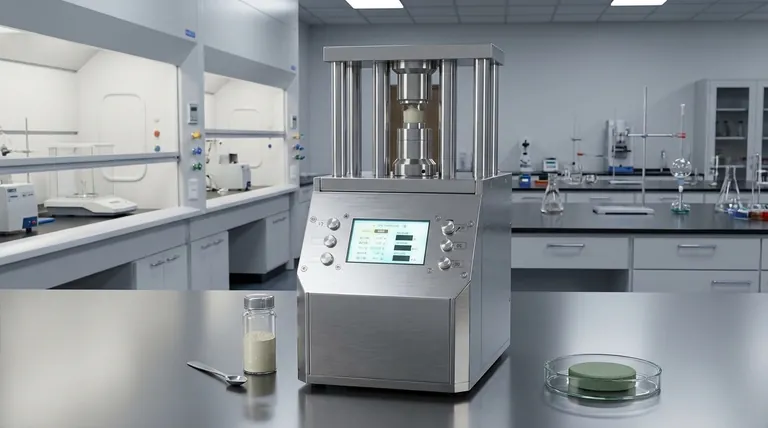
The Critical Role of Densification
Eliminating Voids and Pores
Metal halide electrolytes begin as loose powders containing significant amounts of air. Air is an electrical insulator that disrupts the movement of ions.
A hydraulic press minimizes these inter-particle pores, removing the voids that would otherwise act as barriers to current flow. This creates a solid medium essential for accurate testing.
Establishing Ion Transport Pathways
Ionic conductivity relies on the physical movement of ions through a material. In a loose powder, these pathways are broken and discontinuous.
Applying uniaxial pressure creates intimate physical contact between grains. This contact creates effective, continuous highways for lithium-ion or other metal-ion transport throughout the sample.
Overcoming Resistance Barriers
Reducing Grain Boundary Resistance
The interface where two particles meet is known as a grain boundary. In loose or lightly pressed powders, these boundaries present high resistance to ion flow.
If this resistance is too high, it dominates the measurement. High-density compaction significantly diminishes grain boundary resistance, allowing the measurement current to travel primarily through the bulk material.
Measuring Intrinsic vs. Extrinsic Properties
Researchers need to know how conductive the chemical compound itself is (intrinsic conductivity).
Without sufficient pressure, you are measuring the resistance of the air gaps and poor contacts (extrinsic artifacts). A dense pellet ensures the data collected via methods like Electrochemical Impedance Spectroscopy (EIS) accurately reflects the material's true performance.
Precision and Reproducibility
The Necessity of Uniform Pressure
Hand-pressing or low-pressure methods often result in uneven density gradients.
Laboratory hydraulic presses apply controlled, uniform pressure (e.g., 400 MPa for NaTaCl6). This uniformity is critical for obtaining reproducible results across different samples and batches.
Creating Self-Supporting "Green Pellets"
Beyond electrochemical properties, the sample must be mechanically stable to be handled and placed in a test cell.
The press compacts the ceramic or composite powder into a "green pellet"—a dense, self-supporting disc. This physical integrity is a prerequisite for accurate sensor placement and potential subsequent processing, such as sintering.
Common Pitfalls to Avoid
The Risk of Under-Pressing
If the pressure applied is insufficient, the pellet will retain high internal porosity.
This leads to artificially low conductivity readings. You may incorrectly conclude that a promising material formulation is a failure, when the issue was actually insufficient particle contact during preparation.
Interpreting "Total" Conductivity
It is crucial to understand that even with a press, grain boundaries exist.
However, proper compaction shifts the ratio so that bulk conductivity becomes the dominant measurable factor. Failing to press the pellet makes it impossible to mathematically separate bulk resistance from interfacial resistance during data analysis.
Making the Right Choice for Your Goal
To ensure your research yields publication-grade data, align your pressing parameters with your specific objectives.
- If your primary focus is Materials Discovery: Prioritize pressures high enough (e.g., 400 MPa) to maximize density, ensuring you are screening for chemical potential rather than packing efficiency.
- If your primary focus is Battery Prototyping: Focus on creating "green pellets" with sufficient mechanical integrity to withstand the handling required for cell assembly and subsequent sintering steps.
Ultimately, the hydraulic press acts as a validation tool, stripping away physical variables so you can observe the true electrochemical nature of your material.
Summary Table:
| Purpose | Key Benefit | Typical Pressure |
|---|---|---|
| Eliminate Air Gaps | Ensures continuous ion pathways | Up to 400 MPa |
| Reduce Grain Boundary Resistance | Measures intrinsic material conductivity | High, uniform pressure |
| Create Green Pellets | Provides mechanical stability for testing | Controlled, reproducible force |
Ensure your solid-state electrolyte research yields accurate, publication-grade data with KINTEK's laboratory hydraulic presses. Our automatic lab presses, isostatic presses, and heated lab presses are engineered to deliver the uniform, high-pressure compaction essential for creating dense, defect-free pellets. Whether you're focused on materials discovery or battery prototyping, our equipment helps you eliminate experimental artifacts and measure true intrinsic conductivity. Don't let sample preparation compromise your results—contact our experts today to find the perfect press for your laboratory's needs.
Visual Guide
Related Products
- Laboratory Hydraulic Press Lab Pellet Press Machine for Glove Box
- Laboratory Hydraulic Press 2T Lab Pellet Press for KBR FTIR
- 24T 30T 60T Heated Hydraulic Lab Press Machine with Hot Plates for Laboratory
- Laboratory Hydraulic Press Lab Pellet Press Button Battery Press
- Laboratory Hydraulic Pellet Press for XRF KBR FTIR Lab Press
People Also Ask
- How does a laboratory hydraulic press contribute to the preparation of Li3-3xScxSb samples? Optimize Ionic Conductivity
- What is the function of a laboratory hydraulic press in FT-IR of curcumin-coated MWCNTs? Achieve Optical Clarity.
- Why is a laboratory hydraulic press required for compression molding boron-siloxane? Solve High-Loading Density Challenges
- What role does a laboratory hydraulic press play in the preparation of piezoelectric ceramic discs for DC-PG? | KINTEK
- What role does a laboratory hydraulic press play in reaction pellets? Optimizing Lunar Soil and Metal Fuel Density



















