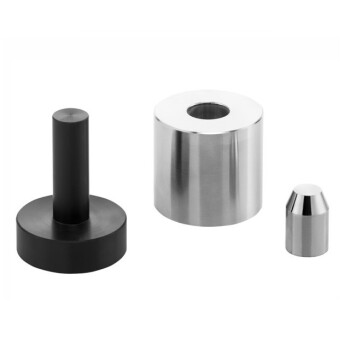
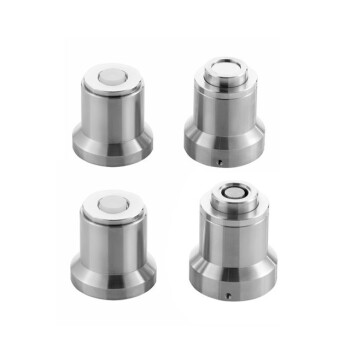
Specialized battery molds are essential because they apply and maintain constant mechanical pressure on the battery stack throughout the testing process. This external force is critical for all-solid-state batteries (ASSBs) to compensate for the lack of liquid electrolyte "wetting" and to preserve the physical integrity of the interface against volume changes during charging and discharging.
Core Takeaway Unlike traditional batteries, solid-state batteries rely entirely on physical contact for ion transport. Specialized molds are required not just to create this contact, but to actively compensate for volume expansion during cycling, preventing the delamination that leads to immediate performance failure and inaccurate data.
Overcoming the Solid-Solid Interface Challenge
The Absence of the "Wetting Effect"
In conventional batteries, liquid electrolytes naturally flow to fill gaps and wet the active materials. Solid-state batteries lack this fluidity.
Without external intervention, microscopic gaps remain between the solid electrolyte and the electrode materials. These gaps block ion flow, resulting in critically high interfacial impedance.
Forcing Physical Contact
Specialized molds apply significant operating pressure (e.g., 60 MPa) to force these solid components together.
This mechanical pressure creates a tight solid-solid interface. This contact is a fundamental prerequisite for achieving efficient ion transport and acquiring valid electrochemical performance data.
Managing Chemo-Mechanical Volume Changes
Compensating for Electrode "Breathing"
During charge and discharge cycles, electrode materials undergo significant physical changes.
Materials like silicon anodes and NCM cathodes experience volume expansion (lithiation) and contraction (delithiation). The battery effectively "breathes" or pulses mechanically during operation.
Preventing Delamination and Peeling
If the testing mold is static or rigid, shrinking electrodes will pull away from the electrolyte.
Specialized molds with pressure-maintaining functions or compensation mechanisms adapt to these changes. They ensure continuous mechanical constraint, suppressing particle peeling and preventing the interface from cracking or detaching.
Understanding the Trade-offs: Material & Design Requirements
The Necessity of High-Strength Insulation
Standard metal clamps are often insufficient for ASSB testing due to the risk of short circuits and deformation under high loads.
Specialized molds often utilize PEEK (polyetheretherketone). This material offers the high mechanical strength needed to withstand extreme pressures (up to 60 MPa) without deforming, while simultaneously providing the electrical insulation necessary to isolate the test system.
Complexity of Pressure Control
Applying pressure is not a "set it and forget it" process for accurate research.
The equipment must utilize components like high-precision titanium alloy plungers or hydraulic presses to ensure uniformity. Uneven pressure can lead to localized current hotspots or structural failure, skewing test results and masking the true capabilities of the battery chemistry.
Ensuring Data Accuracy in ASSB Testing
To generate reliable data, you must match your testing hardware to the specific physical demands of your battery chemistry.
- If your primary focus is Initial Impedance Analysis: Ensure your mold can apply high, uniform pressure (e.g., 60 MPa) to eliminate physical voids and establish the initial solid-solid interface.
- If your primary focus is Long-Term Cycle Life: Prioritize molds with active pressure maintenance or compensation features to counteract particle shrinkage and prevent contact failure over hundreds of cycles.
Success in solid-state battery testing is defined by the ability to maintain the mechanical integrity of the interface as strictly as the chemical stability of the materials.
Summary Table:
| Feature | Specialized ASSB Molds | Standard Clamps/Molds |
|---|---|---|
| Interface Contact | Actively forces solid-solid contact to lower impedance | Poor contact; high interfacial resistance |
| Volume Compensation | Adapts to electrode "breathing" (expansion/contraction) | Rigid; leads to delamination and peeling |
| Pressure Stability | Maintains constant pressure (up to 60 MPa) | Pressure drops as material shifts |
| Material Insulation | High-strength PEEK prevents short circuits | Risk of electrical shorts or deformation |
| Data Reliability | Accurate electrochemical performance profiling | Skewed results due to mechanical failure |
Maximize Your ASSB Research Precision with KINTEK
Don't let mechanical failure compromise your battery data. KINTEK specializes in comprehensive laboratory pressing solutions, offering manual, automatic, heated, and glovebox-compatible models designed specifically for the rigorous demands of all-solid-state battery research.
Whether you need cold/warm isostatic presses or specialized pressure-maintaining molds to eliminate interfacial impedance and manage volume changes, our experts are ready to help you find the perfect fit for your lab.
Contact KINTEK today to enhance your battery testing workflow!
References
- Shijie Xu, Yongan Yang. High-Performance Silicon Anode Empowered by Lithium-Aluminum Alloy for All-Solid-State Lithium-Ion-Batteries. DOI: 10.2139/ssrn.5556781
This article is also based on technical information from Kintek Solution Knowledge Base .
Related Products
- Carbide Lab Press Mold for Laboratory Sample Preparation
- Lab Cylindrical Press Mold for Laboratory Use
- Lab Infrared Press Mold for Laboratory Applications
- Lab Button Battery Tablet Press Sealing Mold
- Lab Isostatic Pressing Molds for Isostatic Molding
People Also Ask
- What is the purpose of incorporating cartridge heaters into a lab press mold for MLCC block compression? Optimize Results
- What is the function of a pressing tool in thermoplastic panels? Master Precision Shaping & Fusion Bonding
- Why is precise cooling management of the lab press mold necessary? Protect Core Integrity in Thermoforming
- How does the geometry of laboratory molds influence mycelium-based composites? Optimize Density and Strength
- What is the significance of standardized molds in lab presses? Ensure Precise Seal Material Evaluation