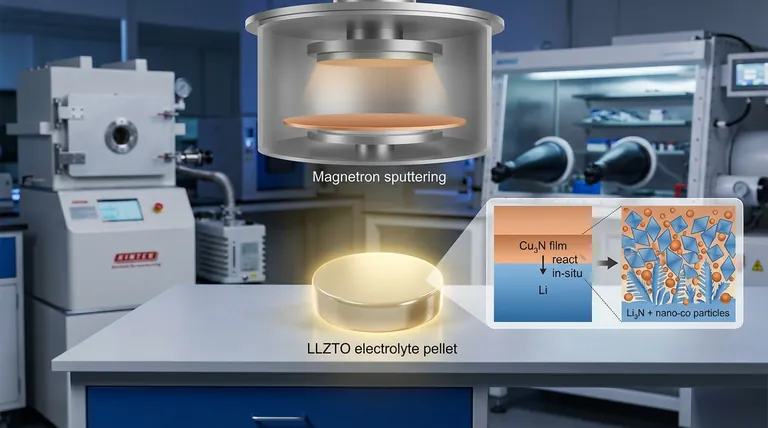
Magnetron sputtering is chosen specifically for its ability to ensure the precise, uniform deposition of Copper Nitride (Cu₃N) thin films onto LLZTO electrolytes. This uniformity is the foundational requirement for creating a stable interface that can effectively suppress the formation of lithium dendrites.
The core advantage lies in the film's ability to react in-situ with lithium, transforming into a mixed conductive layer of Li₃N and nano-Cu. This unique composition homogenizes the electric field and accelerates ion transport, treating the root cause of dendrite growth.
The Engineering Behind the Solution
To understand why this specific technology and material combination is used, we must look at how it modifies the physical and chemical interactions at the battery interface.
The Role of Magnetron Sputtering
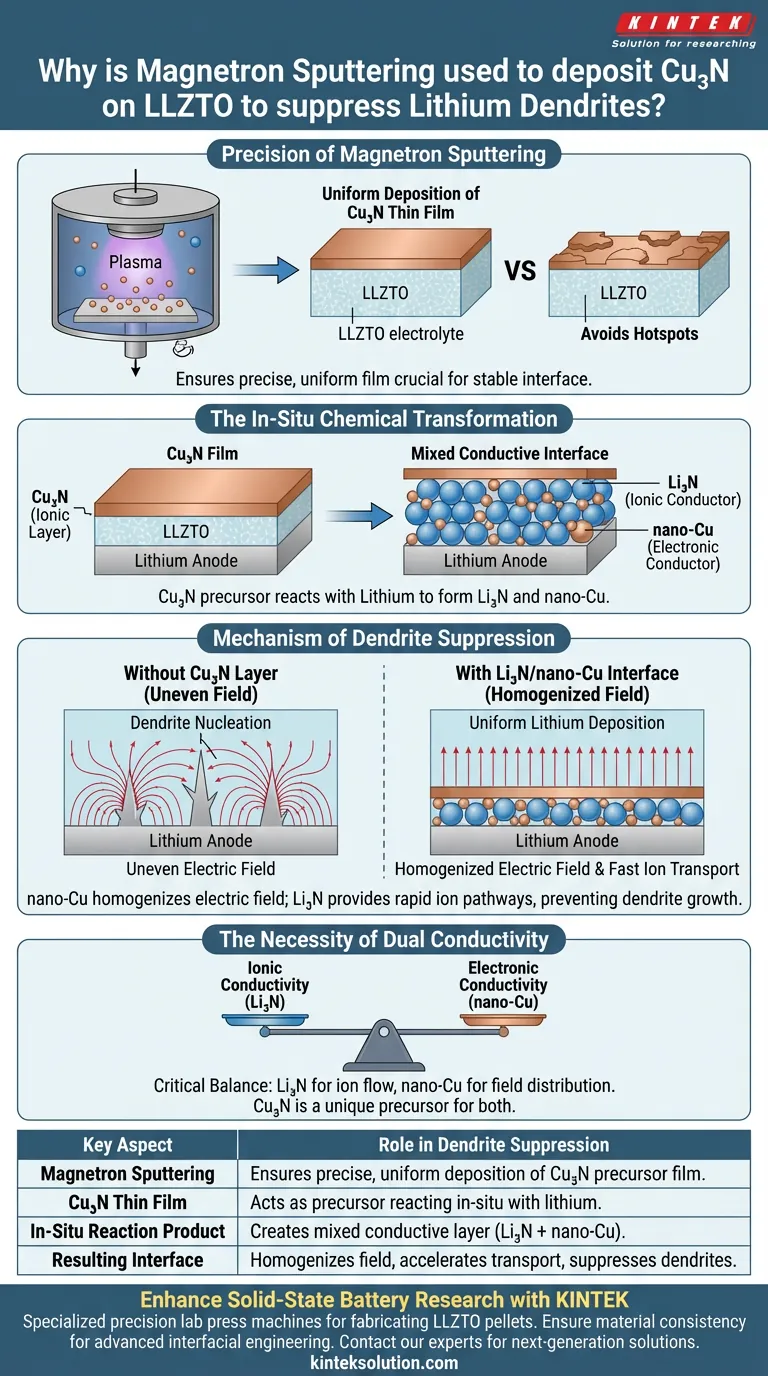
The primary challenge with solid-state electrolytes like LLZTO is achieving a perfect contact with the anode. Magnetron sputtering is utilized because it provides superior control over film thickness and coverage.
It allows for a highly uniform deposition of the Cu₃N layer. Without this uniformity, gaps or thickness variations would create localized hotspots, rendering the dendrite suppression strategy ineffective from the start.
The In-Situ Chemical Transformation
The Cu₃N film is actually a precursor. Its true value emerges when it comes into contact with lithium metal.
Upon contact, a chemical reaction occurs in-situ. This reaction converts the uniform Cu₃N film into a specialized mixed conductive interface.
This new layer consists of two critical components: Li₃N, which acts as a superior ionic conductor, and nano-Cu, which serves as an electronic conductor.
Mechanism of Dendrite Suppression
The formation of lithium dendrites is typically driven by uneven electric fields and sluggish ion movement.
The nano-Cu component effectively homogenizes the electric field distribution across the interface. By spreading the current density evenly, it prevents the localized charge accumulation that usually triggers dendrite nucleation.
Simultaneously, the Li₃N component provides rapid pathways for lithium ion migration. This ensures that lithium deposits uniformly rather than building up into sharp, penetrating needles.
Critical Considerations and Trade-offs
While effective, this approach relies heavily on the precise balance of the mixed conductive interface.
The Necessity of Dual Conductivity
The success of this method hinges on the simultaneous presence of both ionic and electronic conductivity.
If the layer were solely an ionic conductor, it might not sufficiently regulate the electric field distribution. Conversely, if it were purely electronically conductive, it could lead to short circuits or block ion flow.
Therefore, the Cu₃N precursor is essential because it is one of the few materials that cleanly reacts to form both necessary components (Li₃N and nano-Cu) in a single step.
Making the Right Choice for Your Goal
The use of magnetron sputtering for Cu₃N deposition is a targeted solution for interfacial instability. Here is how to verify if this approach aligns with your specific objectives:
- If your primary focus is Manufacturing Precision: Magnetron sputtering is the requisite tool to ensure the uniformity required for consistent battery performance.
- If your primary focus is Battery Safety and Lifespan: The formation of the Li₃N/nano-Cu interface is the critical mechanism needed to fundamentally suppress dendrite growth and prevent short circuits.
By controlling the interface at the nanoscale, you convert a potential point of failure into a stable, high-performance junction.
Summary Table:
| Key Aspect | Role in Dendrite Suppression |
|---|---|
| Magnetron Sputtering | Ensures precise, uniform deposition of the Cu₃N precursor film. |
| Cu₃N Thin Film | Acts as a precursor that reacts in-situ with lithium. |
| In-Situ Reaction Product (Li₃N + nano-Cu) | Creates a mixed conductive layer that homogenizes the electric field and accelerates ion transport. |
| Resulting Interface | Prevents localized lithium buildup, fundamentally suppressing dendrite growth. |
Ready to enhance the safety and performance of your solid-state battery research?
KINTEK specializes in precision lab press machines, including automatic and heated lab presses, which are essential for fabricating and testing solid electrolyte pellets like LLZTO. Our equipment helps ensure the material consistency needed for advanced interfacial engineering, such as depositing uniform thin films.
Contact our experts today to discuss how our reliable laboratory solutions can support your development of next-generation, dendrite-free batteries.
Visual Guide
Related Products
- Warm Isostatic Press for Solid State Battery Research Warm Isostatic Press
- Lab Cylindrical Press Mold for Laboratory Use
- Laboratory Hydraulic Split Electric Lab Pellet Press
- Lab Double Plate Heating Mold for Laboratory Use
- Assemble Square Lab Press Mold for Laboratory Use
People Also Ask
- Why must composite cathodes be sealed in vacuum lamination bags for WIP? Ensure Battery Stability and Density
- What is the function of elastic molds in warm isostatic pressing? Achieve Uniform Density in Composite Particles
- How do sacrificial volume materials (SVM) maintain microchannels in isostatic pressing? Ensure Structural Integrity
- What is the significance of temperature control in Warm Isostatic Pressing? Unlock Uniform Densification and Process Stability
- How does Warm Isostatic Pressing differ from traditional pressing methods? Unlock Uniform Density for Complex Parts