
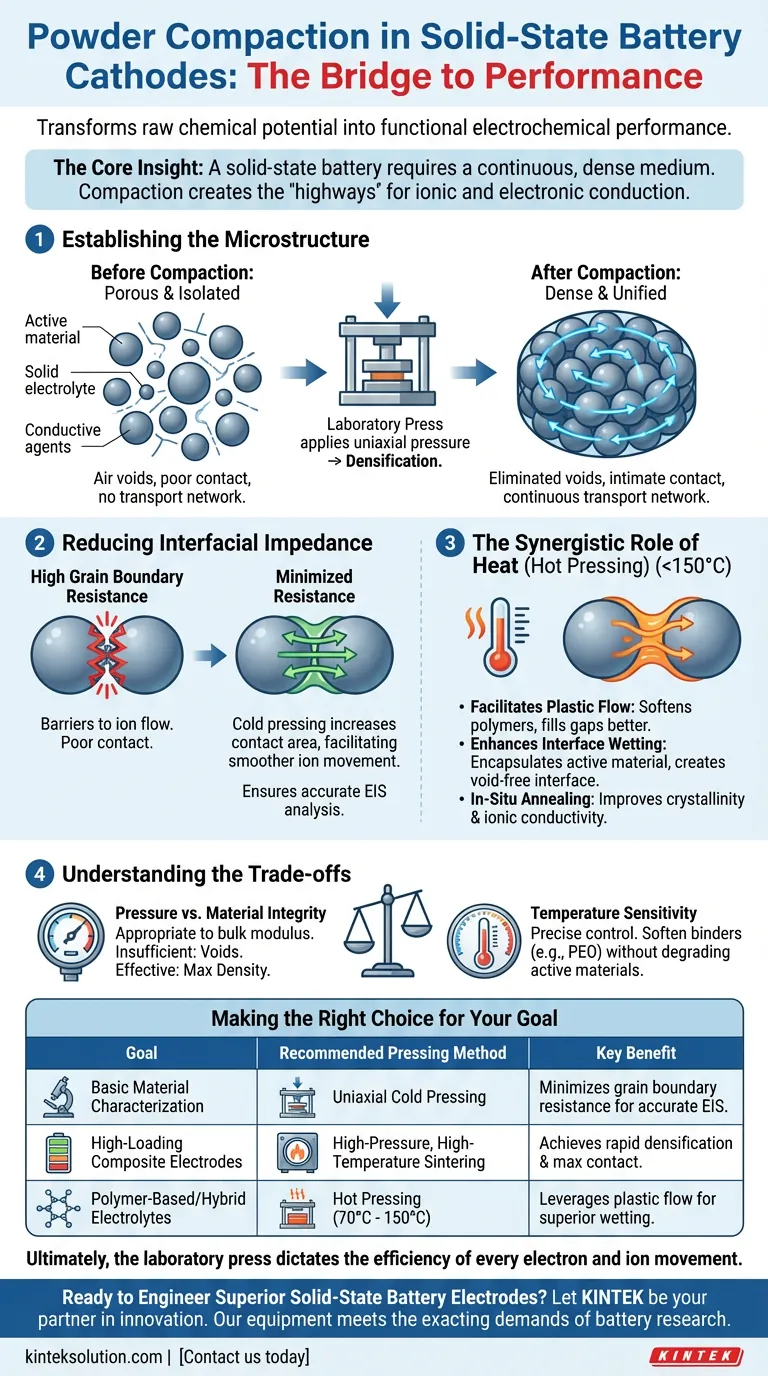
Powder compaction via a laboratory press is the critical bridge that transforms raw chemical potential into functional electrochemical performance.
In the preparation of solid-state battery composite cathodes, this process applies uniaxial pressure to a loose mixture of active materials, solid electrolytes, and conductive agents. By forcing these particles into a dense, cohesive state, the press eliminates air voids and establishes the intimate physical contact required for ions and electrons to move freely, thereby enabling the battery to function efficiently.
The Core Insight A solid-state battery cannot function with loose powder; it requires a continuous, dense medium for transport. The laboratory press creates this medium by mechanically forcing particles together to minimize interfacial impedance, creating the "highways" necessary for ionic and electronic conduction.
Establishing the Microstructure
The primary goal of using a laboratory press is to engineering the electrode's internal architecture. Without this step, the cathode remains a porous collection of isolated particles.
Eliminating Internal Voids
The immediate physical effect of applying high pressure is densification.
The press compacts the active material and solid electrolyte particles, aggressively reducing or eliminating the empty spaces (voids) between them.
Creating Intimate Contact
For a solid-state battery to operate, particles must physically touch to transfer charges.
High-pressure forming forces these particles into intimate contact, transforming a disjointed mixture into a unified solid structure.
Establishing Transport Networks
Once voids are removed and contact is made, a continuous network is formed.
This network allows for the simultaneous transport of ions and electrons throughout the cathode, which is the fundamental requirement for electrochemical reactivity.
Reducing Interfacial Impedance
Beyond simple structure, compaction is a tool for managing electrical and ionic resistance.
Minimizing Grain Boundary Resistance
The interfaces between particles, known as grain boundaries, act as barriers to ion flow.
By increasing the contact area between particles through cold pressing, you significantly reduce the resistance at these boundaries, facilitating smoother ion movement.
Ensuring Accurate Analysis
If the contact between particles is poor, test data will be skewed by artificial resistance.
Compacting the material into a dense pellet ensures that subsequent tests, such as Electrochemical Impedance Spectroscopy (EIS), reflect the material's intrinsic capability rather than artifacts of poor preparation.
The Synergistic Role of Heat (Hot Pressing)
While cold pressure is effective, introducing heat via a heated lab press (hot pressing) unlocks advanced material behaviors, particularly for polymer-based systems.
Facilitating Plastic Flow
Applying heat (e.g., below 150°C) softens specific components, such as polymer binders or solid electrolytes.
This softening allows the materials to flow plastically under pressure, filling gaps more effectively than mechanical force alone could achieve.
Enhancing Interface Wetting
Heat allows polymeric components to "wet" and encapsulate the active material particles.
This creates a seamless, void-free interface that drastically lowers impedance compared to simple cold contact.
In-Situ Annealing
The hot-pressing process serves a dual purpose by acting as an annealing treatment.
This can improve the crystallinity of the electrolyte, which often results in higher intrinsic ionic conductivity within the composite.
Understanding the Trade-offs
While compaction is necessary, the method of application dictates the quality of the result.
Pressure vs. Material Integrity
Pressure must be "appropriate" to the material's bulk modulus.
Insufficient pressure leaves voids and high resistance, while effective pressure maximizes density; however, the specific pressure must be tuned to the compressibility of the specific electrolyte used.
Temperature Sensitivity
Hot pressing is powerful but requires precise thermal control.
Temperatures must be high enough to soften binders (like PEO) but low enough to avoid degrading the chemical structure of the active materials.
Making the Right Choice for Your Goal
The specific pressing technique you employ should align with your specific research objectives.
- If your primary focus is basic material characterization: Use uniaxial cold pressing to minimize grain boundary resistance and ensure your EIS data reflects intrinsic material properties.
- If your primary focus is high-loading composite electrodes: Utilize high-pressure, high-temperature sintering to achieve rapid densification and maximum interfacial contact.
- If your primary focus is polymer-based or hybrid electrolytes: Employ hot pressing (approx. 70°C - 150°C) to leverage plastic flow for superior wetting and reduced interfacial impedance.
Ultimately, the laboratory press does not just shape the battery; it dictates the efficiency of every electron and ion that moves through it.
Summary Table:
| Goal | Recommended Pressing Method | Key Benefit |
|---|---|---|
| Basic Material Characterization | Uniaxial Cold Pressing | Minimizes grain boundary resistance for accurate EIS data. |
| High-Loading Composite Electrodes | High-Pressure, High-Temperature Sintering | Achieves rapid densification and maximum interfacial contact. |
| Polymer-Based/Hybrid Electrolytes | Hot Pressing (70°C - 150°C) | Leverages plastic flow for superior wetting and reduced impedance. |
Ready to Engineer Superior Solid-State Battery Electrodes?
The precise compaction provided by a KINTEK laboratory press is the critical first step in transforming your raw materials into high-performance cathodes. Whether you need the controlled pressure of an automatic lab press for consistent pellets, the uniform density of an isostatic press, or the enhanced interface engineering of a heated lab press for polymer-based systems, our equipment is designed to meet the exacting demands of battery research.
We specialize in serving laboratories like yours, providing the tools to minimize interfacial impedance and unlock the full potential of your composite materials. Let KINTEK be your partner in innovation.
Contact us today to discuss your specific application and find the perfect press for your research goals!
Visual Guide
Related Products
- Laboratory Hydraulic Press 2T Lab Pellet Press for KBR FTIR
- Laboratory Hydraulic Press Lab Pellet Press Button Battery Press
- Laboratory Hydraulic Press Lab Pellet Press Machine for Glove Box
- Laboratory Split Manual Heated Hydraulic Press Machine with Hot Plates
- Laboratory Hydraulic Pellet Press for XRF KBR FTIR Lab Press
People Also Ask
- What is the role of a laboratory pressure machine and KBr in FTIR? Master Sample Preparation for Flame Retardants
- What is the role of a laboratory hydraulic press in high-loading NCM811 cathode prep for solid-state batteries?
- Why is a laboratory hydraulic press necessary for sample preparation? Precise Pelleting for Spiro Heterocyclic Analysis
- What role does a laboratory hydraulic press play in reaction pellets? Optimizing Lunar Soil and Metal Fuel Density
- What are the general applications of a laboratory hydraulic press? Maximize Precision in Material Research



















