
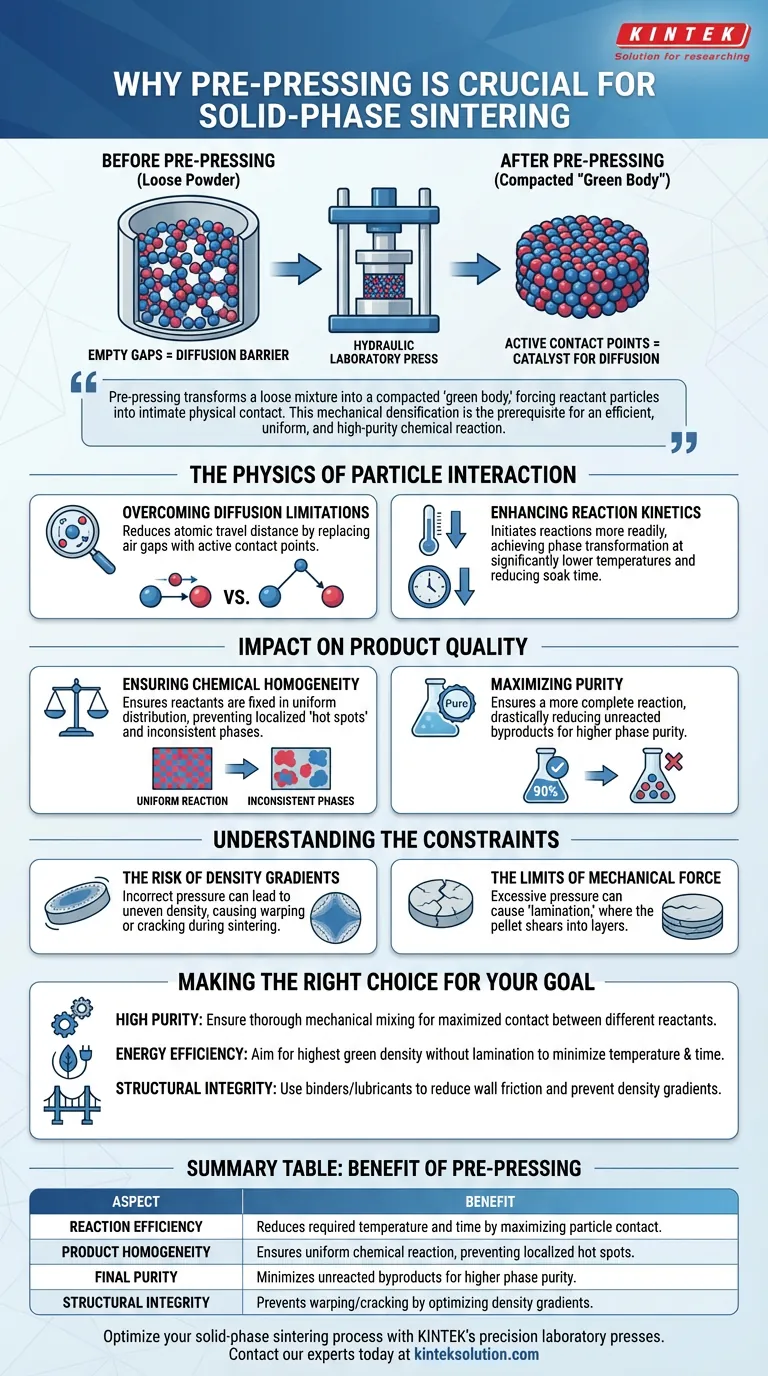
Pre-pressing raw materials acts as the critical catalyst for solid-state diffusion. It transforms a loose mixture of powders into a compacted "green body," forcing reactant particles into intimate physical contact. This mechanical densification is the prerequisite for an efficient, uniform, and high-purity chemical reaction during the sintering phase.
The fundamental goal of pre-pressing is to overcome the distance between particles. By mechanically maximizing the contact area, you significantly lower the energy barrier required for reaction, reducing both the temperature and time needed to achieve a pure final product.
The Physics of Particle Interaction
Overcoming Diffusion Limitations
In solid-state synthesis, atoms must physically move (diffuse) from one particle to another to react. Unlike liquids or gases, solids do not mix freely.
By using a laboratory press to create a dense pellet, you drastically reduce the distance atoms must travel. You are effectively replacing the empty air gaps found in loose powder with active contact points between reactants.
Enhancing Reaction Kinetics
Because the particles are physically forced together, the chemical reaction initiates more readily. This intimacy directly affects the kinetics of the process.
Consequently, you can achieve the desired phase transformation at a significantly lower temperature compared to loose powders. This also reduces the total "soak time" required at peak heat, saving energy and preserving furnace life.
Impact on Product Quality
Ensuring Chemical Homogeneity
Loose powders often suffer from localized reactions, where parts of the mixture react fully while others remain unreacted.
A pressed green body ensures that the reactants are fixed in a uniform distribution relative to one another. This leads to a uniform chemical reaction throughout the entire volume of the material, preventing "hot spots" or inconsistent phases.
Maximizing Purity
Incomplete reactions are a primary source of impurities in solid-state synthesis. If particles are not touching, they simply will not react, leaving behind residual starting materials.
Pre-pressing ensures a more complete reaction, drastically reducing the presence of unreacted byproducts. The result is a final material with higher phase purity and superior physical properties.
Understanding the Constraints
The Risk of Density Gradients
While pressing is crucial, applying pressure incorrectly can lead to uneven density within the pellet. Friction against the die walls can cause the edges to be less dense than the center.
This gradient can lead to warping or cracking during the sintering process as different parts of the pellet shrink at different rates.
The Limits of Mechanical Force
There is a threshold where additional pressure no longer yields better contact and may actually damage the green body. Excessive pressure can cause "lamination," where the pellet shears into layers.
It is vital to find the optimal pressure range that maximizes density without introducing structural defects prior to sintering.
Making the Right Choice for Your Goal
To optimize your solid-phase sintering process, align your pressing strategy with your specific objectives:
- If your primary focus is High Purity: Ensure thorough mechanical mixing prior to pressing to guarantee that the maximised contact points are between different reactants, not identical ones.
- If your primary focus is Energy Efficiency: Aim for the highest possible green density without lamination to minimize the temperature and time required for the reaction.
- If your primary focus is Structural Integrity: Use a binder or lubricant during pressing to reduce wall friction and prevent density gradients that cause cracking during sintering.
A well-pressed green body is the single most effective way to guarantee the success of a solid-state reaction before the furnace is ever turned on.
Summary Table:
| Aspect | Benefit of Pre-Pressing |
|---|---|
| Reaction Efficiency | Reduces required temperature and time by maximizing particle contact. |
| Product Homogeneity | Ensures uniform chemical reaction, preventing localized hot spots. |
| Final Purity | Minimizes unreacted byproducts for higher phase purity. |
| Structural Integrity | Prevents warping/cracking by optimizing density gradients. |
Optimize your solid-phase sintering process with KINTEK's precision laboratory presses. Whether you need an automatic lab press, isostatic press, or heated lab press, our machines are engineered to deliver the uniform compaction and density control essential for high-purity, homogeneous results. Enhance your reaction kinetics, reduce energy costs, and achieve superior product quality—contact our experts today to find the perfect press for your laboratory needs!
Visual Guide
Related Products
- Laboratory Split Manual Heated Hydraulic Press Machine with Hot Plates
- 24T 30T 60T Heated Hydraulic Lab Press Machine with Hot Plates for Laboratory
- Laboratory Hydraulic Press Lab Pellet Press Machine for Glove Box
- Automatic Laboratory Hydraulic Press Lab Pellet Press Machine
- Automatic Heated Hydraulic Press Machine with Hot Plates for Laboratory
People Also Ask
- Why is a laboratory hydraulic press with heating plates required for PLA/TEC films? Achieve Precise Sample Integrity
- Why reduce load when applying composite strengthening tabs? Protect Specimen Integrity and Data Accuracy
- What role does a laboratory heated hydraulic press play in LTCC? Essential for High-Density Ceramic Lamination
- Why is a laboratory heated hydraulic press required? Ensure Precise Vulcanization for NBR/EPDM Nanocomposites
- Why is a laboratory heated hydraulic press utilized during the lamination stage of NASICON green tapes?



















