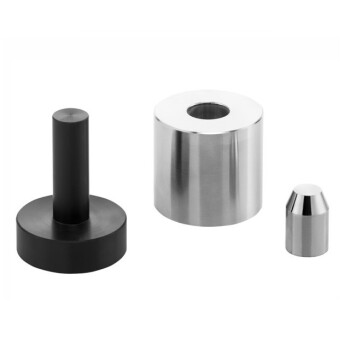
The pressing process is the defining step that transforms a porous, coated mixture into a functional, high-performance battery electrode. Utilizing a high-precision laboratory press applies controlled physical pressure to dried electrode sheets, significantly increasing the compaction density of the active materials. This process is essential for optimizing the contact between particles, enhancing electronic conductivity, and ensuring the structural integrity required for reliable battery operation.
The pressing process establishes a critical balance between physical density and void space. It maximizes volumetric energy density and electron flow while preserving the specific pore structure necessary for electrolyte infiltration and ion transport.
Optimizing Physical Structure and Density
Increasing Compaction Density
The primary physical goal of the pressing process is to minimize void space within the electrode composite. By compressing the active materials, conductive agents, and binders, the process significantly enhances the energy density per unit volume.
Controlling Electrode Thickness
Precision presses ensure the electrode sheet achieves a uniform thickness across its entire surface. This uniformity is vital for consistent electrochemical reaction rates and prevents localized hotspots that could degrade battery performance.
Regulating Porosity
While density is important, the electrode must remain permeable. The pressing process determines the final pore structure, which dictates how effectively the electrolyte can wet the material. Proper control ensures the electrolyte diffusion rate is optimized for the battery's intended application.
Enhancing Electrochemical Performance
Improving Electronic Conductivity
For a battery to function, electrons must move freely through the solid electrode material. Pressing forces particles into tight contact with one another, bridging gaps that would otherwise impede electron flow.
Reducing Contact Resistance
A major source of efficiency loss in batteries is the resistance found at material interfaces. High-precision pressing minimizes the contact resistance between individual active particles and the conductive additives.
Strengthening Current Collector Adhesion
The active material must be mechanically bonded to the current collector (typically copper or aluminum foil). Controlled pressure ensures the material adheres tightly to the foil, reducing the interfacial transport impedance and preventing delamination during cycling.
Ensuring Long-Term Stability
Facilitating Stable SEI Formation
A dense, uniform physical structure is fundamental for the formation of a stable Solid Electrolyte Interface (SEI) film. A uniform SEI layer helps minimize impedance growth over time, which is critical for extending the cycle life of the battery.
Suppressing Dendrite Growth
In specific applications like lithium-metal batteries, uniform external physical constraints help suppress the vertical growth of lithium dendrites. This promotes dense lithium deposition and prevents short circuits caused by dendrite penetration.
Reducing "Dead Lithium" Formation
By maintaining mechanical integrity and ensuring uniform ion transport, precise pressing reduces the formation of isolated or "dead" lithium. This directly contributes to higher reversible capacity and improved safety profiles.
Understanding the Trade-offs
The Risk of Over-Compaction
If the pressure applied is too high, the electrode porosity may become too low. This "chokes" the battery by preventing the liquid electrolyte from penetrating the structure, severely limiting ionic transport and causing poor performance at high discharge rates.
The Risk of Under-Compaction
Conversely, insufficient pressure results in a loose structure with poor particle-to-particle contact. This leads to high internal electrical resistance, low energy density, and a high likelihood of the material detaching from the current collector.
Particle Mechanical Stress
Extreme pressure can fracture the active material particles themselves. This mechanical degradation exposes new surfaces to the electrolyte, leading to parasitic reactions and accelerated battery aging.
Making the Right Choice for Your Goal
To maximize the effectiveness of the pressing process, you must tune the pressure parameters to your specific performance objectives:
- If your primary focus is High Energy Density: Apply higher pressure to maximize compaction density and minimize void volume, fitting more active material into the cell.
- If your primary focus is High Power (Fast Charging): Use moderate pressure to maintain sufficient porosity, ensuring rapid electrolyte diffusion and ion transport.
- If your primary focus is Cycle Life: Prioritize pressure uniformity to ensure a stable SEI layer and strong adhesion to the current collector, preventing mechanical degradation over time.
Ultimately, the precision of the pressing process dictates whether an electrode achieves its theoretical potential or becomes the bottleneck of the entire battery system.
Summary Table:
| Process Objective | Key Parameter | Impact on Battery Performance |
|---|---|---|
| Energy Density | Compaction Density | Increases capacity per unit volume through void reduction. |
| Electron Flow | Contact Resistance | Enhances particle-to-particle contact and conductivity. |
| Ion Transport | Porosity Control | Regulates electrolyte wetting and diffusion rates. |
| Durability | Interfacial Adhesion | Strengthens bond to current collector to prevent delamination. |
| Cycle Life | SEI Stability | Ensures uniform surface structure for stable film formation. |
Maximize Your Battery Research with KINTEK Precision Solutions
Elevate your electrode manufacturing with KINTEK, the industry leader in comprehensive laboratory pressing solutions. Whether you require manual, automatic, heated, multifunctional, or glovebox-compatible models, our equipment is engineered to provide the exact physical constraints needed for high-performance battery research.
From optimizing energy density to ensuring long-term cycle stability with our cold and warm isostatic presses, KINTEK provides the reliability and precision your lab demands. Don't let your pressing process be the bottleneck of your innovation.
Contact KINTEK Today for a Specialized Consultation
References
- Kei Nishikawa, Kiyoshi Kanamura. Global Trends in Battery Research and Development: The Contribution of the Center for Advanced Battery Collaboration. DOI: 10.5796/electrochemistry.25-71059
This article is also based on technical information from Kintek Solution Knowledge Base .
Related Products
- Button Battery Sealing Press Machine for Lab
- Laboratory Hydraulic Press Lab Pellet Press Button Battery Press
- Lab Infrared Press Mold for Laboratory Applications
- Warm Isostatic Press for Solid State Battery Research Warm Isostatic Press
- Lab Cylindrical Press Mold for Laboratory Use
People Also Ask
- Why use standardized CR2032 components & high-precision presses? Ensure reliability in lithium metal battery research.
- Why is a laboratory battery sealing press essential for desolvation energy testing? Ensure Reliable Kinetic Data
- Why is a laboratory hydraulic press or battery sealing machine essential? Ensure Coin Cell Data Integrity
- How do laboratory battery sealing machines ensure performance consistency? Master Your Lithium and LFP Battery Assembly
- What role does a laboratory sealing press play in thermal analysis of solid dispersion films? Ensure Data Integrity