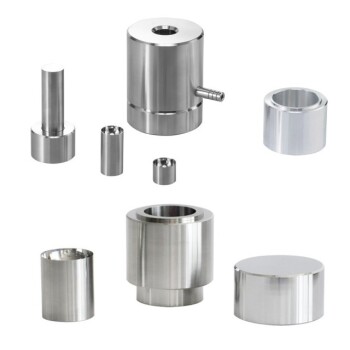
The selection of rubber molds is critical in Warm Isostatic Pressing (WIP) because the mold serves as the primary medium for pressure transmission. The mechanical properties of the chosen rubber, such as fluororubber, directly determine how uniformly pressure is distributed across the metal powder, which fundamentally dictates the density and geometric accuracy of the final component.
Core Takeaway: In WIP, the rubber mold is an active mechanical participant, not just a passive container. Its specific deformation behavior at elevated temperatures determines whether the powder densifies evenly or suffers from structural distortions.
The Physics of Pressure Transmission
Acting as the Transmission Medium
In the WIP process, the rubber mold functions as the bridge between the external pressure source and the metal powder.
It must transfer isostatic pressure equally to every surface of the complex geometry inside.
If the mold material does not possess the correct mechanical characteristics, pressure gradients will occur, leading to uneven densification.
The Impact on Uniformity
The uniformity of the pressed part is strictly tied to the mechanical properties of the rubber.
If the rubber behaves unpredictably under load, the powder will not compress at the same rate in all directions.
This variation can cause internal density defects that compromise the structural integrity of the final product.
The Role of Temperature and Simulation
Temperature-Dependent Behavior
Rubber materials change their physical characteristics significantly when heated to WIP operating temperatures.
You must select a material, such as fluororubber, that maintains stable deformation parameters at the specific thermal range required for your powder.
As noted in broader molding contexts, incorrect operating temperatures can lead to either incomplete densification (too low) or unintended deformation (too high).
Leveraging Finite Element Analysis (FEA)
To ensure the mold selection is correct, engineers utilize Finite Element Analysis.
This simulation method uses the specific deformation parameters of the rubber at high temperatures to model the process.
By doing so, you can precisely predict the powder's densification response and the final geometric accuracy before physical testing begins.
Understanding the Trade-offs
Complexity vs. Predictability
While rubber molds allow for complex shapes, their flexibility introduces variables that rigid molds do not face.
The trade-off lies in the difficulty of predicting the exact final dimensions, as the rubber deforms significantly under pressure.
Thermal Stability Limits
Selecting a rubber with the wrong thermal rating can be catastrophic.
If the rubber softens excessively, it may fail to transmit sufficient pressure; if it remains too rigid, it may not transfer pressure isostatically.
Balancing the material's heat resistance with its required elasticity is the central challenge of mold selection.
Optimizing Your WIP Process
To ensure high-quality output in Warm Isostatic Pressing, align your mold selection with your specific production goals:
- If your primary focus is Geometric Accuracy: Prioritize the use of Finite Element Analysis (FEA) to model the specific deformation parameters of the rubber at your target temperature.
- If your primary focus is Uniform Density: Select a mold material, such as high-grade fluororubber, known for consistent mechanical properties to ensure even pressure transmission.
- If your primary focus is Process Efficiency: rigorous testing of the operating temperature is required to balance powder densification against the risk of mold degradation.
The success of the WIP process is defined by the compatibility between the mold's mechanical limits and the thermal requirements of the powder.
Summary Table:
| Key Factor | Role in WIP Process | Impact on Quality |
|---|---|---|
| Pressure Transmission | Acts as the medium between pressure source and powder | Ensures uniform isostatic compression |
| Material Selection | Uses stable rubbers like fluororubber at high temps | Prevents structural distortions and density defects |
| Thermal Stability | Maintains elastic behavior at elevated temperatures | Ensures predictable deformation and mold longevity |
| FEA Simulation | Models deformation parameters of the rubber mold | Predicts final part geometry and densification |
Elevate Your Powder Metallurgy with KINTEK Precision Solutions
Achieving perfect density and complex geometries in battery research and material science requires more than just pressure—it requires the right equipment. KINTEK specializes in comprehensive laboratory pressing solutions, including manual, automatic, heated, and multifunctional models, alongside advanced cold and warm isostatic presses (CIP/WIP).
Our systems are designed to handle the critical variables of temperature and pressure transmission, ensuring your research yields consistent, high-quality results. Whether you need glovebox-compatible units or high-performance isostatic presses, KINTEK provides the expertise to optimize your workflow.
Ready to refine your pressing process? Contact our technical experts today to find the perfect solution for your lab.
References
- Effect of a rubber mould on densification and deformation of metal powder during warm isostatic pressing. DOI: 10.1016/s0026-0657(03)80358-2
This article is also based on technical information from Kintek Solution Knowledge Base .
Related Products
- Lab Isostatic Pressing Molds for Isostatic Molding
- Lab Heat Press Special Mold
- Cylindrical Lab Electric Heating Press Mold for Laboratory Use
- Warm Isostatic Press for Solid State Battery Research Warm Isostatic Press
- Special Shape Lab Press Mold for Laboratory Applications
People Also Ask
- What is the purpose of incorporating cartridge heaters into a lab press mold for MLCC block compression? Optimize Results
- What is the function of an isostatic lab press in energy storage research? Achieve Superior Material Standardization
- How do laboratory press machines resolve increased impedance in solid-state batteries? Achieve Low-Resistance Interfaces
- How does controlling the parameters of a laboratory isostatic press contribute to reducing deformation in LTCC channels?
- What is the mechanism of a laboratory isostatic press for PPO inactivation? Preserve Puree Quality with High Pressure