
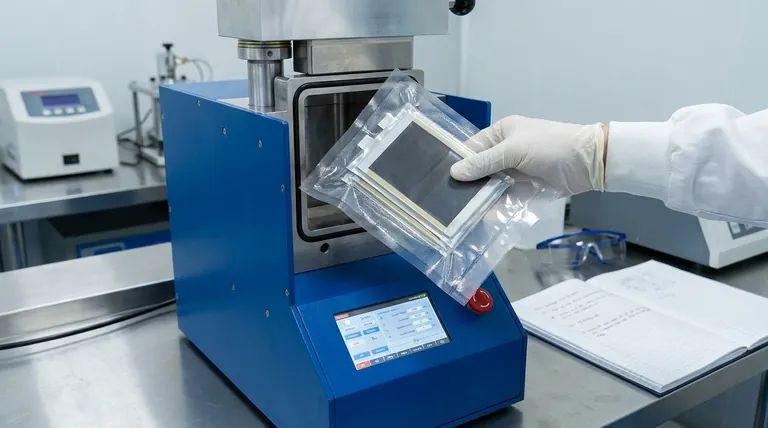
Encapsulation is fundamentally about balancing isolation with force transmission. You must use a laminated sealing bag during Cold Isostatic Pressing (CIP) to create an impermeable barrier between your solid-state battery components and the liquid pressure medium (typically oil). This bag prevents the hydraulic fluid from chemically contaminating your sample, while its flexibility ensures that the external pressure is transferred uniformly to the material, achieving the necessary densification without physical contact.
The laminated sealing bag serves as a flexible interface that allows high pressure to densify the sample while blocking the hydraulic fluid. It preserves the chemical integrity of sensitive components like Solid Polymer Electrolytes (SPE) by preventing oil infiltration during the shaping process.
The Mechanics of Protection and Densification
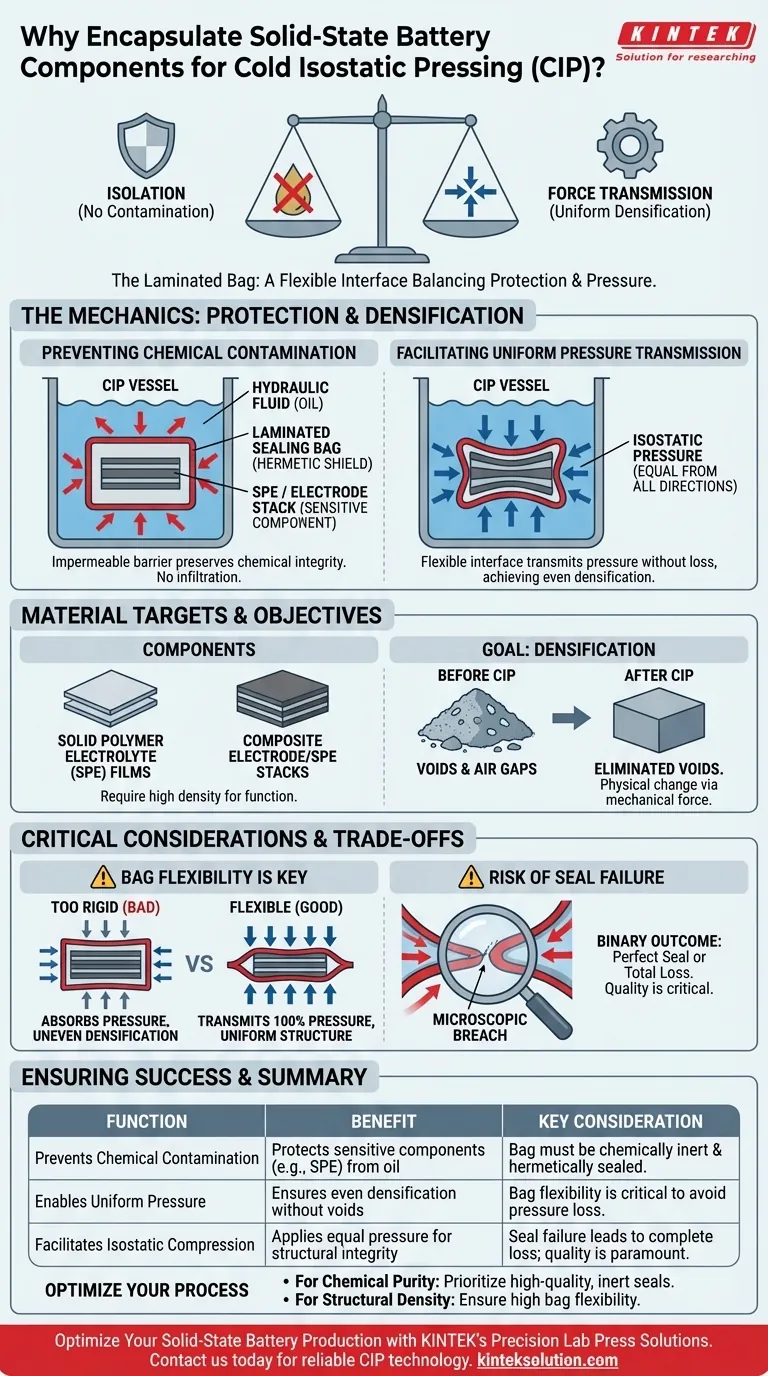
Preventing Chemical Contamination
The CIP process relies on a liquid medium, usually oil, to generate immense pressure.
Solid-state battery components, particularly SPE films and electrode stacks, are highly sensitive to impurities.
If these components were exposed directly to the oil, the liquid would infiltrate the porous structure, ruining the chemical composition and rendering the battery material useless. The bag acts as a hermetic shield.
Facilitating Uniform Pressure Transmission
While the bag must isolate the sample, it must not mechanically shield it from the pressure.
The "laminated" nature of the bag provides durability, but the material must remain flexible.
This flexibility allows the isostatic pressure (equal pressure from all directions) to pass through the bag wall without loss, ensuring the powder or stack inside is compressed evenly.
Material Targets and Objectives
Components Requiring Encapsulation
This process is specifically used for compressing powders and semi-finished parts.
Common applications include shaping Solid Polymer Electrolyte (SPE) films or composite electrode/SPE stacks.
These materials require high density to function correctly, which is why the compression force must be applied directly and evenly.
The Goal of Densification
The primary objective of subjecting these components to CIP is densification.
By compressing the materials, you eliminate voids and air gaps within the powder or stack.
The sealing bag ensures that this physical change happens purely through mechanical force, rather than through liquid absorption.
Critical Considerations and Trade-offs
The Necessity of Bag Flexibility
A common error is selecting a sealing material that is too rigid in an attempt to protect the sample.
If the bag is too stiff, it will absorb some of the pressure rather than transmitting it to the sample.
This leads to uneven densification and structural weak points in the final battery component.
The Risk of Seal Failure
The isolation provided by the bag is binary: it either works perfectly, or it fails completely.
Even a microscopic breach in the laminated seal will allow oil to enter under high pressure.
This results in total loss of the sample; therefore, the quality of the lamination is as critical as the pressure settings of the machine.
Ensuring Success in Your CIP Process
To maximize the performance of your solid-state battery components, select your sealing materials based on your specific processing goals:
- If your primary focus is Chemical Purity: Prioritize high-quality laminated seals that are chemically inert and proven to withstand the specific oil used in your CIP equipment.
- If your primary focus is Structural Density: Ensure the bag material is highly flexible to guarantee that 100% of the isostatic pressure is transmitted to the sample without mechanical resistance.
By viewing the sealing bag as an active transmission membrane rather than just a container, you safeguard the electrochemical potential of your final product.
Summary Table:
| Function | Benefit | Key Consideration |
|---|---|---|
| Prevents Chemical Contamination | Protects sensitive components like SPE films from oil infiltration | Bag material must be chemically inert and hermetically sealed |
| Enables Uniform Pressure Transmission | Ensures even densification of powders and stacks without voids | Bag flexibility is critical to avoid pressure loss |
| Facilitates Isostatic Compression | Applies equal pressure from all directions for structural integrity | Seal failure leads to complete sample loss; quality is paramount |
Optimize Your Solid-State Battery Production with KINTEK's Precision Lab Press Solutions
Are you developing solid-state batteries and need reliable Cold Isostatic Pressing (CIP) to achieve perfect densification without contamination? KINTEK specializes in advanced lab press machines, including isostatic presses designed for sensitive materials like Solid Polymer Electrolytes (SPE) and electrode stacks. Our equipment ensures uniform pressure transmission and chemical purity, helping you maintain the integrity of your components.
Contact us today via our contact form to discuss how our CIP technology can enhance your research and production outcomes. Let KINTEK be your partner in achieving high-density, contamination-free battery materials.
Visual Guide
References
- Benoît Denis Louis Campéon, Naoaki Yabuuchi. Virtues of Cold Isostatic Pressing for Preparation of All‐Solid‐State‐Batteries with Poly(Ethylene Oxide). DOI: 10.1002/cssc.202301054
This article is also based on technical information from Kintek Solution Knowledge Base .
Related Products
- Electric Split Lab Cold Isostatic Pressing CIP Machine
- Automatic Lab Cold Isostatic Pressing CIP Machine
- Manual Cold Isostatic Pressing CIP Machine Pellet Press
- Electric Lab Cold Isostatic Press CIP Machine
- Lab Isostatic Pressing Molds for Isostatic Molding
People Also Ask
- What role do electric lab cold isostatic presses play in industrial contexts? Bridge R&D and Manufacturing with Precision
- What are the applications of electric lab cold isostatic presses in research settings? Advance Material R&D with High-Pressure CIPs
- What advantages does electrical Cold Isostatic Pressing (CIP) have over manual CIP? Boost Efficiency and Consistency
- Why is Cold Isostatic Pressing (CIP) applied after uniaxial pressing? Optimize Superconductor Precursor Density
- What are the process advantages of using Cold Isostatic Pressing (CIP) for LSMO? Achieve Defect-Free Density







