The Unseen Constraint in Modern Science
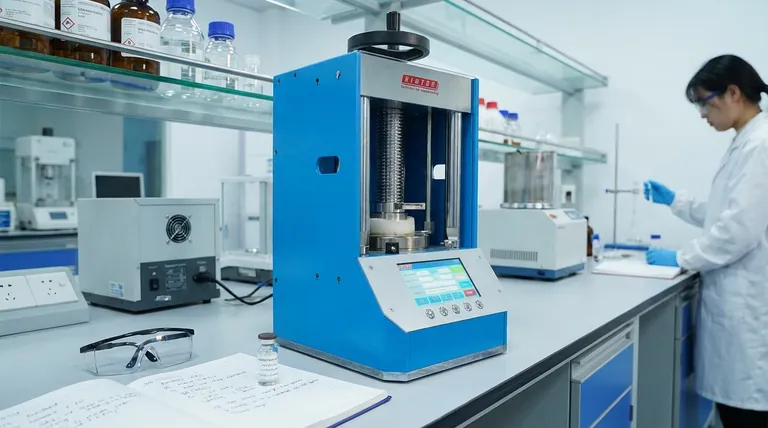
Walk into any advanced research laboratory, from a pharmaceutical cleanroom to a university materials science department. The most valuable commodity is not the exotic chemicals or the gleaming equipment. It's the flat, unassuming surface of the lab bench.
Every square inch of that benchtop is fought for. It represents a finite resource in the pursuit of infinite questions. This spatial constraint is more than an inconvenience; it's a fundamental bottleneck that can slow discovery, complicate workflows, and add a hidden cognitive tax on the researcher. The challenge isn't just to find space, but to use it with profound intelligence.
The Tyranny of the Benchtop
A cluttered workspace doesn't just look messy; it creates friction. When a scientist has to move a vortex mixer and a stack of notes to make room for a simple sample preparation, it breaks their flow of thought. This is the psychological cost of poor spatial ergonomics.
Traditional high-force equipment, born from industrial factory floors, is often the worst offender. A massive hydraulic press, capable of incredible force, is useless if it requires a dedicated room that the lab simply doesn't have. The question then becomes: how do you bring monumental force to the place it's most needed—the researcher's own bench?
Rethinking Force: From Industrial Floor to Laboratory Bench
The compact hydraulic mini press is the elegant answer to this question. Its design is not merely about shrinking a large machine. It's a fundamental rethinking of how, where, and by whom hydraulic force can be applied.
This is not a feature; it is a philosophy. It makes high-force applications accessible and practical in settings where the size, weight, and complexity of a traditional press would be prohibitive.
A New Design Philosophy
The core principle is to maximize utility in a minimal footprint. This design choice has several cascading benefits that directly address the constraints of a modern lab.
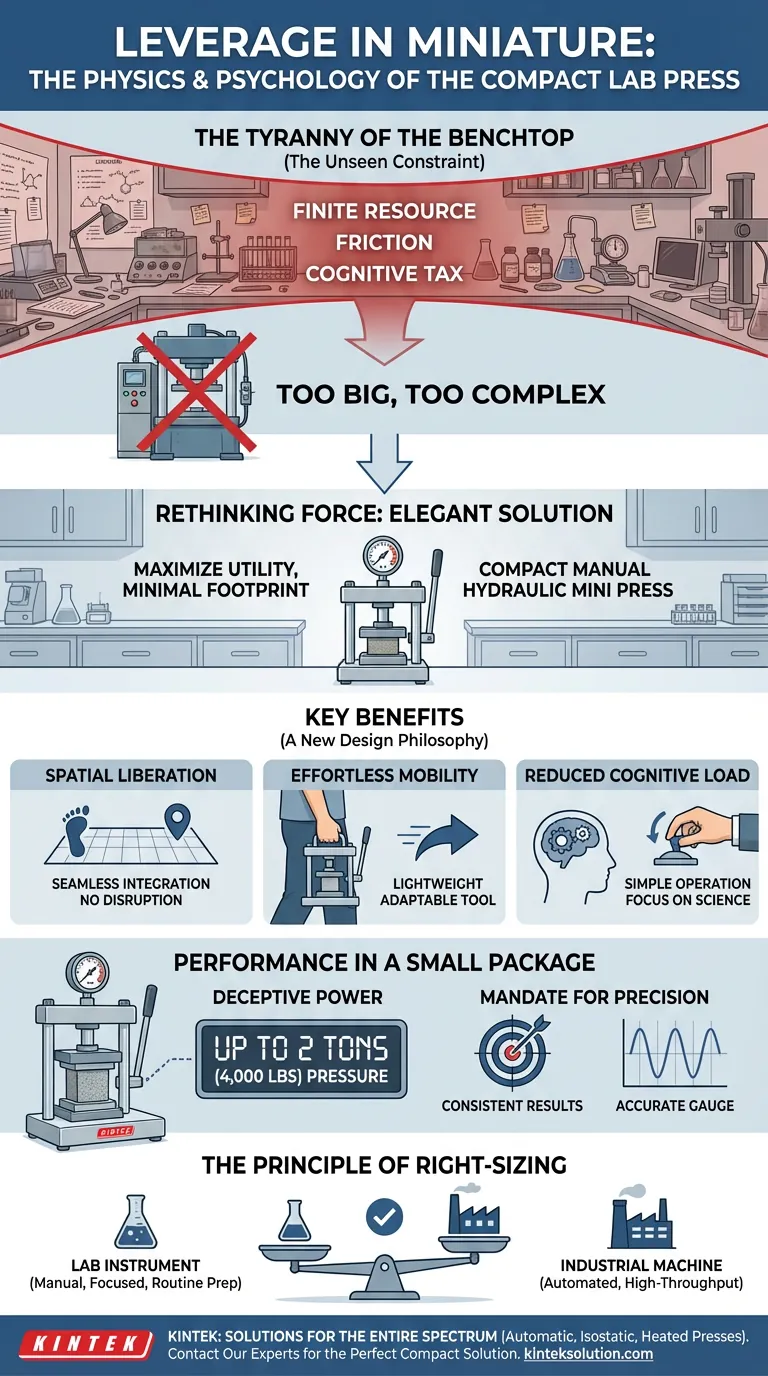
- Spatial Liberation: Its small footprint is engineered specifically for a standard lab counter. This allows it to integrate seamlessly into existing workflows without a major, disruptive reconfiguration of the workspace.
- Effortless Mobility: A compact design is an inherently lightweight design. It can be moved and installed by a single person, transforming it from a static piece of infrastructure into a flexible, adaptable tool that follows the research.
- Reduced Cognitive Load: Simplicity is a powerful feature. A manual press with a straightforward mechanism removes operational complexity, allowing the student or technician to focus on the science of their sample, not the engineering of the machine.
Performance in a Small Package
The term "mini" can be misleading. It refers to size, not capability. These devices are precision-engineered workhorses, designed to deliver significant and repeatable force within their compact frames.
Deceptive Power
Despite their modest size, a high-quality hydraulic mini press can consistently generate substantial pressure, often up to 2 tons (4,000 lbs). This is more than sufficient for a wide range of critical laboratory tasks, such as creating KBr pellets for FTIR spectroscopy or preparing polymer films for tensile testing.
The Mandate for Precision
In science, repeatability is everything. A result that cannot be reproduced is not a result at all. This is why many compact presses are equipped with clear, accurate pressure gauges. They allow for the precise and consistent application of force, ensuring that each sample is prepared under identical conditions, a cornerstone of valid experimental design.
The Principle of Right-Sizing: Knowing the Limits
Honest engineering requires acknowledging what a tool is not designed to do. A compact press is a specialized instrument, and its value lies in its focus.
- Scale and Scope: While 2 tons is immense for a gram of sample powder, it is a fraction of the force needed for industrial manufacturing. These are laboratory instruments, not factory machines.
- Manual vs. Automated: The majority of mini presses are manually operated. This is a deliberate choice prioritizing simplicity, cost-effectiveness, and portability. For high-throughput screening or automated workflows, an electric or fully automatic press may be a better fit, though it represents a different point on the complexity-efficiency spectrum.
Choosing the correct press is about aligning the tool's purpose with your own. For teaching labs and routine sample prep, a simple manual press is ideal. For rigorous R&D, a model with a precise gauge is non-negotiable. For higher throughput, automation becomes key.
Ultimately, the compact press embodies a powerful form of engineering romanticism: the achievement of immense force through a simple, elegant, and human-scale tool. It democratizes pressure, bringing a fundamental physical force out of the machine shop and onto the lab bench where the next discovery awaits.
Specialists like KINTEK, with a range of automatic, isostatic, and heated lab presses, provide solutions across this entire spectrum of needs. If your work is limited by the tyranny of the benchtop, it may be time to rethink the scale of your tools.
To find the perfect compact solution for your application, Contact Our Experts.
Visual Guide
Related Products
- Laboratory Hydraulic Press Lab Pellet Press Machine for Glove Box
- Lab Round Bidirectional Press Mold
- Lab Polygon Press Mold
- Assemble Square Lab Press Mold for Laboratory Use
- Automatic Laboratory Hydraulic Press Lab Pellet Press Machine
Related Articles
- The Physics of Transparency: Why Pressure is the Silent Architect of Spectroscopic Clarity
- The Architecture of Density: Why Pressure is the Silent Architect of Solid-State Batteries
- The Geometry of Electrons: Why Surface Precision is the Silent Partner in SECM Research
- The Geometry of Ionic Flow: Why Precision Pressing Dictates Material Truth
- The Architecture of Heat: Why Sample Density Dictates the Truth in Metal Hydride Research



















