The Factory Floor's Two Stories
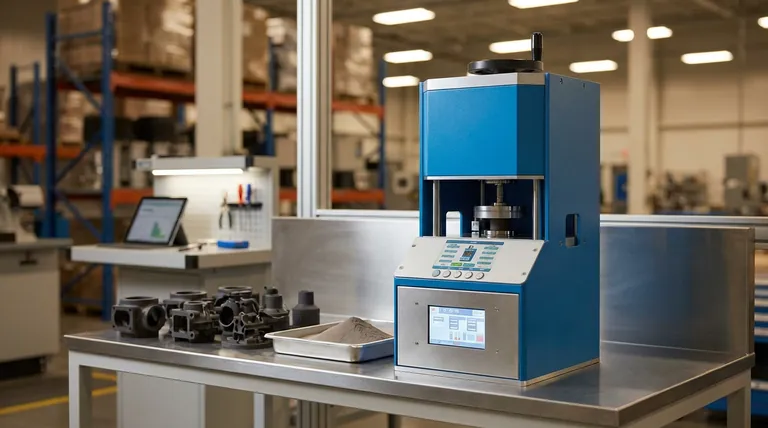
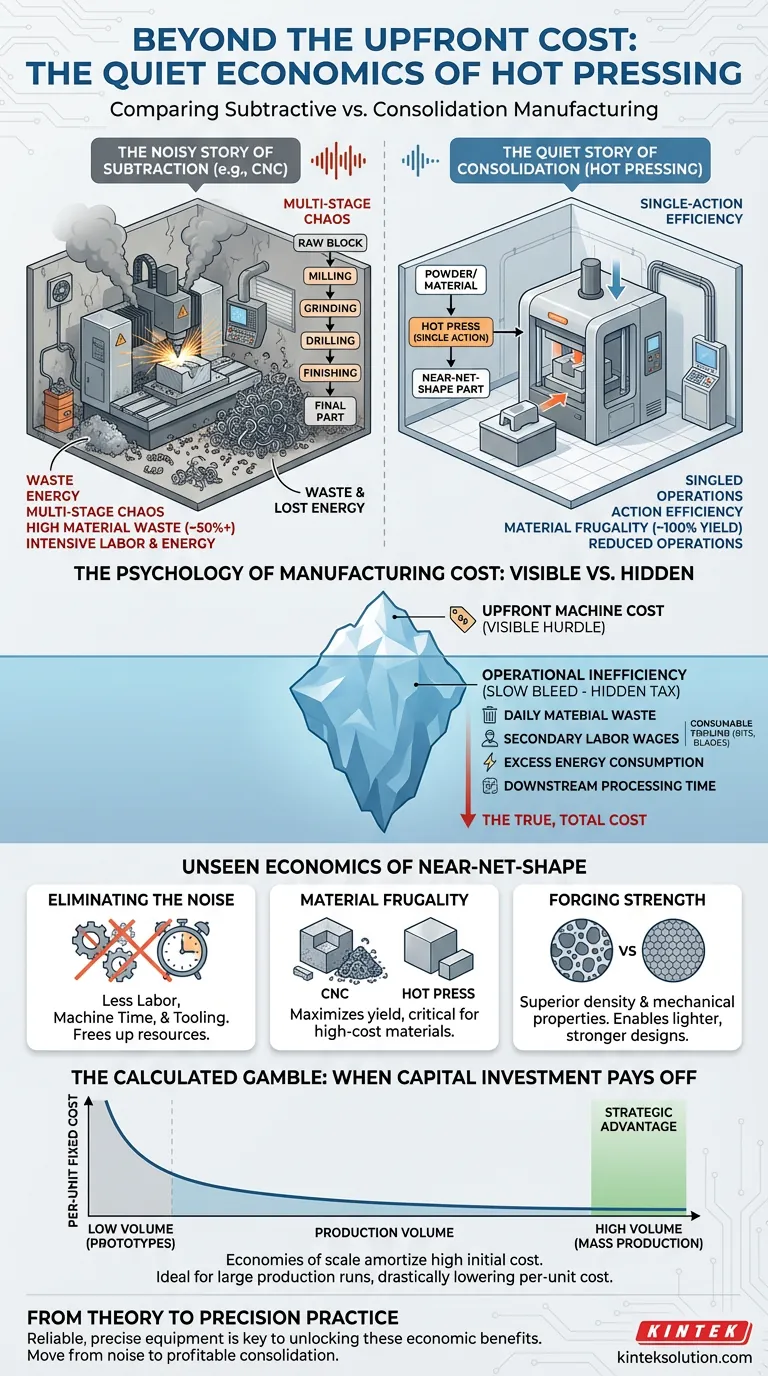
Picture a modern factory floor. In one corner, there's constant noise. CNC machines scream as they carve intricate parts from solid blocks of metal. Shavings pile up, representing not just waste, but money, material, and energy discarded. Each part moves through multiple stations: milling, grinding, drilling, finishing. It's a story of subtraction.
In another corner, it's quieter. A heated press applies immense, silent force to a measure of powder in a die. In a single action, it produces a component that's dense, strong, and nearly identical to its final form. This is a story of consolidation.
These two stories represent a fundamental choice in manufacturing. And our intuition about which is more "expensive" is often flawed.
The Psychology of Manufacturing Cost
We are psychologically wired to fixate on large, visible, one-time costs. The price tag on a hot pressing machine is a significant capital expenditure, and it feels like a hurdle. It's easy to see and hard to ignore.
What's much harder to see is the "slow bleed" of operational inefficiency—the daily cost of wasted material, the hourly wages for secondary processing, the energy consumed by multiple machines. These costs don't appear on a single invoice; they are a tax on the process, paid every day, for every part produced.
Choosing a manufacturing method isn't just an engineering decision; it's a battle against cognitive bias. The real question is not "What does the machine cost?" but "What is the true, total cost to produce one finished part?"
The Unseen Economics of Near-Net-Shape
The economic power of hot pressing lies in its ability to create "near-net-shape" parts. This single concept systematically dismantles the hidden taxes of traditional manufacturing.
Eliminating the Noise of Subtraction
A part that emerges from the press almost finished is a part that doesn't need extensive—and expensive—secondary machining.
- Labor Costs: Reduced or eliminated.
- Machine Time: Freed up for other tasks.
- Consumable Tooling: Savings on bits, blades, and cutters.
- Energy Consumption: Drastically lowered.
The quiet efficiency of the press replaces the costly, multi-stage chaos of subtractive methods. The savings compound with every unit produced.
The Virtue of Material Frugality
In a world of volatile supply chains and rising material costs, waste is not just inefficient; it's a strategic liability. Subtractive manufacturing can easily waste 50% or more of a raw material block.
Hot pressing, an additive or formative process, consolidates nearly 100% of the initial material into the final component. This isn't a minor improvement; it's a revolutionary shift in material efficiency, especially when working with advanced ceramics, alloys, or other high-cost powders.
Forging Strength from Within
The combination of intense heat and pressure doesn't just shape the material; it fundamentally improves it. Hot pressing produces parts with superior density and mechanical properties.
This allows engineers to design components that are lighter and stronger, achieving the required performance with less material. It's another, more subtle layer of cost reduction—the kind born from elegant engineering.
The Calculated Gamble: When Capital Investment Pays Off
Hot pressing is not a universal solution. Its power is unlocked under specific conditions, turning a high initial cost into a decisive competitive advantage.
The Volume Threshold
The economic model of hot pressing is built on the principle of economies of scale. The high fixed cost of machinery and tooling is amortized over the production run.
| Production Volume | Per-Unit Fixed Cost | Viability |
|---|---|---|
| Low (e.g., Prototypes) | Extremely High | Unsuitable; use CNC or 3D Printing. |
| High (e.g., Mass Production) | Negligibly Low | Highly cost-effective and strategic. |
For small batches, the cost is prohibitive. But once production crosses into the hundreds of thousands or millions, the per-unit cost plummets, making it one of the most cost-effective methods available.
Cycle Time vs. Total Throughput
While the cycle time for a single hot press operation might be longer than a stamping machine, this metric is misleading. The true measure is the total time from raw material to finished, shippable part.
By eliminating entire downstream departments for machining and finishing, hot pressing can dramatically shorten the total production timeline, improving cash flow and time-to-market.
From Theory to Precision Practice
Achieving this level of efficiency isn't accidental. It requires equipment engineered for absolute repeatability, precise temperature control, and consistent pressure. The theoretical savings only become real when the machinery is reliable.
This is where specialized equipment becomes critical. KINTEK’s range of automatic lab presses and heated lab presses provides the stable, high-pressure environment needed to transform this economic theory into tangible production reality. They are the tools that enable engineers to move from the noisy story of subtraction to the quiet, profitable story of consolidation.
By understanding the relationship between upfront investment and the hidden, recurring costs of production, you can make a strategic choice that pays dividends for years. To explore how the right equipment can redefine your manufacturing economics, Contact Our Experts.
Visual Guide
Related Products
- Automatic High Temperature Heated Hydraulic Press Machine with Heated Plates for Lab
- Heated Hydraulic Press Machine with Heated Plates for Vacuum Box Laboratory Hot Press
- Heated Hydraulic Press Machine With Heated Plates For Vacuum Box Laboratory Hot Press
- Automatic Heated Hydraulic Press Machine with Hot Plates for Laboratory
- Laboratory Manual Heated Hydraulic Press Machine with Hot Plates
Related Articles
- The Architecture of Slow: Why Physical Precision Dictates Chemical Destiny
- The Architecture of Certainty: Why the Laboratory Press is the Anchor of Material Science
- The Vanishing Boundary: The Hidden Thermodynamics of LTCC Lamination
- The Alchemy of 160°C: Why Precision Pressing is the Silent Backbone of Rubber Science
- The Invisible Forge: Why the Laboratory Press is the Soul of Nano-Composites



















