
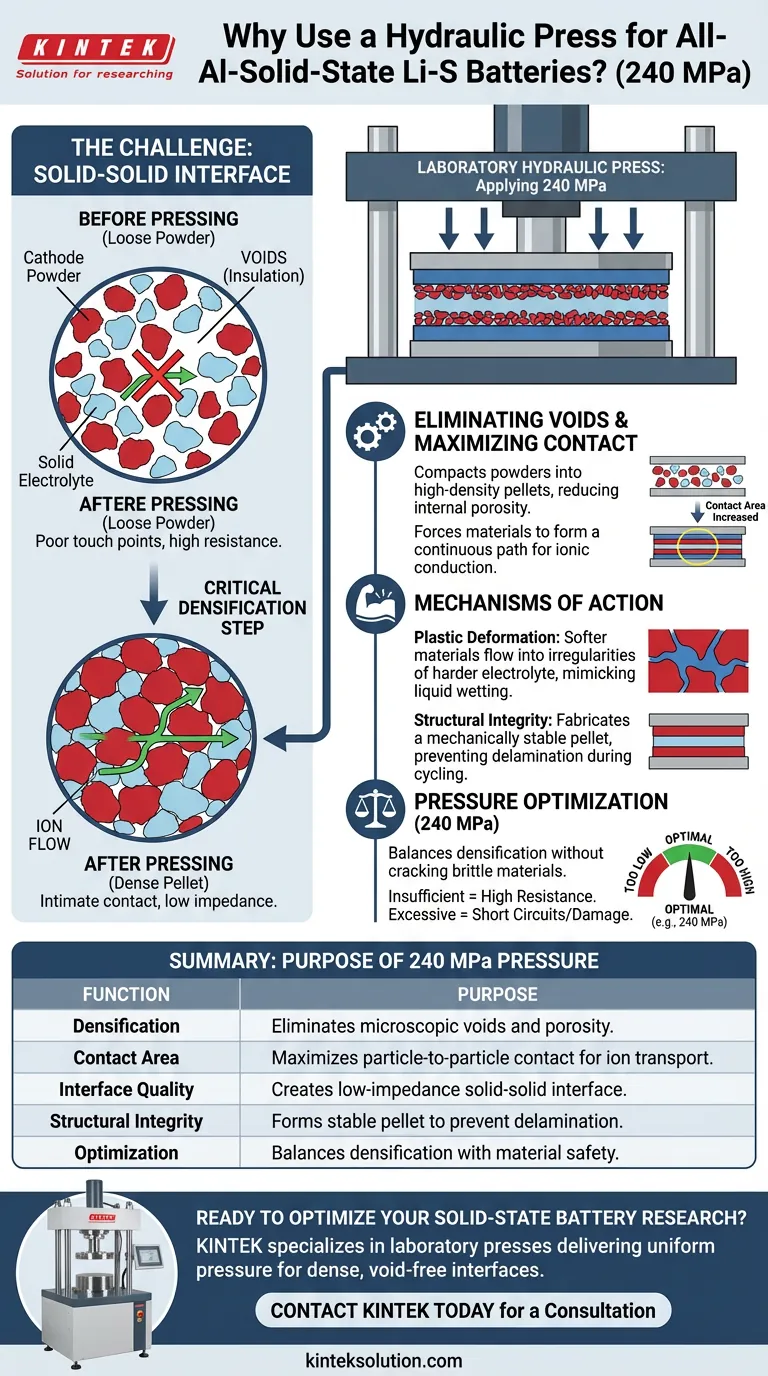
The application of 240 MPa via a hydraulic press is a critical densification step designed to overcome the inherent physical limitations of solid materials. Unlike liquid electrolytes that naturally wet surfaces and fill gaps, solid-state electrolyte and cathode powders require this immense mechanical force to eliminate microscopic voids, ensuring the intimate particle-to-particle contact necessary for lithium ions to move.
The Core Insight: In solid-state batteries, "contact" equates to "conductivity." The hydraulic press forces rigid particles to behave like a unified solid block, mechanically bridging the gaps that would otherwise act as insulating barriers to ion flow.
The Challenge of the Solid-Solid Interface
In conventional batteries, liquid electrolytes easily permeate the porous structure of the cathode. In all-solid-state lithium-sulfur batteries, however, you are attempting to move ions between two rigid solids.
Without sufficient external force, the interface between the electrolyte particles and the cathode material is plagued by voids and poor touch points. The hydraulic press solves this by creating a low-impedance solid-solid interface.
Eliminating Voids and Porosity
When cathode and electrolyte powders are mixed, the resulting structure is naturally porous. Air gaps between particles act as electrical insulators.
Applying 240 MPa compacts these composite powders into high-density pellets. This significantly reduces internal porosity, removing the "dead space" that hinders battery performance.
Maximizing Contact Area
Ion transport relies on physical pathways. If a particle of sulfur does not physically touch the solid electrolyte, it cannot contribute to the battery's energy storage.
High pressure increases the contact area between particles. It forces the materials together so tightly that they form a continuous path for ionic conduction, lowering the contact resistance at the interface.
Mechanisms of Action
The pressure does not just hold the layers together; it fundamentally alters the microstructure of the battery components.
Plastic Deformation
While ceramic electrolytes are rigid, other components (like lithium metal or certain composite cathodes) can undergo plastic deformation under high pressure.
The press forces these softer materials to flow into the microscopic irregularities of the harder electrolyte surface. This fills surface defects and establishes a "seamless" connection that mimics the wettability of a liquid.
Structural Integrity
A loose powder mixture lacks mechanical stability. The pressing process fabricates a mechanically stable pellet.
This structural integrity is vital for maintaining performance over time, preventing the layers from delaminating or separating during the expansion and contraction cycles of battery operation.
Understanding the Trade-offs
While pressure is essential, it is not a "more is always better" variable. The references highlight a range of pressures (from 200 MPa to 500 MPa), suggesting that 240 MPa is a specific optimization for your materials.
Pressure Optimization
Insufficient pressure leaves voids, resulting in high interfacial resistance and poor ion transport. Conversely, excessive pressure can potentially crack brittle ceramic electrolyte particles or cause internal short circuits.
Multi-Step Compaction
Some assembly protocols utilize a staged approach. For example, a lower pressure (e.g., 200 MPa) might be used to pre-form the electrolyte, followed by a higher pressure to consolidate the full stack.
Using 240 MPa specifically indicates a balance: it is high enough to densify the sulfur-electrolyte cathode composite without necessarily reaching the extreme pressures used for final cell consolidation in other architectures.
Making the Right Choice for Your Goal
The application of pressure is the primary lever you have to control the internal resistance of a solid-state cell.
- If your primary focus is High Ionic Conductivity: Ensure the pressure is sufficient to minimize porosity; voids are the primary enemy of ion movement in solid-state systems.
- If your primary focus is Cycle Life: Focus on the uniformity of the pressure; a dense, void-free interface prevents the formation of "hot spots" (dendrites) and maintains contact as the active materials expand and contract.
Summary: You use the hydraulic press to mechanically force solid particles into a unified, dense continuum, transforming a pile of resistive powder into a highly conductive energy storage device.
Summary Table:
| Function | Purpose of 240 MPa Pressure |
|---|---|
| Densification | Eliminates microscopic voids and porosity between solid particles. |
| Contact Area | Maximizes particle-to-particle contact for efficient ion transport. |
| Interface Quality | Creates a low-impedance solid-solid interface, mimicking liquid electrolyte wetting. |
| Structural Integrity | Forms a mechanically stable pellet to prevent delamination during cycling. |
| Optimization | Balances densification with the risk of damaging brittle materials. |
Ready to Optimize Your Solid-State Battery Research?
Achieving the precise, high-pressure densification required for advanced battery development is critical. KINTEK specializes in laboratory press machines, including automatic lab presses and heated lab presses, designed to deliver the uniform pressure and control your research demands.
Our equipment helps researchers like you create the dense, void-free interfaces essential for high-performance all-solid-state batteries. Contact us today to find the perfect press for your lab's needs and enhance your energy storage innovations.
Contact KINTEK for a Consultation
Visual Guide
Related Products
- Laboratory Hydraulic Press Lab Pellet Press Machine for Glove Box
- Laboratory Hydraulic Press 2T Lab Pellet Press for KBR FTIR
- 24T 30T 60T Heated Hydraulic Lab Press Machine with Hot Plates for Laboratory
- Laboratory Hydraulic Press Lab Pellet Press Button Battery Press
- Laboratory Hydraulic Pellet Press for XRF KBR FTIR Lab Press
People Also Ask
- How does a laboratory hydraulic press contribute to the preparation of Li3-3xScxSb samples? Optimize Ionic Conductivity
- What is the function of a laboratory hydraulic press in FT-IR of curcumin-coated MWCNTs? Achieve Optical Clarity.
- Why is a laboratory hydraulic press required for compression molding boron-siloxane? Solve High-Loading Density Challenges
- What role does a laboratory hydraulic press play in reaction pellets? Optimizing Lunar Soil and Metal Fuel Density
- What role does a laboratory hydraulic press play in the preparation of piezoelectric ceramic discs for DC-PG? | KINTEK



















