
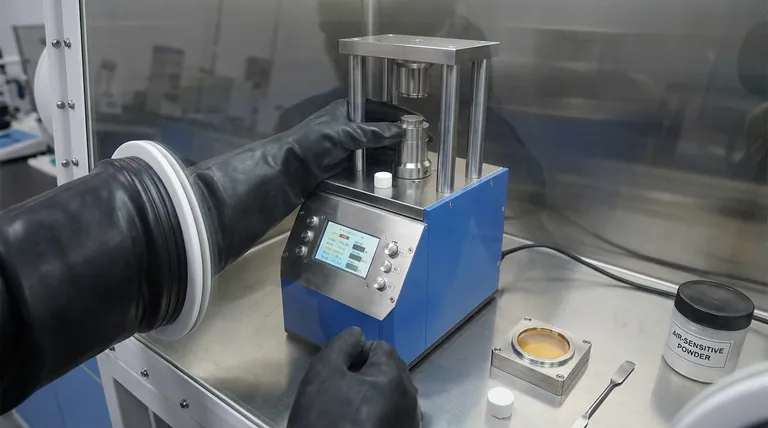
A laboratory press is the critical enabler for preparing air-sensitive materials for X-ray Diffraction (XRD) by compacting loose powders into solid pellets within a controlled environment. By operating inside an inert-atmosphere glove box, the press transforms reactive samples—such as halide electrolytes—into a form that fits precisely into specialized, air-tight holders, ensuring the material remains isolated from moisture and oxygen during analysis.
The laboratory press acts as the essential bridge between a reactive raw material and accurate structural data. By densifying the sample into a pellet within a protective atmosphere, it allows for the use of sealed holders with X-ray transparent windows, guaranteeing that the diffraction pattern reflects the material's true structure rather than degradation byproducts.
The Mechanics of Air-Free Preparation
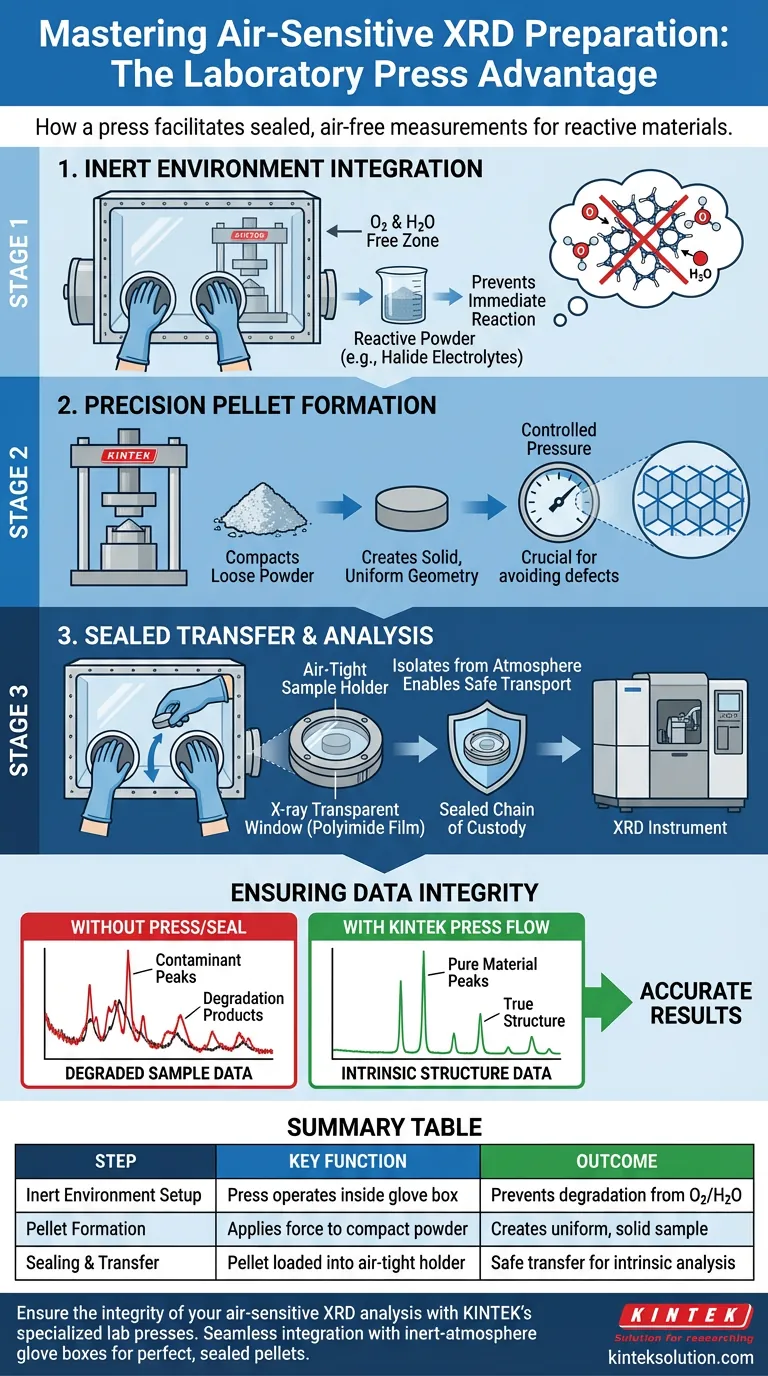
Integration with Inert Environments
To analyze materials that degrade upon contact with air, the sample preparation must occur entirely within an inert-atmosphere glove box.
The laboratory press is instrumental here, as it is placed inside the glove box to manipulate the powder in a safe, oxygen-free zone. This setup prevents the immediate chemical reactions that would occur if the raw powder were exposed to the lab environment.
Creating the Ideal Sample Form
Inside the glove box, the press applies force to the sensitive powder to create a consolidated pellet.
This step is vital because loose powder is difficult to contain securely in vertical sample holders without scattering or shifting. Pressing the material creates a uniform, solid geometric shape that is sized perfectly to fit the instrument's specific tooling.
Sealing for Transport and Analysis
Once the pellet is formed, it is loaded into a specialized air-tight sample holder.
These holders typically feature an X-ray transparent window, such as a polyimide film, which allows X-rays to pass through while keeping air out. Because the pellet was pressed and loaded inside the glove box, the holder can now be removed and transferred to the XRD instrument without compromising the sample's integrity.
Ensuring Data Integrity
Preventing Degradation Products
The primary goal of this workflow is to eliminate degradation products.
When air-sensitive materials like halide electrolytes touch moisture or oxygen, they react chemically, changing their composition. Without the press-enabled sealing process, the resulting XRD data would show peaks for these contaminants rather than the material of interest.
capturing the Intrinsic Structure
By maintaining a sealed chain of custody from the glove box to the X-ray beam, researchers ensure they are measuring the intrinsic crystal structure.
The diffraction data collected represents the pure material as synthesized. This accuracy is non-negotiable for research into high-performance materials where even slight structural changes affect performance.
Understanding the Operational Trade-offs
Process Complexity vs. Data Quality
Using a laboratory press inside a glove box adds significant steps to the workflow compared to standard ambient preparation.
It requires compatible equipment that fits within the limited space of a glove box and creates a bottleneck in sample throughput. However, this added complexity is the unavoidable cost of obtaining valid data for reactive materials.
Parameter Control
While the press enables the creation of pellets, the application of pressure must be controlled.
As noted in broader applications like XRF, presses offer versatile control over speeds and pressures. In XRD preparation, applying consistent pressure is crucial to avoid inducing structural defects or preferred orientation in the crystals, which could skew the diffraction intensity data.
Making the Right Choice for Your Goal
To maximize the quality of your XRD analysis for air-sensitive materials, consider your specific research needs:
- If your primary focus is Data Purity: Prioritize a press workflow that integrates seamlessly with a high-quality glove box to eliminate all exposure to moisture.
- If your primary focus is Sample Stability: Ensure your press tooling matches the dimensions of your air-tight holder exactly to prevent pellet breakage during the transfer.
- If your primary focus is High Throughput: Leverage a hydraulic press with programmable settings to rapidly reproduce pellets of consistent density and thickness.
By isolating your sample from the atmosphere through precision pressing and sealing, you ensure that your data reflects the chemistry you created, not the air it breathed.
Summary Table:
| Step | Key Function | Outcome |
|---|---|---|
| Inert Environment Setup | Press operates inside a glove box. | Prevents sample degradation from oxygen/moisture. |
| Pellet Formation | Applies force to compact loose powder. | Creates a uniform, solid sample for secure handling. |
| Sealing & Transfer | Pellet is loaded into an air-tight holder. | Enables safe transfer to XRD for intrinsic structure analysis. |
Ensure the integrity of your air-sensitive XRD analysis with KINTEK's specialized lab presses.
Our automatic lab presses, isostatic presses, and heated lab presses are designed for seamless integration with inert-atmosphere glove boxes, providing the precise control needed to prepare perfect, sealed pellets. By partnering with KINTEK, you eliminate degradation and capture true structural data for materials like halide electrolytes.
Contact us today to discuss how our laboratory pressing solutions can safeguard your most sensitive samples and enhance your research outcomes.
Visual Guide
Related Products
- Laboratory Hydraulic Press Lab Pellet Press Machine for Glove Box
- Heated Hydraulic Press Machine with Heated Plates for Vacuum Box Laboratory Hot Press
- Laboratory Hydraulic Press Lab Pellet Press Button Battery Press
- 24T 30T 60T Heated Hydraulic Lab Press Machine with Hot Plates for Laboratory
- Automatic Heated Hydraulic Press Machine with Hot Plates for Laboratory
People Also Ask
- How does a laboratory hydraulic press contribute to the preparation of Li3-3xScxSb samples? Optimize Ionic Conductivity
- What is the function of a laboratory hydraulic press in FT-IR of curcumin-coated MWCNTs? Achieve Optical Clarity.
- Why is a laboratory hydraulic press required for compression molding boron-siloxane? Solve High-Loading Density Challenges
- What role does a laboratory hydraulic press play in the preparation of piezoelectric ceramic discs for DC-PG? | KINTEK
- What role does a laboratory hydraulic press play in reaction pellets? Optimizing Lunar Soil and Metal Fuel Density



















