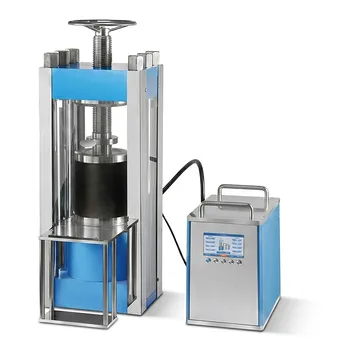
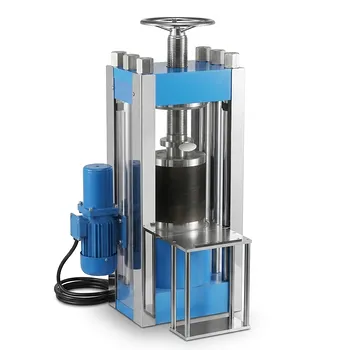
Heated lab presses execute lamination by applying controlled thermal energy and mechanical force to bond multiple layers of distinct materials into a single composite. This process typically involves stacking substrates—such as paper, plastic, metal, or fabric—between heated platens to activate adhesives or fuse the materials, resulting in a unified structure with superior physical characteristics.
The core function of a heated lab press in lamination is to enhance material performance. By fusing layers under heat and pressure, you create composites that possess greater strength, durability, and resistance to environmental factors than the individual materials could achieve alone.
The Mechanics of the Lamination Process
Creating Composite Bonds
The primary role of the heated press is to facilitate the bonding of dissimilar layers.
Operators place a stack of materials, such as plastic films over paper or metal foils, between the press platens.
The machine applies precise pressure to ensure total contact between these layers, eliminating air pockets that could weaken the final product.
Thermal Activation
Heat is the catalyst in this process.
The heated platens raise the temperature of the material stack to a specific set point.
This thermal energy melts thermoplastic layers or cures adhesive agents, effectively "gluing" the strata together into a permanent bond.
Enhancing Material Properties
Increasing Structural Integrity
Lamination significantly improves the physical limitations of base materials.
By combining layers, the press creates a composite that is stronger and more durable than its parts.
This is critical for applications requiring high tensile strength or resistance to tearing.
Environmental Resistance
The lamination process is often used to add protective qualities to a substrate.
Press-bonded layers provide a robust barrier against moisture, preventing degradation in humid environments.
They also offer increased resistance to harsh chemicals, extending the lifespan of the material.
Industry Applications
Packaging and Printing
The packaging industry relies heavily on lamination for both protection and aesthetics.
Heated presses are used to prototype multi-layer packaging films that must keep food fresh or products safe.
In printing, lamination protects ink and paper from wear, ensuring legibility and visual appeal over time.
Construction and Manufacturing
In construction, lamination is used to create durable structural components.
The process bonds layers to form materials capable of withstanding significant structural loads.
Engineers use lab presses to test these composites before approving them for large-scale building projects.
Understanding the Trade-offs
Batch vs. Continuous Processing
It is important to recognize that a lab press operates as a batch process.
Unlike roll-to-roll laminators used in mass production, a lab press creates one sample at a time.
This makes it ideal for R&D and testing, but unsuitable for high-volume manufacturing output.
Platen Size Limitations
The size of your laminate is strictly limited by the dimensions of the press platens.
You cannot process materials larger than the press area without risking uneven bonding or edge failure.
This constraint requires careful material preparation and sizing prior to the lamination cycle.
Making the Right Choice for Your Goal
When employing a heated lab press for lamination, align your approach with your specific objectives:
- If your primary focus is Material Testing: Prioritize precise temperature control to ensure you can replicate exact failure points and bond strengths.
- If your primary focus is Prototyping: Focus on the versatility of the press to handle various thicknesses and material types (plastics, metals, fabrics) without recalibration.
A heated lab press is the definitive tool for validating the performance and durability of composite materials before they move to full-scale production.
Summary Table:
| Feature | Lamination Role | Key Benefit |
|---|---|---|
| Thermal Activation | Melts thermoplastics & cures adhesives | Creates permanent, unified bonds |
| Mechanical Force | Eliminates air pockets & ensures contact | Increases structural integrity & strength |
| Barrier Creation | Applies protective outer layers | Enhances moisture & chemical resistance |
| Batch Processing | Ideal for R&D and prototyping | Allows precise testing before mass production |
Elevate Your Material Research with KINTEK
Unlock superior structural integrity and environmental resistance in your composite materials with KINTEK's advanced laboratory pressing solutions. Whether you are developing next-generation battery components or durable construction materials, our range of manual, automatic, heated, and multifunctional presses provides the precision your R&D demands.
Why choose KINTEK?
- Versatility: Specialized models including cold and warm isostatic presses.
- Precision: Industry-leading temperature and pressure control for reliable prototyping.
- Innovation: Glovebox-compatible designs tailored for sensitive battery research.
Contact KINTEK Today to find the perfect press for your lamination and material testing needs!
Related Products
- 24T 30T 60T Heated Hydraulic Lab Press Machine with Hot Plates for Laboratory
- Automatic Heated Hydraulic Lab Press 120x120mm Plate Fully Automated Material Research Press
- Automatic Heated Hydraulic Lab Press with Programmable Touch Screen Controls and Precision Temperature Regulation
- Automatic Heated Hydraulic Lab Press Machine 200x200 Plate Size for Battery Research and Materials Science
- Manual Heated Hydraulic Lab Press with Integrated Hot Plates Hydraulic Press Machine
People Also Ask
- Function of a Laboratory Hydraulic Press with Heated Platens in SSE? Enhance Battery Density & Conductivity
- Why is a laboratory hydraulic press with heating plates required for PLA/TEC films? Achieve Precise Sample Integrity
- What role does a laboratory heated hydraulic press play in LTCC? Essential for High-Density Ceramic Lamination
- What is the primary function of a laboratory heated hydraulic press? Mastering Thermoplastic Carbon Fiber Composites
- What is the critical role of a laboratory heated hydraulic press? Mastering PVC Sample Prep for Testing