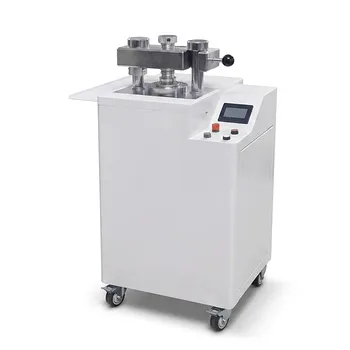
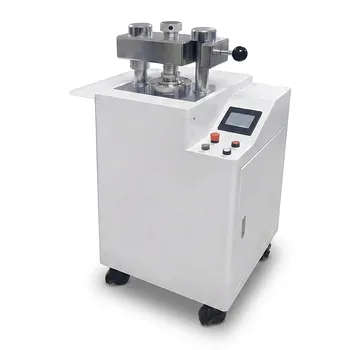
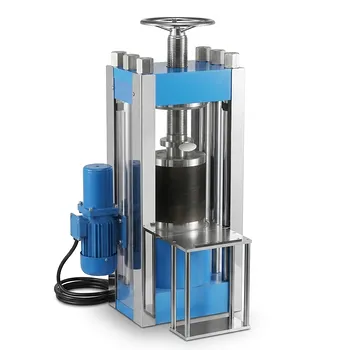
Pellet presses are fundamental instruments in the fabrication of electrode materials, primarily used to compress mixtures of active materials and binders into uniform, cohesive sheets or pellets. By applying substantial force, these devices transform loose powders into solid electrode components essential for the construction of batteries and supercapacitors.
Core Insight: The primary value of a pellet press is not just shaping material, but optimizing density and connectivity. By eliminating voids and forcing particles closer together, the press significantly lowers internal resistance and maximizes the energy storage capability of the final device.
The Mechanics of Electrode Preparation
Forming Electrode Sheets
The foundational use of a pellet press is the conversion of raw chemical mixtures into usable solid forms.
Researchers combine active materials with binders and conductive agents to create a homogenous mix. The press then consolidates this loose mixture into a stable, unified electrode sheet ready for assembly.
Precise Thickness Control
Achieving a specific, uniform thickness is critical for the consistency of energy storage devices.
Pellet presses allow operators to exert exact control over the dimensions of the sample. This ensures that every electrode produced meets strict geometric specifications, which is vital for standardized testing and quality control.
Creating Composite Electrodes
Advanced energy storage often requires combining materials with different properties.
Presses facilitate the creation of composite electrodes by layering different active materials before compression. This allows for the engineering of complex structures that can leverage the benefits of multiple chemical compounds in a single unit.
Enhancing Electrochemical Performance
Increasing Electrode Density
The performance of a battery is directly tied to how much active material is packed into a given volume.
By applying high pressure, the pellet press creates a denser electrode structure. This densification directly enhances the charge-discharge performance, allowing the device to store and release energy more efficiently.
Improving Electrical Conductivity
Loose particles create poor electrical pathways, resulting in high internal resistance.
Compression ensures excellent electronic contact between the active material particles themselves and the current collector. This creates a better internal structure, reducing ohmic polarization and ensuring the electrode conducts electricity effectively.
Objective Performance Assessment
To accurately judge the quality of a material or coating, the mechanical variables must be constant.
Hydraulic presses provide constant, repeatable pressure, creating electrodes with uniform density. This uniformity isolates the chemical variables, allowing researchers to objectively assess how surface coatings or new materials improve capacity without mechanical inconsistencies skewing the data.
Understanding the Trade-offs
The Risk of Over-Densification
While density is generally good, applying excessive pressure can be detrimental.
If an electrode is pressed too tightly, it may close off the porous network required for electrolyte infiltration. Without these pathways, ions cannot move freely, which can actually degrade the battery's rate performance despite the high density.
Material Deformation
Different materials have different tolerance levels for compression.
High-pressure environments allow researchers to simulate fracture points and study plasticity, but in production, one must ensure the pressure does not crush or fracture the active material particles. Destroying the particle structure can lead to immediate failure or reduced cycle life.
Making the Right Choice for Your Goal
To maximize the utility of a pellet press, you must align your processing parameters with your specific research or production objectives.
- If your primary focus is High Energy Density: Prioritize higher pressure settings to maximize particle packing and minimize volume, but ensure electrolyte channels remain open.
- If your primary focus is Reproducibility and Standardization: Focus on the repeatability of the pressure application to ensure every test cell (such as a coin cell) has identical mechanical properties.
- If your primary focus is Composite R&D: Utilize the press to experiment with layered structures, ensuring the pressure is sufficient to bond the layers without causing delamination.
Success in electrode preparation lies in balancing mechanical density with electrochemical accessibility.
Summary Table:
| Key Feature | Role in Electrode Preparation | Impact on Performance |
|---|---|---|
| Densification | Compresses active material and binders | Increases energy density and capacity |
| Connectivity | Forces particles into close electronic contact | Reduces internal resistance and ohmic loss |
| Thickness Control | Ensures uniform and repeatable sample dimensions | Standardizes testing and quality control |
| Layering | Facilitates construction of composite electrodes | Enables advanced material engineering |
| Pressure Control | Manages the balance between density and porosity | Optimizes ion mobility and electrolyte infiltration |
Elevate Your Battery Research with KINTEK
Precision in electrode preparation is the foundation of high-performance energy storage. KINTEK specializes in comprehensive laboratory pressing solutions tailored for the most demanding R&D environments. Whether you are developing next-generation coin cells or exploring complex composite structures, we offer:
- Manual & Automatic Hydraulic Presses for consistent and repeatable results.
- Heated & Multifunctional Models to suit diverse chemical formulations.
- Glovebox-Compatible & Isostatic Presses (Cold/Warm) specifically designed for sensitive battery material research.
Don't let mechanical inconsistencies skew your data. Contact us today to find the perfect pressing solution for your lab!
Related Products
- Automatic XRF Pellet Press for Laboratory Spectrometry Sample Preparation
- Laboratory Hydraulic Split Electric Lab Pellet Press
- Manual Laboratory Hydraulic Pellet Press Lab Hydraulic Press
- Laboratory Hydraulic Pellet Press for XRF KBR FTIR Lab Press
- Automatic Laboratory Hydraulic Press Lab Pellet Press Machine
People Also Ask
- How can contamination occur during the preparation of pressed pellets for XRF analysis? Expert Prevention Guide
- How does the sample material influence the required pressing load for making an XRF pellet? Find the Optimal Pressure
- What are the different methods for preparing a sample pellet for XRF analysis? Expert Guide to Superior XRF Results
- What are the advantages of preparing a sample as a dense pellet for XRF? Unlock High-Precision Trace Element Analysis
- What is the primary purpose of using an automatic pellet press? Achieve Precise Geopolymer Analysis Results