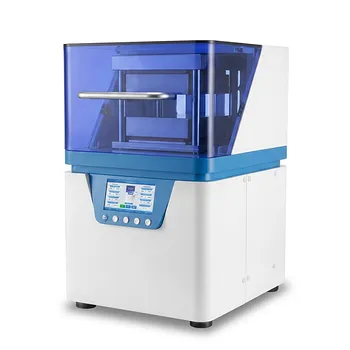
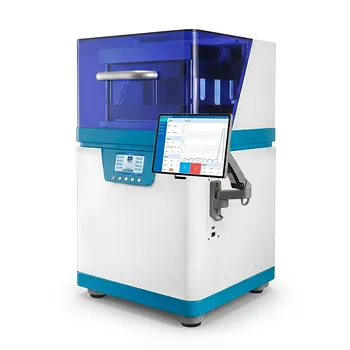
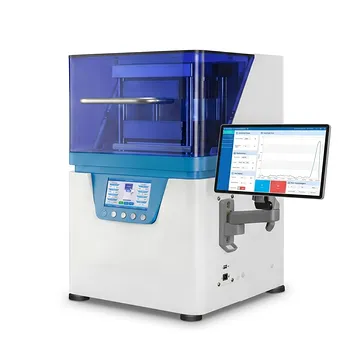
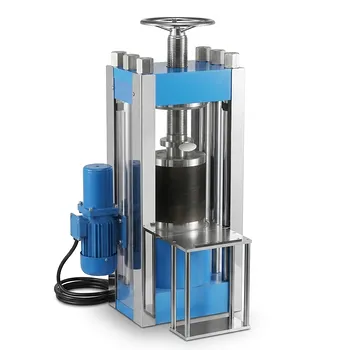
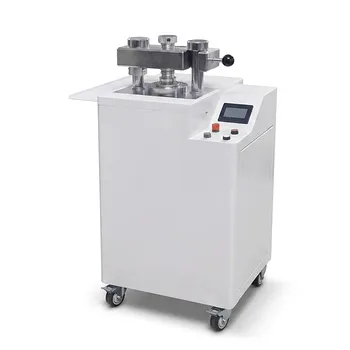
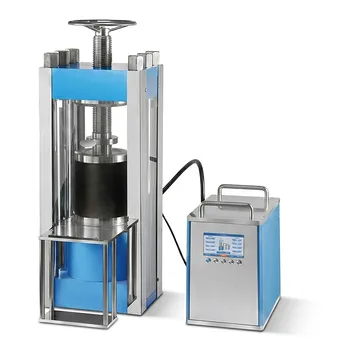
Utilizing a press to hermetically seal pans is achieved by applying direct mechanical force rather than heat or adhesives. By using a plunger to exert significant pressure on the assembly, you force the pan and its lid to fuse together physically.
The underlying mechanism is cold welding, where sufficient pressure creates a permanent, airtight bond between the container and the lid at the molecular level.
The Mechanics of the Seal
The Role of the Plunger
The central component in this process is the plunger.
To create a seal, the plunger is engaged to press down on the pan and lid combination.
Applying Pressure
The press functions by converting mechanical force into pressure.
This pressure is applied evenly across the contact points of the pan and lid.
Understanding Cold Welding
Unlike traditional sealing methods that melt materials, this process creates a cold weld.
The pressure effectively fuses the metal of the lid to the pan without introducing thermal energy.
This results in a unified structure rather than two separate pieces glued together.
The Resulting Seal Quality
Hermetic Integrity
The primary outcome of this process is a hermetic seal.
This means the container is made airtight and impervious to external contaminants.
Reliability
Because the seal is created through physical welding, it offers a high degree of durability.
The bond is integral to the material itself, reducing the risk of leaks associated with gaskets or glues.
Operational Considerations
Pressure Requirements
For cold welding to occur, the press must be capable of delivering specific, high-force pressure.
Insufficient pressure will result in a closed container, but not a true weld.
Irreversibility
It is important to understand that cold welding is generally a permanent joining technique.
Once the plunger applies the pressure and the weld forms, the lid cannot be removed without damaging or destroying the seal.
Making the Right Choice for Your Goal
This method is best suited for applications requiring absolute containment and sample integrity.
- If your primary focus is sample preservation: Rely on the cold weld to prevent oxidation or contamination from the outside environment.
- If your primary focus is process efficiency: Utilize the press for its ability to create instant seals without waiting for heating elements or adhesives to set.
By leveraging mechanical pressure to create a cold weld, you ensure a secure, hermetic environment for the contents of your pan.
Summary Table:
| Feature | Cold Welding (Press Sealing) | Traditional Sealing (Glues/Heat) |
|---|---|---|
| Mechanism | Mechanical pressure & molecular fusion | Thermal melting or adhesive bonding |
| Seal Type | Hermetic (Airtight/Contaminant-proof) | Temporary or semi-permanent |
| Heat Impact | Zero (Preserves heat-sensitive samples) | Potential thermal degradation |
| Durability | High (Integrated bond) | Variable (Risk of glue failure/leaks) |
| Speed | Instantaneous | Requires curing or cooling time |
Secure Your Samples with KINTEK Pressing Solutions
Ensure absolute sample integrity and prevent contamination with KINTEK’s advanced laboratory presses. Whether you are conducting sensitive battery research or material analysis, our comprehensive range—including manual, automatic, heated, and glovebox-compatible models—delivers the precise force required for flawless hermetic sealing and cold welding.
Ready to enhance your lab's efficiency and reliability? Contact KINTEK today to find the perfect cold or warm isostatic press tailored to your specific research needs.
Related Products
- Automatic Hydraulic Heat Press Machine with Multi Stage Programmable Control and Integrated Water Cooling Plate Size 180x180mm
- Warm Isostatic Press for Solid State Battery Research Warm Isostatic Press
- Automatic Heated Hydraulic Press Machine with Heated Plates for Laboratory
- Automatic Hydraulic Hot Press with Large Plate and Precision Temperature Control for Advanced Material Sample Preparation and Industrial Research
- Split Automatic Heated Hydraulic Press Machine with Heated Plates
People Also Ask
- How does a laboratory hydraulic heat press facilitate the molding of cellulose composite specimens? Precision Molding
- How is a hydraulic heat press used for sample preparation? Achieve Uniform, Void-Free Samples for Lab Analysis
- What is the role of a hydraulic heat press in material testing? Unlock Superior Data for Research & QC
- What is a hydraulic heat press? Discover Precision Material Bonding and Sample Preparation
- What are the industrial applications of a hydraulic heat press? Powering Lamination, Bonding, and R&D Efficiency