
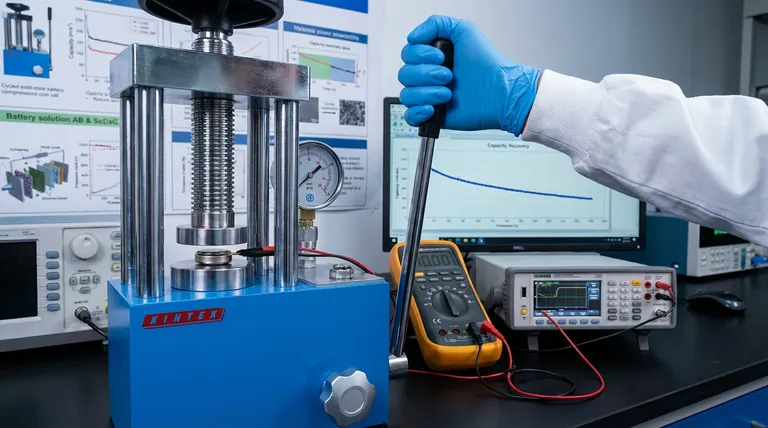
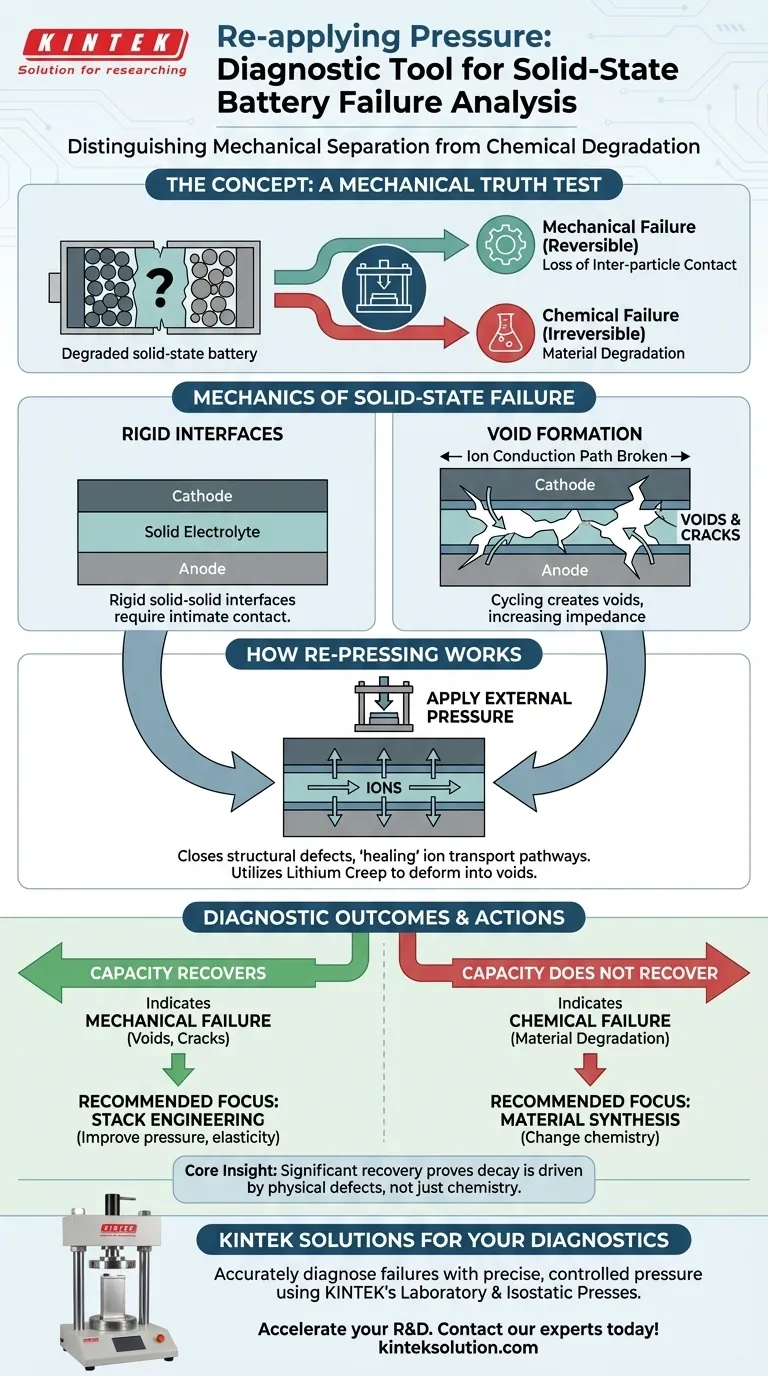
Re-applying external pressure serves as a mechanical "truth test" for solid-state batteries that have lost capacity over time. By compressing a degraded cell, researchers can differentiate between permanent chemical decomposition and reversible mechanical separation. If the battery's capacity is significantly restored after re-pressing, it confirms that the primary failure mode is loss of inter-particle contact rather than irreversible material degradation.
Core Insight Significant capacity recovery after re-pressing provides definitive proof that performance decay is driven by physical voids, cracks, and delamination. This diagnostic step isolates mechanical failure by demonstrating that ion conduction pathways can be re-established simply by closing structural defects.
The Mechanics of Solid-State Failure
To understand why this diagnostic works, one must first understand the unique environment inside a solid-state battery.
The Rigid Interface Challenge
Unlike liquid electrolytes, which flow to fill gaps, solid-state electrolytes create rigid solid-solid interfaces.
For ions to move, the cathode, anode, and electrolyte particles must maintain intimate physical contact. There is no fluid to bridge the gap if these components separate.
Void Formation During Cycling
During repeated charge and discharge cycles, the internal landscape of the battery changes physically.
Specifically, the stripping and deposition of lithium can create voids and cracks at the electrode-electrolyte interface.
As these voids grow, they break the continuous pathway required for ion transport, causing a spike in impedance and a drop in apparent capacity.
How Re-Pressing Diagnoses the Problem
Re-applying pressure acts as a toggle switch for ion conductivity, allowing you to isolate the root cause of failure.
Testing for Reversibility
When a battery fails, it is often unclear if the active materials have chemically degraded or simply become electrically isolated.
Re-pressing the cell applies force to the internal stack. If the capacity returns, the damage was mechanical and reversible.
If the capacity does not return, the failure is likely due to irreversible chemical changes or side reactions that pressure cannot fix.
Closing Structural Defects
High external pressure physically forces the separated layers back together.
This action closes the cracks and voids formed during cycling, effectively "healing" the ion transport pathways.
Utilizing Lithium Creep
Pressure takes advantage of the physical properties of lithium metal.
References indicate that maintaining or re-applying pressure utilizes the creep properties of lithium to plastically deform the metal into voids, ensuring seamless contact is regained.
Understanding the Trade-offs
While valuable, this diagnostic method must be interpreted with an understanding of the physical limitations involved.
Diagnostic vs. Solution
Re-applying pressure is an excellent tool for failure analysis, but it is not necessarily a viable operational solution for commercial cells.
If a battery requires massive pressure to function, it indicates a fundamental design weakness in the binding mechanism or stack pressure system.
The Risk of Over-compression
While pressure restores contact, excessive force can damage the solid electrolyte separator or deform the current collectors.
The goal is to restore the intimate contact achieved during initial assembly, not to crush the internal structure.
Applying This Diagnostic to Your Project
When analyzing a failed solid-state prototype, use the results of the re-pressing test to guide your next engineering steps.
- If your primary focus is Stack Engineering: A recovery in capacity indicates you must improve the external packaging pressure or internal elasticity to accommodate volume changes during cycling.
- If your primary focus is Material Synthesis: A lack of capacity recovery suggests the active materials or electrolyte have suffered chemical degradation, requiring a change in chemistry rather than mechanics.
By distinguishing between a broken connection and a broken chemistry, you stop solving the wrong problem.
Summary Table:
| Diagnostic Outcome | Indicated Failure Mode | Recommended Focus |
|---|---|---|
| Capacity Recovers | Mechanical (loss of contact, voids, cracks) | Stack Engineering, Pressure Systems |
| Capacity Does Not Recover | Chemical (irreversible material degradation) | Material Synthesis, Chemistry |
Need to accurately diagnose your solid-state battery failures? KINTEK specializes in laboratory press machines, including automatic lab presses and isostatic presses, which are essential for applying the precise, controlled pressure required for this diagnostic technique. Our equipment helps researchers like you isolate failure mechanisms and accelerate R&D. Contact our experts today to find the perfect press for your battery testing needs!
Visual Guide
Related Products
- Warm Isostatic Press for Solid State Battery Research Warm Isostatic Press
- Laboratory Hydraulic Press Lab Pellet Press Button Battery Press
- Button Battery Sealing Press Machine for Lab
- Lab Button Battery Tablet Press Sealing Mold
- Lab Infrared Press Mold for Laboratory Applications
People Also Ask
- Why must composite cathodes be sealed in vacuum lamination bags for WIP? Ensure Battery Stability and Density
- How do sacrificial volume materials (SVM) maintain microchannels in isostatic pressing? Ensure Structural Integrity
- What is the function of elastic molds in warm isostatic pressing? Achieve Uniform Density in Composite Particles
- What are the advantages of using a Warm Isostatic Press (WIP) for batteries? Achieve Superior Interface Contact
- What is the significance of temperature control in Warm Isostatic Pressing? Unlock Uniform Densification and Process Stability






