
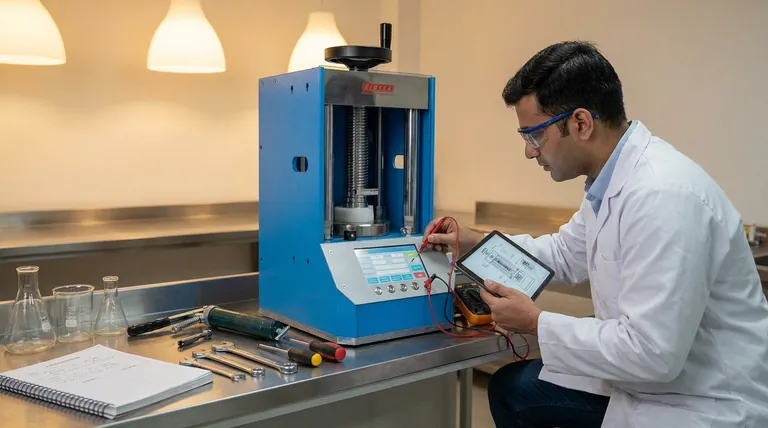
For any laboratory press, technical support is obtained by directly contacting the equipment's manufacturer or the supplier from whom you purchased it. These entities are your primary resource for both immediate troubleshooting assistance and for sourcing the necessary spare parts to ensure your press remains operational.
The key to minimizing downtime is not just knowing who to call, but understanding that effective support relies on a partnership with your provider for both reactive troubleshooting and proactive maintenance.
The Two Pillars of Technical Support
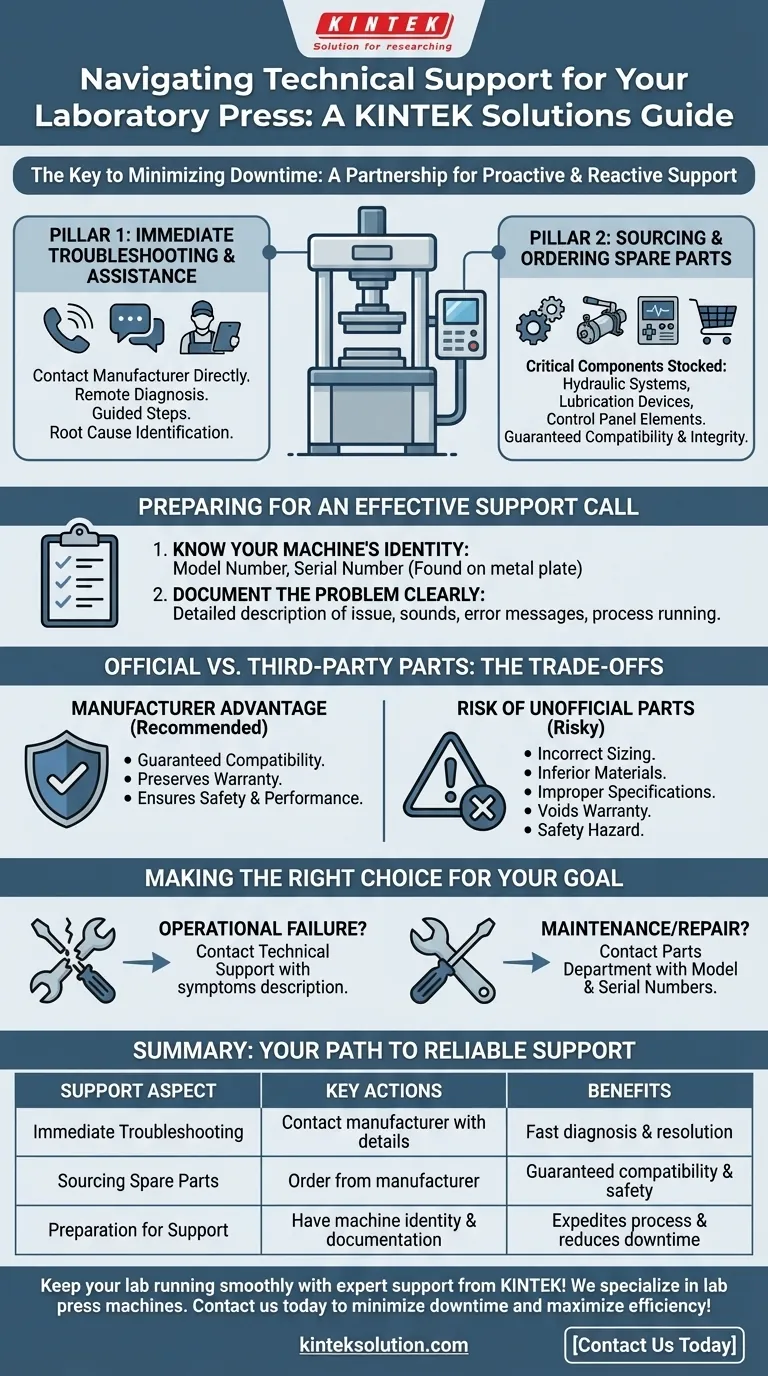
Resolving issues with a laboratory press typically falls into two categories: immediate assistance for operational problems and sourcing parts for repair or maintenance. Your manufacturer is the central point of contact for both.
Immediate Troubleshooting and Assistance
When your press malfunctions or you have operational questions, your first step is to contact the manufacturer's technical support team. They are equipped to diagnose problems remotely, guide you through troubleshooting steps, and help you identify the root cause of the issue.
Sourcing and Ordering Spare Parts
Over time, components will wear out. Manufacturers and suppliers maintain a stock of critical spare parts to ensure the long-term serviceability of their equipment.
You can order a range of components directly from them, including:
- Hydraulic system components
- Lubrication devices
- Control panel elements (buttons, screens, etc.)
By sourcing parts from the original manufacturer, you guarantee compatibility and maintain the integrity of your equipment.
Preparing for an Effective Support Call
To get the fastest and most accurate resolution, you must provide the support team with specific information. Having this ready before you make contact will significantly expedite the process.
Know Your Machine's Identity
The most critical pieces of information are the model number and serial number of your laboratory press. These are typically found on a metal plate affixed to the machine's frame. This allows the support team to access the exact specifications and history of your unit.
Document the Problem Clearly
Be prepared to describe the issue in detail. Note what happened, what sounds the machine made, any error messages on the display, and what process was being run when the problem occurred. The more detail you can provide, the faster the diagnosis will be.
Understanding the Trade-offs: Official vs. Third-Party Parts
While the manufacturer is the recommended source, it's important to understand why. The decision of where to source parts has direct consequences for safety and reliability.
The Manufacturer Advantage: Guaranteed Compatibility
When you order from the manufacturer or their authorized supplier, you receive parts that are guaranteed to be correct for your specific model. This eliminates the risk of incompatibility, ensures proper performance, and often keeps your equipment's warranty intact.
The Risk of Unofficial Parts
Sourcing components from a third-party supplier can be risky. You may face issues with incorrect sizing, inferior materials, or improper specifications that could lead to further equipment damage or, worse, a safety hazard. Using unofficial parts almost always voids any existing warranty.
Making the Right Choice for Your Goal
Your path to a solution depends on the nature of your need. Always start by identifying your equipment's model and serial number.
- If your primary focus is resolving an operational failure: Contact the manufacturer's technical support line prepared to describe the symptoms of the problem in detail.
- If your primary focus is performing maintenance or a known repair: Contact the manufacturer's parts department with your model and serial number to order the exact components required for the job.
Following this structured approach ensures you receive the correct support and parts efficiently, keeping your laboratory equipment in reliable working order.
Summary Table:
| Support Aspect | Key Actions | Benefits |
|---|---|---|
| Immediate Troubleshooting | Contact manufacturer with model/serial numbers and issue details | Fast diagnosis and resolution of operational problems |
| Sourcing Spare Parts | Order from manufacturer for components like hydraulic systems and control panels | Guaranteed compatibility, safety, and warranty preservation |
| Preparation for Support | Have machine identity and problem documentation ready | Expedites support process and reduces downtime |
Keep your lab running smoothly with expert support from KINTEK! We specialize in lab press machines, including automatic lab presses, isostatic presses, and heated lab presses, serving all your laboratory needs. Our technical team ensures quick troubleshooting and provides genuine spare parts for reliable performance. Contact us today to minimize downtime and maximize efficiency!
Visual Guide
Related Products
- Laboratory Hydraulic Press 2T Lab Pellet Press for KBR FTIR
- Laboratory Hydraulic Press Lab Pellet Press Button Battery Press
- Laboratory Hydraulic Press Lab Pellet Press Machine for Glove Box
- Laboratory Split Manual Heated Hydraulic Press Machine with Hot Plates
- Laboratory Hydraulic Pellet Press for XRF KBR FTIR Lab Press
People Also Ask
- What is the role of a laboratory pressure machine and KBr in FTIR? Master Sample Preparation for Flame Retardants
- What is the role of a laboratory hydraulic press in high-loading NCM811 cathode prep for solid-state batteries?
- Why is a laboratory hydraulic press necessary for sample preparation? Precise Pelleting for Spiro Heterocyclic Analysis
- What role does a laboratory hydraulic press play in reaction pellets? Optimizing Lunar Soil and Metal Fuel Density
- Why is a laboratory hydraulic press considered essential for DFC solid-state batteries? Unlocking Interface Efficiency



















