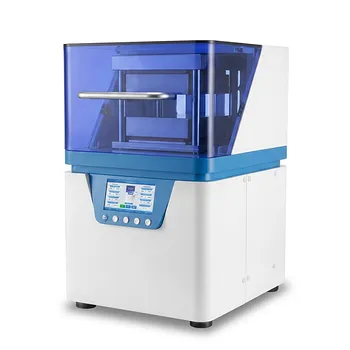
To calculate the applied force, you must multiply the pressure reading by the effective area of the ram piston. Although some sources may suggest dividing, the laws of physics dictate that Force equals Pressure multiplied by Area ($F = P \times A$). The gauge displays the internal intensity of the hydraulic fluid, which is then translated into total force as it pushes against the surface area of the press ram.
While the gauge tells you the pressure of the oil, the size of the ram determines the work it can do. To find the total force, you must identify the effective surface area of the cylinder and multiply it by the pressure reading.
The Core Formula
The Relationship Between Pressure and Force
A hydraulic press operates on Pascal's principle. The pressure gauge indicates how much force is being applied to a single unit of area (such as one square inch).
To get the total force, you must sum up that pressure across the entire surface of the piston. Therefore, the calculation is Force = Pressure $\times$ Area.
Why Division is Incorrect
It is critical to correct a common misconception found in some documentation. You do not divide pressure by area.
Dividing pressure by area would result in a nonsensical unit. Multiplying them ensures that the area units cancel out, leaving you with a unit of force (such as Pounds or Newtons).
Identifying Your Variables
Reading the Pressure ($P$)
Your gauge provides the first half of the equation. Note the specific unit of measurement displayed on the dial.
Common units include psi (pounds per square inch), bar, or MPa (megapascals).
Finding the Effective Area ($A$)
This is the variable most users miss. The "effective area" refers to the surface area of the piston (ram) inside the cylinder that the oil pushes against.
This information is often listed in the press manual under technical specifications. If the manual is unavailable, you can calculate it by measuring the bore diameter of the cylinder and using the formula $Area = \pi \times radius^2$.
Managing Unit Consistency
Working with Imperial Units (PSI)
If your gauge reads in psi, you must calculate the ram area in square inches.
Multiplying these gives you the force in pounds-force. You can then divide by 2,000 to convert that figure into Tons.
Working with Metric Units (MPa)
If your gauge reads in MPa, you should calculate the area in square meters.
Multiplying these gives you the force in MegaNewtons (or Newtons). Ensure you are consistent with your decimal places to avoid massive calculation errors.
Common Pitfalls to Avoid
Confusing Rod vs. Bore
A common mistake is measuring the chrome rod extending from the cylinder.
The rod is usually smaller than the actual piston inside the cylinder. Using the rod diameter will result in a calculation that underestimates your true force. Always use the cylinder bore diameter.
Ignoring Friction Losses
The calculated force is the "theoretical" force.
In reality, seal friction and mechanical resistance typically reduce the actual output by a small percentage (often 1-5%). For precise calibration, this loss must be considered.
Making the Right Calculation for Your Goal
To accurately determine the tonnage of your press, follow the path that matches your available data:
- If your primary focus is Imperial (PSI): Multiply the gauge pressure (psi) by the ram area (sq in) to get pounds of force.
- If your primary focus is Metric (MPa): Multiply the gauge pressure (MPa) by the ram area (sq mm) and adjust the decimal to find Newtons.
- If your primary focus is Safety/Limits: Always use the manufacturer's specified effective area from the manual rather than manual measurements to ensure maximum accuracy.
The gauge measures the effort, but the ram size dictates the impact.
Summary Table:
| Variable | Symbol | Common Units | How to Obtain |
|---|---|---|---|
| Pressure | P | psi, MPa, bar | Read directly from the pressure gauge |
| Effective Area | A | sq in, sq mm | Find in manual or calculate from cylinder bore |
| Applied Force | F | Tons, lbs, Newtons | Multiply Pressure (P) by Effective Area (A) |
| Conversion | - | - | Divide lbs by 2,000 to get US Tons |
Precision Engineering for Your Research Success
Don't let calculation errors compromise your material science results. KINTEK specializes in comprehensive laboratory pressing solutions designed for accuracy and durability. Whether you require manual, automatic, heated, or multifunctional presses, or specialized cold and warm isostatic presses for advanced battery research, our equipment provides the consistency your lab demands.
Ready to elevate your lab's performance? Our technical experts are here to help you select the perfect press and provide the support you need for precise force applications.
Contact KINTEK Today to Find Your Solution
Related Products
- Automatic Hydraulic Hot Press with Large Plate and Precision Temperature Control for Advanced Material Sample Preparation and Industrial Research
- Automatic Hydraulic Heat Press Machine with Multi Stage Programmable Control and Integrated Water Cooling Plate Size 180x180mm
- Automatic High Temperature Heated Hydraulic Press Machine with Heated Plates for Lab
- Automatic Heated Hydraulic Lab Press with Programmable Touch Screen Controls and Precision Temperature Regulation
- Manual Heated Hydraulic Lab Press with Integrated Hot Plates Hydraulic Press Machine
People Also Ask
- What are the specific features and applications of hydraulic hot press machines? Precision Solutions for Modern Labs
- How does an automatic hydraulic press operate? Achieve Precision and Consistency in Lab Pelleting
- What are the advantages and common applications of an automatic hydraulic press? Elevate Your Lab's Precision
- What is the technical significance of setting a precise dwell time? Achieve Peak Material Density and Stability
- When is an automatic hydraulic press more suitable than a manual press? Scale Your Lab with Precision & Speed