
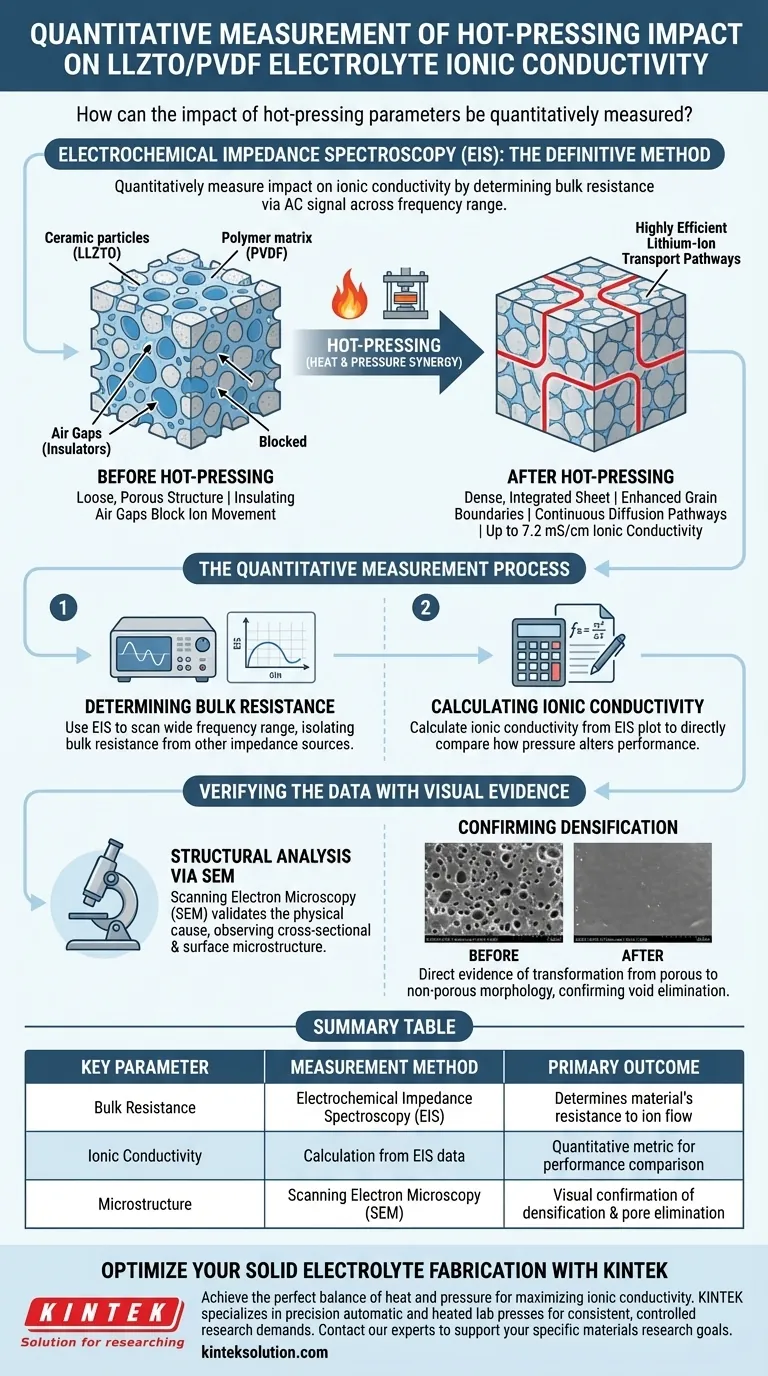
Electrochemical Impedance Spectroscopy (EIS) is the definitive method for quantitatively measuring the impact of hot-pressing parameters on ionic conductivity. By applying a small AC signal across a wide frequency range, this technique determines the material's bulk resistance, which is then used to calculate the specific ionic conductivity relative to the pressure and temperature applied.
The core objective of hot-pressing is to eliminate insulating air gaps within the electrolyte. EIS serves as the quantitative feedback loop, translating physical densification into measurable improvements in lithium-ion transport performance.
The Quantitative Measurement Process
Determining Bulk Resistance
To evaluate the electrolyte, you cannot simply measure DC resistance. You must use Electrochemical Impedance Spectroscopy (EIS).
This technique scans a wide frequency range to isolate the bulk resistance of the material from other impedance sources.
Calculating Ionic Conductivity
Once the bulk resistance is identified via the EIS plot, you can calculate the ionic conductivity.
This calculation provides the metric needed to directly compare how different hot-pressing pressures alter the final performance of the LLZTO/PVDF electrolyte.
The Mechanism of Improvement
Eliminating Insulating Gaps
The primary reason pressure affects conductivity is the reduction of porosity.
Before hot-pressing, the membrane is often a loose, porous structure containing air gaps. These gaps act as insulators, blocking the movement of ions.
Enhancing Grain Boundaries
Hot-pressing applies both heat and pressure to create a dense, integrated sheet.
This improves the physical bonding at grain boundaries between the ceramic particles and the polymer matrix.
Creating Diffusion Pathways
The improved contact establishes continuous, highly efficient pathways for lithium-ion transport.
This structural integration can increase ionic conductivity by several orders of magnitude, potentially reaching values as high as 7.2 mS/cm.
Verifying the Data with Visual Evidence
Structural Analysis via SEM
While EIS provides the numerical conductivity, Scanning Electron Microscopy (SEM) validates the physical cause.
SEM allows you to observe the cross-sectional and surface microstructure of the electrolyte membrane.
Confirming Densification
A comparison of SEM images before and after processing provides direct evidence of the transformation.
You should look for the shift from a porous, loose structure to a non-porous, dense morphology, confirming that voids have been successfully eliminated.
Understanding the Process Trade-offs
The Necessity of Densification
The relationship between pressure and conductivity is not incidental; it is critical.
Without sufficient hot-pressing, the presence of voids prevents the electrolyte from achieving practical conductivity levels.
The Synergy of Heat and Pressure
Pressure alone is rarely sufficient. The process relies on the combination of thermal energy and mechanical force.
This synergy is required to flow the polymer matrix around the ceramic particles, ensuring the complete removal of insulating air gaps.
Making the Right Choice for Your Goal
To optimize your LLZTO/PVDF electrolyte fabrication, apply the following approach:
- If your primary focus is optimizing transport performance: Use EIS to iteratively test different pressures, identifying the exact parameter set that minimizes bulk resistance.
- If your primary focus is process validation: Use SEM to visually confirm that your chosen parameters are sufficient to close all porous voids and fully densify the membrane.
Successful optimization requires correlating the numerical gain in conductivity directly to the physical elimination of microstructure porosity.
Summary Table:
| Key Parameter | Measurement Method | Primary Outcome |
|---|---|---|
| Bulk Resistance | Electrochemical Impedance Spectroscopy (EIS) | Determines material's resistance to ion flow |
| Ionic Conductivity | Calculation from EIS data | Quantitative metric for performance comparison |
| Microstructure | Scanning Electron Microscopy (SEM) | Visual confirmation of densification and pore elimination |
Optimize Your Solid Electrolyte Fabrication with KINTEK
Are you developing LLZTO/PVDF or other solid-state electrolytes? Achieving the perfect balance of heat and pressure is critical for maximizing ionic conductivity. KINTEK specializes in precision lab press machines, including automatic lab presses and heated lab presses, designed to deliver the consistent, controlled pressure and temperature your research demands.
Our equipment helps researchers like you eliminate insulating voids and create dense, highly conductive membranes. Whether you're optimizing hot-pressing parameters for academic publication or scaling up for pilot production, KINTEK provides the reliable tools you need to succeed.
Ready to enhance your electrolyte performance? Contact our experts today to discuss how our lab presses can support your specific materials research goals.
Visual Guide
Related Products
- Automatic High Temperature Heated Hydraulic Press Machine with Heated Plates for Lab
- Heated Hydraulic Press Machine with Heated Plates for Vacuum Box Laboratory Hot Press
- Automatic Heated Hydraulic Press Machine with Hot Plates for Laboratory
- Heated Hydraulic Press Machine With Heated Plates For Vacuum Box Laboratory Hot Press
- Laboratory Split Manual Heated Hydraulic Press Machine with Hot Plates
People Also Ask
- Function of a Laboratory Hydraulic Press with Heated Platens in SSE? Enhance Battery Density & Conductivity
- How does a laboratory heated hydraulic press facilitate PBN sample prep for WAXS? Achieve Precise X-Ray Scattering
- What are the requirements for electrode pressing with high-viscosity ionic liquids like EMIM TFSI? Optimize Performance
- What are the industrial applications of heated hydraulic presses? Master Heat & Force for Precision Manufacturing
- Why is a laboratory hydraulic press with heating plates required for PLA/TEC films? Achieve Precise Sample Integrity



















