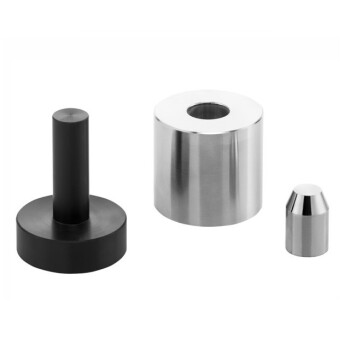
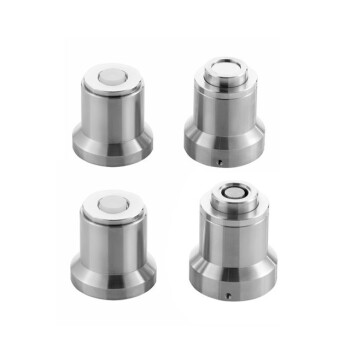
Dedicated battery fixtures are the critical mechanical enablers of sulfide all-solid-state battery testing. They function by applying a stable, constant axial pressure—often reaching levels such as 75 MPa—to actively compensate for the significant volume expansion and contraction that electrode materials undergo during charge and discharge cycles.
Core Takeaway unlike liquid electrolytes that flow to fill gaps, solid electrolytes require physical force to maintain connectivity. Dedicated fixtures provide continuous mechanical compensation to prevent the internal layers from separating, ensuring that the solid-solid interfaces remain intact even as the battery "breathes" during operation.
The Mechanics of Interface Stability
Counteracting Volume Changes
During the intercalation and de-intercalation of ions (charging and discharging), active materials in the battery physically swell and shrink. Without external constraints, this movement would cause the internal structure to loosen. Dedicated fixtures apply constant pressure to mechanically "follow" this expansion, keeping the stack compressed.
Preventing Delamination
The interface between the electrode and the solid electrolyte is the most vulnerable point in these batteries. If pressure is lost, the layers can physically separate (delaminate). Fixtures ensure these solid-solid contacts remain fused, preventing the battery from failing due to internal disconnection.
Inhibiting Void Formation
As lithium is stripped from the anode, microscopic vacancies or voids can form at the interface. Accumulated voids lead to a loss of contact and increased resistance. Continuous axial pressure forces the material to collapse into these voids, maintaining a dense, active interface.
Improving Electrochemical Performance
Stabilizing Ion Transport
For a solid-state battery to function, ions must physically hop from particle to particle. By maintaining intimate contact between the cathode, anode, and electrolyte, fixtures ensure the ion transport pathways remain unbroken. This stability is essential for maintaining performance during high-current cycling.
Reducing Interfacial Resistance
Loose contact between layers creates high electrical resistance, wasting energy as heat. Firm, uniform pressure significantly lowers this interfacial resistance. This leads to higher coulombic efficiency and better overall energy throughput.
Suppressing Dendrite Growth
Sustained pressure plays a chemical as well as a mechanical role. It effectively suppresses the growth of lithium dendrites (metal spikes). By minimizing the space available for dendrites to form, pressure reduces the risk of these spikes penetrating the electrolyte and causing short circuits.
Understanding the Trade-offs
The Risk of Low Pressure
If the applied pressure is too low (typically below 5 MPa), the fixture cannot overcome the internal stress of the materials. This results in poor contact, rapid impedance growth, and premature battery failure.
The Danger of Excessive Pressure
While the primary reference notes pressure up to 75 MPa can be used, higher pressures introduce risks. Excessive force can cause soft lithium metal to deform and squeeze into microscopic cracks in the electrolyte. This deformation can lead to internal short circuits, highlighting the need for precise optimization rather than simply maximizing pressure.
Making the Right Choice for Your Goal
To maximize the utility of your testing fixtures, align the pressure strategy with your specific development objectives:
- If your primary focus is Cycle Life: Maintain a moderate, constant pressure (e.g., 20–30 MPa) to prevent delamination and void formation without over-stressing the electrolyte.
- If your primary focus is Safety and Reliability: strictly limit the upper pressure bounds to avoid forcing lithium infiltration, which can cause sudden short circuits during testing.
By treating mechanical pressure as a controllable variable rather than a static condition, you can stabilize the internal architecture of sulfide solid-state batteries and unlock their true performance potential.
Summary Table:
| Mechanism | Impact on Battery Performance |
|---|---|
| Volume Compensation | Actively manages electrode expansion/contraction during cycling |
| Interface Stability | Prevents physical delamination between electrolyte and electrode |
| Void Inhibition | Collapses vacancies at the anode to maintain dense contact |
| Dendrite Suppression | Minimizes space for lithium spikes to penetrate the electrolyte |
| Resistance Control | Significantly lowers interfacial resistance for higher efficiency |
Maximize Your Battery Research Precision with KINTEK
Maintaining stable mechanical pressure is the key to unlocking the potential of next-generation energy storage. At KINTEK, we specialize in comprehensive laboratory pressing solutions designed for the rigorous demands of all-solid-state battery research.
Whether you require manual, automatic, heated, or glovebox-compatible models, our specialized fixtures and presses—including cold and warm isostatic options—provide the constant axial pressure needed to stabilize interfaces and prevent delamination.
Ready to elevate your testing accuracy? Contact KINTEK today to find the perfect pressing solution for your lab's specific needs.
References
- Ji Young Kim, H. Alicia Kim. Design Parameter Optimization for Sulfide-Based All-Solid-State Batteries with High Energy Density. DOI: 10.2139/ssrn.5376190
This article is also based on technical information from Kintek Solution Knowledge Base .
Related Products
- Warm Isostatic Press for Solid State Battery Research Warm Isostatic Press
- Lab Infrared Press Mold for Laboratory Applications
- Lab Cylindrical Press Mold for Laboratory Use
- Lab Button Battery Tablet Press Sealing Mold
- Carbide Lab Press Mold for Laboratory Sample Preparation
People Also Ask
- Why must composite cathodes be sealed in vacuum lamination bags for WIP? Ensure Battery Stability and Density
- How do sacrificial volume materials (SVM) maintain microchannels in isostatic pressing? Ensure Structural Integrity
- What is the function of elastic molds in warm isostatic pressing? Achieve Uniform Density in Composite Particles
- What is the mechanism of a Warm Isostatic Press (WIP) on cheese? Master Cold Pasteurization for Superior Safety
- What are the advantages of using a Warm Isostatic Press (WIP) for batteries? Achieve Superior Interface Contact