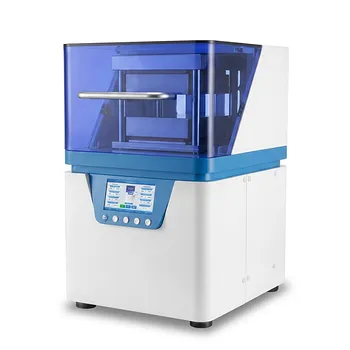
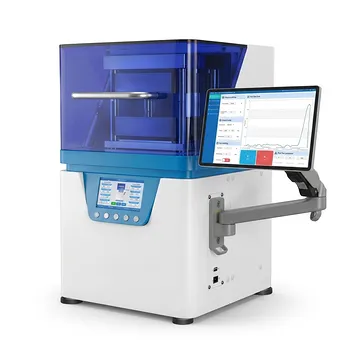
Hydraulic presses are fundamental instruments in material science, serving as both rigorous testing environments and precision preparation tools. They contribute to research by applying controlled high pressure to investigate how materials behave under extreme stress, while simultaneously providing the mechanical force necessary to create uniform powder mixtures for accurate compositional analysis.
Core Takeaway The hydraulic press acts as a bridge between theoretical material science and practical application. Its value lies in its versatility: it can destroy a sample to measure its limits (testing) or compress it with perfect uniformity to facilitate further chemical analysis (preparation).
Analyzing Material Behavior Under Stress
Evaluating Strength and Durability
One of the primary functions of a hydraulic press in research is to assess the structural integrity of materials. By subjecting substances to high pressure, researchers can determine critical mechanical properties.
This includes measuring elasticity, plasticity, and fracture points. Understanding these limits is essential for predicting how a material will perform in real-world engineering or construction scenarios.
Assessing Manufacturing Performance
Beyond raw strength, presses allow researchers to simulate specific manufacturing challenges. For example, they are used to test blocking resistance in print materials.
This test measures a material's tendency to adhere to itself under pressure. It ensures that laminates, rubbers, and plastics will not fail or fuse incorrectly during production or storage.
Simulating Extreme Environments
Combining Heat and Pressure
Advanced research often requires more than just mechanical force; it requires the simulation of complex environmental variables. Heated hydraulic presses are employed to evaluate materials under the dual strain of high pressure and high temperature.
This capability is crucial for investigating how substances degrade, harden, or deform under extreme conditions. It provides the data necessary to innovate materials for aerospace, automotive, and industrial applications where heat and pressure are constant factors.
Precision Sample Preparation
Ensuring Uniform Distribution
According to the primary reference, a critical contribution of the hydraulic press is preparing powder mixtures for compositional analysis.
To analyze a material accurately, its components must be distributed evenly. The press compacts these mixtures into a solid state, ensuring the sample is uniform throughout.
Facilitating Spectroscopy
In analytical chemistry, specifically for techniques like FTIR spectroscopy, sample quality dictates result quality. Hydraulic presses produce uniform pellets that allow for consistent light transmission.
Without the ability to produce these repeatable, high-quality samples, advanced chemical analysis would yield unreliable data.
The Importance of Consistency
Repeatability as a Standard
In research, a result is only valuable if it can be repeated. Hydraulic presses are favored because they offer consistent pressure application.
This mechanical consistency removes human error from the equation. It ensures that whether a researcher is testing fracture points or creating a test pellet, the conditions remain identical across every trial.
Making the Right Choice for Your Goal
Depending on your specific research focus, the role of the hydraulic press changes from a destructive testing tool to a constructive preparation tool.
- If your primary focus is Physical Durability: Prioritize a press capable of simulating extreme pressure and temperature to identify elasticity limits and fracture points.
- If your primary focus is Chemical Analysis: Focus on the press's ability to deliver consistent, uniform compaction to create defect-free pellets for spectroscopy.
Ultimately, the hydraulic press transforms raw material data into actionable engineering insights.
Summary Table:
| Application Category | Key Functions | Research Benefit |
|---|---|---|
| Mechanical Testing | Stress, elasticity, and fracture analysis | Determines structural limits and durability |
| Manufacturing Simulation | Blocking resistance and adhesion testing | Ensures material performance during production |
| Environmental Simulation | Combined high heat and high pressure | Evaluates performance in extreme conditions |
| Sample Preparation | Uniform powder compaction and pelletizing | Facilitates accurate FTIR and chemical analysis |
Elevate Your Material Research with KINTEK
Precision is the backbone of scientific discovery. KINTEK specializes in comprehensive laboratory pressing solutions designed to meet the rigorous demands of modern material science. Whether you are conducting breakthrough battery research or routine compositional analysis, our versatile range of equipment provides the reliability you need:
- Manual & Automatic Presses: For consistent, repeatable sample preparation.
- Heated & Multifunctional Models: To simulate complex environmental stresses.
- Isostatic Presses (Cold & Warm): For achieving maximum material density and uniformity.
- Glovebox-Compatible Systems: For specialized research in controlled environments.
Ready to transform your raw data into actionable engineering insights? Contact KINTEK today to find the perfect press for your laboratory.
Related Products
- Automatic Hydraulic Hot Press with Large Plate and Precision Temperature Control for Advanced Material Sample Preparation and Industrial Research
- Automatic Hydraulic Heat Press Machine with Multi Stage Programmable Control and Integrated Water Cooling Plate Size 180x180mm
- Automatic High Temperature Heated Hydraulic Press Machine with Heated Plates for Lab
- Automatic Heated Hydraulic Lab Press with Programmable Touch Screen Controls and Precision Temperature Regulation
- Manual Heated Hydraulic Lab Press with Integrated Hot Plates Hydraulic Press Machine
People Also Ask
- What are the specific features and applications of hydraulic hot press machines? Precision Solutions for Modern Labs
- How does an automatic hydraulic press operate? Achieve Precision and Consistency in Lab Pelleting
- What are the advantages and common applications of an automatic hydraulic press? Elevate Your Lab's Precision
- What is the technical significance of setting a precise dwell time? Achieve Peak Material Density and Stability
- When is an automatic hydraulic press more suitable than a manual press? Scale Your Lab with Precision & Speed