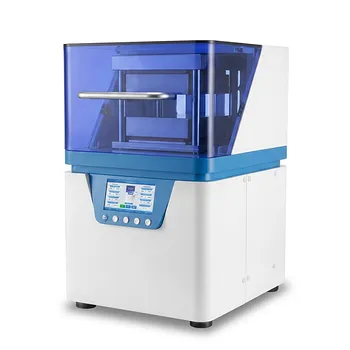
Hydraulic presses act as the catalyst for material innovation by applying immense, precisely controlled pressure to alter the physical structure of substances.
They contribute to the creation of new materials primarily by synthesizing superhard materials—substances valued for their exceptional resistance to wear and heat—and by facilitating the bonding of complex composites used in high-performance industries like aerospace and automotive.
The Core Mechanism
Innovation in material science often requires conditions that mimic extreme natural environments. Hydraulic presses provide the controlled high pressure necessary to force atomic structures into new configurations or bond distinct layers together, creating materials with properties that are impossible to achieve under standard atmospheric conditions.
The Physics of Innovation: Creating Unique Properties
To understand how a machine known for crushing can actually create, you must look at how pressure changes material behavior at a fundamental level.
Synthesizing Superhard Materials
The primary contribution of hydraulic presses to material science is the ability to generate extreme pressure environments.
By subjecting raw materials to high-pressure conditions, researchers can produce superhard materials. These substances possess unique properties, such as extreme hardness and high thermal resistance, making them critical for industrial cutting tools, electronics, and drilling equipment.
Bonding and Curing Composites
Beyond synthesis, hydraulic presses are essential for creating composite materials.
Using heated hydraulic plates, manufacturers can bond layers of different materials—such as wood, plastic, or rubber—or cure resins to create a unified product. This process is vital for producing durable industrial components like conveyor belts and furniture elements.
Lightweight Structural Development
In advanced engineering sectors, presses are used to develop lightweight composite structures.
These materials are crucial for the aerospace and automotive industries, specifically for creating unmanned aircraft structures and sports car bodies. The press allows for the development of cost-effective manufacturing technologies that reduce weight without sacrificing structural integrity.
The Role of Precision in Research
Creating a new material is not just about crushing it; it is about reproducibility.
Standardizing Experimental Samples
Laboratory presses, including isostatic presses, are used to compress experimental powders (such as carbonaceous precursors) into high-strength "green bodies."
This process prepares powder mixtures for compositional analysis, ensuring a uniform distribution of components. Without this uniformity, the resulting material would be inconsistent and unusable.
Ensuring Scientific Validity
For a new material to be scientifically validated, its production must be repeatable.
Hydraulic presses provide a stable and repeatable pressure environment. By precisely controlling compaction pressure and duration, researchers create samples with standardized density. This consistency allows for accurate study of physical properties, such as thermal expansion and radiation resistance.
Understanding the Trade-offs
While hydraulic presses are powerful tools for creation, they require rigorous management of variables to be effective.
The Necessity of Controlled Force
The "more is better" approach does not apply here. Applying excessive force can destroy the internal structure of a sample rather than strengthening it, while insufficient pressure leads to weak bonding or inconsistent densities in composites.
Equipment Specificity
Not all presses serve the same function. A press designed for forging metal operates differently than a heated press used for curing resin. Misapplying the equipment type—for example, using a standard press when an isostatic press is needed for uniform density—will result in flawed material data.
Making the Right Choice for Your Goal
Selecting the right hydraulic application depends entirely on the specific material properties you are trying to isolate or create.
- If your primary focus is synthesizing superhard materials: Prioritize presses capable of generating extreme, sustained high-pressure environments to alter atomic structures.
- If your primary focus is manufacturing composites: Ensure your equipment includes thermal capabilities (heated plates) to facilitate the curing and bonding of resins and layers.
- If your primary focus is material research and data validity: Focus on laboratory presses that offer high precision and repeatability to ensure standardized sample density.
Hydraulic presses bridge the gap between theoretical chemistry and physical reality, turning raw concepts into tangible, high-performance materials.
Summary Table:
| Application | Mechanism | Resulting Material |
|---|---|---|
| Superhard Synthesis | Extreme High-Pressure | Industrial diamonds, high-thermal resistors |
| Composite Bonding | Heated hydraulic plates | Aerospace components, lightweight structures |
| Powder Compaction | Uniform pressure (Isostatic) | High-strength 'green bodies' for analysis |
| Curing & Layering | Controlled force & heat | Durable industrial resins, automotive bodies |
Transform Your Material Research with KINTEK
At KINTEK, we specialize in providing comprehensive laboratory pressing solutions designed for the most demanding research environments. Whether you are synthesizing next-generation superhard materials or developing lightweight composites for the aerospace industry, our equipment delivers the precision and repeatability your work requires.
Our value to your laboratory:
- Versatile Solutions: Choose from manual, automatic, and heated models tailored for specific material curing and bonding tasks.
- Advanced Engineering: High-performance multifunctional and glovebox-compatible presses for sensitive research.
- Specialized Pressing: Industry-leading cold and warm isostatic presses ideal for battery research and achieving uniform density in powder mixtures.
Ready to elevate your material innovation? Contact us today to find the perfect pressing solution and see how KINTEK can bring your theoretical chemistry into physical reality.
Related Products
- Automatic Hydraulic Hot Press with Large Plate and Precision Temperature Control for Advanced Material Sample Preparation and Industrial Research
- Automatic Hydraulic Heat Press Machine with Multi Stage Programmable Control and Integrated Water Cooling Plate Size 180x180mm
- Automatic High Temperature Heated Hydraulic Press Machine with Heated Plates for Lab
- Automatic Heated Hydraulic Lab Press with Programmable Touch Screen Controls and Precision Temperature Regulation
- Manual Heated Hydraulic Lab Press with Integrated Hot Plates Hydraulic Press Machine
People Also Ask
- What are the specific features and applications of hydraulic hot press machines? Precision Solutions for Modern Labs
- How does an automatic hydraulic press operate? Achieve Precision and Consistency in Lab Pelleting
- What are the advantages and common applications of an automatic hydraulic press? Elevate Your Lab's Precision
- What is the technical significance of setting a precise dwell time? Achieve Peak Material Density and Stability
- When is an automatic hydraulic press more suitable than a manual press? Scale Your Lab with Precision & Speed