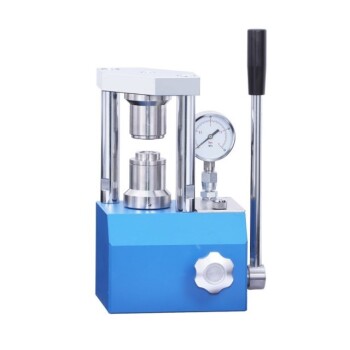
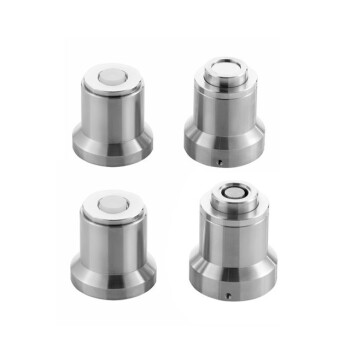
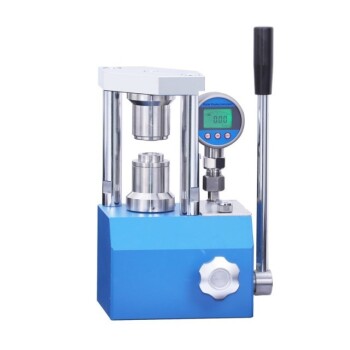
Precision control of mechanical pressure is the decisive factor in ensuring performance consistency for lithium/gel electrolyte/LFP batteries. By applying a constant and exact force during the sealing or pressing process, these machines standardize the internal environment of the battery, minimizing variables that lead to data noise.
Core Takeaway Reliable battery performance relies on eliminating the physical gaps between components. Laboratory presses ensure consistency by creating intimate interfacial contact to lower impedance, while simultaneously forming a hermetic seal to prevent electrolyte loss and anode corrosion.
Optimizing the Electrode-Electrolyte Interface
The primary function of a laboratory press in this context is to standardize the physical connection between the distinct layers of the battery.
Reducing Interfacial Impedance
For a gel polymer electrolyte system, the interface between the lithium anode, the gel membrane, and the LFP cathode is the most critical area.
Without sufficient pressure, microscopic gaps remain between these layers. These gaps create high electrical resistance (impedance), hampering the flow of ions.
Enhancing Charge Transfer
A hydraulic press applies sufficient force to maximize the surface area contact between the solid electrodes and the gel electrolyte.
This tight contact reduces the interfacial charge transfer resistance, allowing lithium ions to move freely and efficiently.
Standardizing Ion Distribution
When the pressure is applied uniformly, the distance between the anode and cathode becomes consistent across the entire cell surface.
This promotes a uniform current density, preventing "hot spots" where ions might pile up, which is essential for accurate, repeatable cycle capacity measurements.
Environmental Isolation and Stability
Beyond mechanical contact, sealing machines play a chemical protection role that directly impacts consistency.
Preventing Electrolyte Evaporation
In gel-based systems, the solvent within the polymer matrix is prone to evaporation if the cell is not sealed perfectly.
A high-precision sealing machine crimps the coin cell or seals the pouch to create an airtight enclosure. This prevents the drying out of the electrolyte, which would otherwise cause a rapid degradation in performance during long-term cycling.
Protecting the Lithium Anode
Lithium metal is highly reactive to moisture and oxygen. Even trace amounts of air entering the cell can corrode the anode.
A hermetic seal acts as a barrier against moisture ingress, ensuring that the chemical reactions observed are purely electrochemical and not side reactions caused by contamination.
The Impact on Long-Term Data
The consistency provided by these machines is most visible during extended testing periods.
Improving Cycle Life Repeatability
By maintaining constant encapsulation pressure, the machine ensures that the internal components do not delaminate (separate) over time.
This mechanical stability is necessary for achieving high coulombic efficiency and stable capacity retention over hundreds or thousands of hours.
Suppressing Dendrite Growth
Tight, uniform pressure helps suppress the formation of lithium dendrites—needle-like structures that grow on the anode.
By physically constraining the anode surface, the press promotes smoother lithium deposition, preventing short circuits and extending the usable life of the battery.
Understanding the Trade-offs
While pressure is vital, it must be calibrated correctly to avoid damaging the cell.
The Risk of Over-Compression
Applying excessive pressure can crush the porous structure of the separator or the gel membrane.
This can lead to internal short circuits or effectively "squeeze out" the liquid component of the gel, creating high-resistance dry spots.
The Risk of Under-Compression
If the pressure is too low, the contact between layers will be insufficient.
This results in high internal resistance and poor rate capability, making the battery appear less powerful than it actually is due to poor assembly rather than chemistry.
Making the Right Choice for Your Goal
To ensure your data is a true reflection of your chemistry and not your assembly process, consider the following:
- If your primary focus is Cycle Life Stability: Prioritize a machine with high-precision hermetic sealing capabilities to prevent moisture ingress and electrolyte evaporation over long durations (e.g., 2000+ hours).
- If your primary focus is Rate Capability/Power: Prioritize a hydraulic press that offers highly uniform pressure distribution to minimize interfacial impedance and ensure rapid ion transfer.
Consistency in assembly leads to confidence in your data.
Summary Table:
| Key Factor | Impact on Battery Performance | Machine Role |
|---|---|---|
| Interfacial Impedance | Lowers electrical resistance for faster ion flow | Maximizes surface contact between layers |
| Current Density | Prevents ion 'hot spots' and uneven wear | Ensures uniform pressure across the cell surface |
| Hermetic Sealing | Prevents electrolyte evaporation & anode corrosion | Creates airtight enclosure via precision crimping |
| Mechanical Stability | Suppresses dendrite growth and delamination | Maintains constant encapsulation pressure |
Elevate Your Battery Research with KINTEK Precision
Don't let assembly variables compromise your research data. KINTEK specializes in comprehensive laboratory pressing solutions designed for the rigorous demands of battery development. Whether you are working on LFP full batteries, gel electrolytes, or lithium metal anodes, our equipment ensures the repeatability you need.
Our value to your lab:
- Versatile Range: Choose from manual, automatic, heated, and multifunctional models.
- Specialized Design: Glovebox-compatible systems and advanced isostatic presses (CIP/WIP).
- Consistent Results: Achieve perfect interfacial contact and hermetic seals every time.
Ready to eliminate data noise and improve cycle life? Contact KINTEK today to find your perfect pressing solution!
References
- Mattia Longo, Julia Amici. Comparative Study of Photopolymerized Gel Polymer Electrolytes Obtained via Thiol‐Ene Click Reaction for Li Metal Batteries. DOI: 10.1002/eem2.70028
This article is also based on technical information from Kintek Solution Knowledge Base .
Related Products
- Button Battery Sealing Press Machine for Lab
- Manual Button Battery Sealing Machine for Battery Sealing
- Lab Button Battery Disassembly and Sealing Mold
- Lab Button Battery Tablet Press Sealing Mold
- Button Battery Sealing Machine for Button Batteries
People Also Ask
- Why use standardized CR2032 components & high-precision presses? Ensure reliability in lithium metal battery research.
- Why is a laboratory battery sealing press essential for desolvation energy testing? Ensure Reliable Kinetic Data
- Why is a laboratory hydraulic press or battery sealing machine essential? Ensure Coin Cell Data Integrity
- What role does a laboratory sealing press play in thermal analysis of solid dispersion films? Ensure Data Integrity
- Why is pressure control critical for HEPBA coin cell assembly? Achieve Precision Lab Sealing Results