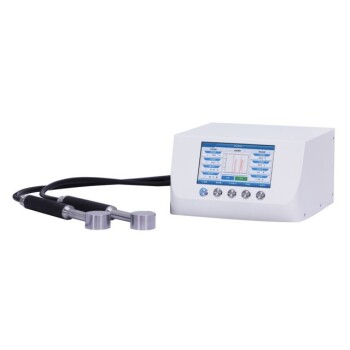
Laboratory-grade heating devices are critical for process stability because they deliver precise temperature gradient control, which is essential for optimizing interface adhesion. By ensuring a robust bond between flexible substrates and sensing elements—such as liquid metal or conductive silver paste—these devices prevent delamination and signal failure during manufacturing.
The core advantage of laboratory-grade equipment lies in its ability to execute multi-stage heating protocols. This capability ensures complete material curing and the release of internal stresses, directly enhancing the long-term reliability of sensors during extensive operational cycles.
The Critical Role of Temperature Precision
Optimizing Interface Adhesion
The interface between the flexible substrate and the sensing element is the most vulnerable point in devices like Soft Magnetoelectric Fingers (SMF).
Laboratory-grade heating provides the exact thermal conditions required to maximize adhesion at this chemical and mechanical boundary.
Without this precision, the bond with materials like liquid metal or conductive silver paste may be inconsistent, leading to immediate structural failure or poor conductivity.
Managing Thermal Gradients
Standard heating elements often suffer from hot spots or uneven distribution.
High-end laboratory devices maintain a controlled temperature gradient across the entire workspace.
This uniformity ensures that every part of the flexible electronic device receives the exact thermal energy required for its specific location and material composition.
Enhancing Durability Through Multi-Stage Heating
Complete Material Curing
Complex flexible electronics often require more than a simple "bake."
Laboratory-grade devices allow for multi-stage heating profiles, which ramp temperatures up and down in specific, controlled phases.
This ensures that curing agents within the conductive pastes or polymers react completely, solidifying the device without degrading delicate components.
Releasing Internal Stresses
The manufacturing process inevitably introduces mechanical stress into flexible materials.
If left unchecked, these internal stresses can cause warping or micro-cracking once the device is in use.
Controlled heating cycles effectively anneal the material, releasing these internal tensions and stabilizing the device geometry before it ever leaves the lab.
Understanding the Trade-offs
Equipment Complexity and Cost
While necessary for high-performance SMFs, laboratory-grade heating systems represent a significant capital investment.
They also introduce process complexity, requiring skilled operators to program and monitor the multi-stage profiles effectively.
Throughput Limitations
The precise, multi-stage curing processes described often take longer than rapid, high-intensity industrial heating methods.
This focus on quality and stability can create a bottleneck in high-volume production environments, forcing a trade-off between manufacturing speed and device reliability.
Making the Right Choice for Your Process
If you are developing Soft Magnetoelectric Fingers or similar flexible electronics, align your heating strategy with your specific reliability goals:
- If your primary focus is device longevity: Prioritize multi-stage heating capabilities to ensure internal stresses are fully released during the curing phase.
- If your primary focus is signal integrity: Ensure your equipment offers precise gradient control to maximize adhesion between the substrate and conductive elements like liquid metal.
Invest in thermal precision today to prevent mechanical failure during tomorrow's extensive cycle testing.
Summary Table:
| Feature | Impact on SMF Manufacturing | Key Benefit |
|---|---|---|
| Temperature Precision | Optimizes interface adhesion | Prevents delamination & signal failure |
| Thermal Uniformity | Eliminates hot spots | Ensures consistent material properties |
| Multi-Stage Heating | Executes complex curing profiles | Complete curing without degradation |
| Stress Management | Releases internal mechanical tensions | Prevents warping and micro-cracking |
Elevate Your Flexible Electronics Research with KINTEK
Precise thermal management is the backbone of reliable sensor manufacturing. KINTEK specializes in comprehensive laboratory pressing and heating solutions—including manual, automatic, heated, and multifunctional models—designed to meet the rigorous demands of battery research and flexible electronics.
Our advanced equipment ensures the exact temperature gradients and multi-stage curing protocols needed to maximize the longevity of your Soft Magnetoelectric Fingers (SMF) and liquid metal interfaces.
Ready to stabilize your manufacturing process and prevent device failure?
Contact KINTEK today for a customized solution!
References
- Yizhuo Xu, Bin Su. A soft magnetoelectric finger for robots’ multidirectional tactile perception in non-visual recognition environments. DOI: 10.1038/s41528-023-00289-6
This article is also based on technical information from Kintek Solution Knowledge Base .
Related Products
- Automatic Heated Hydraulic Press Machine with Hot Plates for Laboratory
- Cylindrical Lab Electric Heating Press Mold for Laboratory Use
- Laboratory Split Manual Heated Hydraulic Press Machine with Hot Plates
- Automatic Heated Hydraulic Press Machine with Heated Plates for Laboratory
- Lab Double Plate Heating Mold for Laboratory Use
People Also Ask
- Function of a Laboratory Hydraulic Press with Heated Platens in SSE? Enhance Battery Density & Conductivity
- Why is a laboratory hydraulic press with heating plates required for PLA/TEC films? Achieve Precise Sample Integrity
- What are the requirements for electrode pressing with high-viscosity ionic liquids like EMIM TFSI? Optimize Performance
- How does a laboratory heated hydraulic press facilitate PBN sample prep for WAXS? Achieve Precise X-Ray Scattering
- What are the industrial applications of heated hydraulic presses? Master Heat & Force for Precision Manufacturing