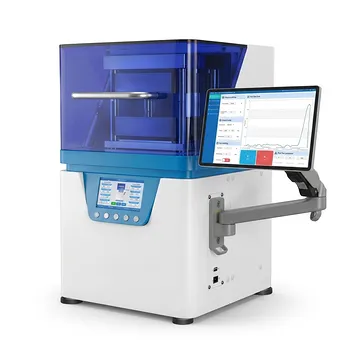
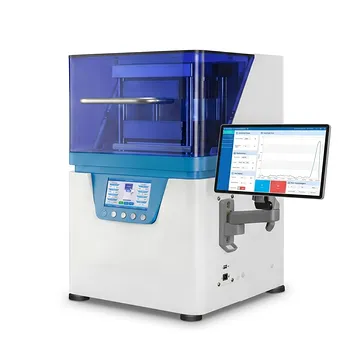
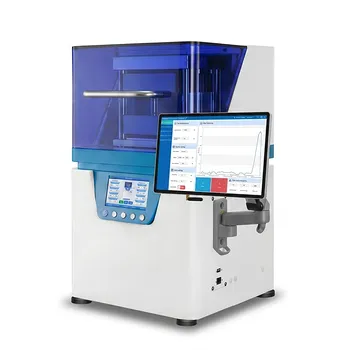
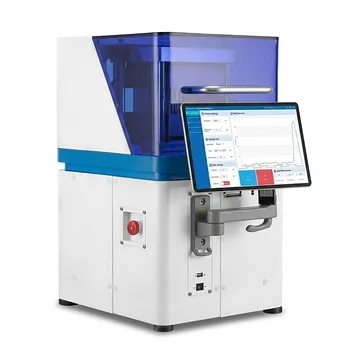
Laboratory hydraulic presses are fundamental instruments for quantifying material behavior under stress. They contribute to material testing by applying precise, controlled force to create test substances and analyze performance during manufacturing processes, such as assessing a material's "blocking resistance"—its tendency to adhere to itself under pressure.
By simulating the physical conditions a material will encounter in the real world, hydraulic presses allow researchers to transition from theoretical design to validated quality control. They provide the necessary data to determine if a material will hold up under the specific rigors of its intended use.
Analyzing Manufacturing Performance
The primary role of the hydraulic press in a manufacturing context is to predict how a product will behave during production and storage.
Assessing Blocking Resistance
A critical application found in manufacturing is testing for blocking resistance. This is particularly relevant for print materials.
The press applies a specific amount of pressure to determining if the material will stick (or "block") to itself. This ensures that stacked or rolled materials can be separated without damage after production.
Creating Test Substances
Beyond destructive testing, these presses are used to create test substances used for further analysis.
By compressing materials into specific shapes or densities, the press prepares samples that are representative of the final manufactured product, ensuring that subsequent performance analysis is accurate.
Evaluating Mechanical Properties
To ensure safety and functionality, materials must be tested against the physical forces they will endure in the field.
Testing Strength and Durability
Hydraulic presses exert massive amounts of force to simulate real-world conditions.
This is vital in industries like construction, where materials must be evaluated for their capacity to withstand heavy structural loads without failing.
Tension and Ductility Testing
While often associated with compression, these presses are also employed for tension testing.
In this process, materials are pulled apart to evaluate mechanical properties such as ductility and tensile strength, revealing how much a material can stretch before breaking.
Advanced Research Applications
In research and development (R&D), the goal shifts from quality control to scientific discovery and material characterization.
Simulating Extreme Conditions
Researchers use hydraulic heat presses to introduce temperature as a variable alongside pressure.
This allows for the investigation of material behavior under combined extreme conditions, providing insights into how substances degrade or strengthen in harsh environments.
Preparing Samples for Compositional Analysis
Hydraulic presses are essential for sample preparation in analytical chemistry.
They are used to compress powder mixtures into uniform pellets or disks. This ensures a uniform distribution of components, which is required for accurate compositional analysis in spectroscopic instruments.
Understanding the Operational Requirements
While hydraulic presses are versatile, their effectiveness relies heavily on precision.
The Necessity of Controlled Force
The value of the data derived from these tests is entirely dependent on the application of controlled force.
If the pressure is not applied uniformly or if the rate of force application varies, the resulting data regarding strength, hardness, or blocking resistance may be skewed. Users must ensure the equipment is calibrated to simulate specific conditions accurately, rather than simply applying maximum force.
Making the Right Choice for Your Goal
To select the right testing protocol or equipment configuration, you must align the machine's capabilities with your specific data requirements.
- If your primary focus is Manufacturing Quality Control: Prioritize presses that can accurately test for blocking resistance to prevent product loss during storage or shipping.
- If your primary focus is Construction or Engineering: Focus on the press's ability to exert high tonnage to rigorously test compressive strength and durability.
- If your primary focus is Material Science R&D: Ensure your setup includes heating capabilities to investigate material behavior under combined thermal and physical stress.
Ultimately, the hydraulic press transforms raw force into actionable data, validating that your materials perform exactly as intended.
Summary Table:
| Application Category | Primary Testing Benefit | Key Material Property Analyzed |
|---|---|---|
| Manufacturing QC | Blocking Resistance | Surface adhesion and stackability |
| Construction/Engineering | Compressive Loading | Structural integrity and durability |
| Material Science R&D | Thermal-Physical Stress | Ductility and behavior under heat |
| Analytical Chemistry | Pelleting/Sample Prep | Compositional uniformity for spectroscopy |
Optimize Your Testing Precision with KINTEK
At KINTEK, we specialize in comprehensive laboratory pressing solutions designed to turn raw force into actionable scientific data. Whether you are conducting cutting-edge battery research or rigorous industrial quality control, our diverse range of equipment—including manual, automatic, heated, multifunctional, and glovebox-compatible models, as well as cold and warm isostatic presses—provides the precision your lab demands.
Ready to elevate your material analysis? Contact our specialists today to find the perfect pressing solution tailored to your specific research goals and industrial requirements.
Related Products
- Laboratory Hydraulic Press Lab Pellet Press Machine for Glove Box
- Laboratory Hydraulic Press 2T Lab Pellet Press for KBR FTIR
- 24T 30T 60T Heated Hydraulic Lab Press Machine with Hot Plates for Laboratory
- Laboratory Hydraulic Press Lab Pellet Press Button Battery Press
- Laboratory Hydraulic Pellet Press for XRF KBR FTIR Lab Press
People Also Ask
- How does a laboratory hydraulic press contribute to the preparation of Li3-3xScxSb samples? Optimize Ionic Conductivity
- What is the function of a laboratory hydraulic press in FT-IR of curcumin-coated MWCNTs? Achieve Optical Clarity.
- Why is a laboratory hydraulic press required for compression molding boron-siloxane? Solve High-Loading Density Challenges
- What role does a laboratory hydraulic press play in reaction pellets? Optimizing Lunar Soil and Metal Fuel Density
- What role does a laboratory hydraulic press play in the preparation of piezoelectric ceramic discs for DC-PG? | KINTEK