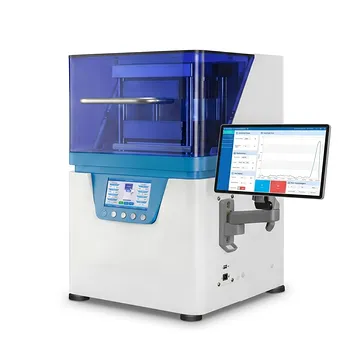
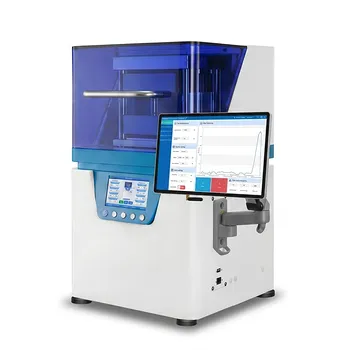
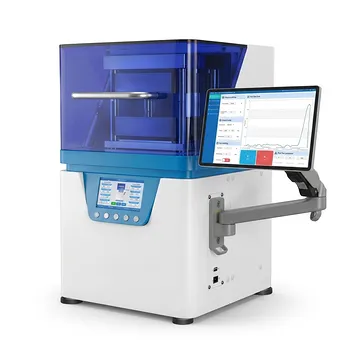
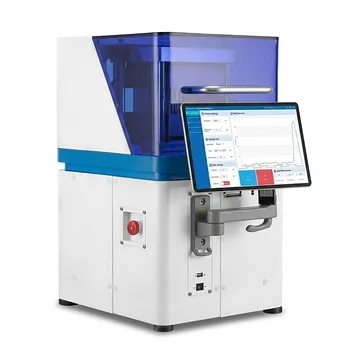
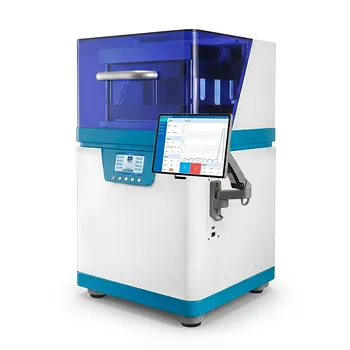
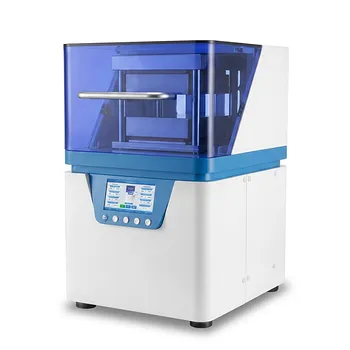
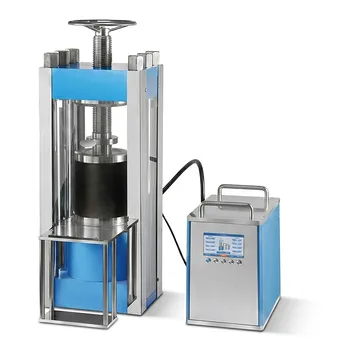
A heated laboratory hydraulic press acts as a catalyst for densification by simultaneously applying extreme pressure and thermal energy to a mycelium network. This process reduces the material's volume by up to 95%, forcing individual fungal hyphae into intimate contact while triggering chemical bonding. The result is the transformation of a loose, porous biological structure into a high-performance, dense composite sheet with superior tensile strength and structural integrity.
The heated hydraulic press converts mycelium from a lightweight, foam-like substance into a dense engineering material by leveraging "hot-pressing" to eliminate internal voids and activate heat-triggered molecular bonding. This mechanical and thermal synergy is essential for achieving the uniform density and durability required for high-performance industrial applications.
The Mechanics of Extreme Densification
Mechanical Compression and Volume Reduction
The primary role of the hydraulic press is to apply massive, controllable pressure—often reaching 100 MPa—to the mycelium substrate. This force drives particle displacement and rearrangement, causing the loose hyphal network to collapse and reduce in height by more than 95%.
Elimination of Internal Gradients
Unlike manual molding, a hydraulic press ensures uniform pressure distribution across the entire surface of the material. This precision eliminates internal density gradients, resulting in a consistent internal structure that is vital for predictable mechanical performance in construction or insulation.
Material Fusion and Solidification
As the pressure forces the biomass powder or fibers together, it facilitates mechanical densification. This process converts low-energy-density raw mycelium into a high-density solid, mimicking the way hydraulic presses create superhard materials or high-energy fuel pellets.
The Role of Thermal Energy in Material Synthesis
Activating Heat-Triggered Bonding
The addition of heat, typically around 160 °C, provides the thermal energy necessary to initiate dynamic reconfiguration of bonds. This heat-triggered bonding allows the compressed hyphae to fuse together, creating a permanent structural change rather than a temporary mechanical squeeze.
Overcoming Particle Resistance
High temperatures help the mycelium particles or "compleximer" structures overcome electrostatic attraction and physical resistance. This allows the fibers to deform and flow into a singular, geometrically specific bulk material that maintains its shape after the pressure is released.
Enhancing Tensile Strength and Stiffness
The synergy of heat and pressure fundamentally alters the material's physical properties. By driving the hyphae into such close proximity that they bond at a molecular level, the process significantly enhances the tensile strength and stiffness of the resulting sheet.
Navigating the Trade-offs of Hot-Pressing
Loss of Biological Viability
One significant trade-off is that the high temperatures required for densification neutralize the living organism. While this makes the material inert and stable for long-term use, it removes the "self-healing" or regenerative capabilities found in living mycelium materials.
Energy Intensity and Scalability
Achieving temperatures of 160 °C and pressures of 100 MPa requires significant energy input and specialized laboratory equipment. Furthermore, the dimensions of the resulting material are strictly limited by the size of the press plates, which can make large-scale manufacturing more complex than traditional growth-based molding.
Potential for Material Brittleness
While hot-pressing increases stiffness and density, over-processing can lead to a loss of elasticity. If the temperature or pressure is too high for the specific species of fungi, the material may become brittle, making it prone to cracking under impact despite its high tensile strength.
Implementing Hot-Pressing for Material Design
Choosing the correct pressing parameters depends entirely on the mechanical requirements of your final product.
- If your primary focus is maximizing tensile strength and stiffness: Utilize the full capabilities of the press by applying simultaneous high pressure (100 MPa) and high temperature (160 °C) to ensure total hyphal bonding.
- If your primary focus is structural uniformity for construction: Prioritize the hydraulic system’s ability to eliminate density gradients, ensuring the material has consistent durability across its entire surface area.
- If your primary focus is maintaining biological activity or "green" processing: Opt for lower-pressure cold-pressing techniques, as the extreme heat of a laboratory press will render the mycelium biologically inert.
By precisely controlling the synergy of heat and pressure, researchers can transform humble fungal growth into a robust, high-performance sustainable alternative to traditional plastics and wood composites.
Summary Table:
| Factor | Action | Key Outcome |
|---|---|---|
| Hydraulic Pressure | Applies up to 100 MPa | 95% volume reduction & void elimination |
| Thermal Energy | Heating to ~160 °C | Activates molecular bonding & material fusion |
| Uniform Distribution | Eliminates internal gradients | Consistent density & predictable performance |
| Hyphal Synergy | Molecular reconfiguration | Enhanced tensile strength & structural stiffness |
Elevate Your Material Research with KINTEK Precision
Transform your sustainable material projects into high-performance engineering realities. KINTEK specializes in comprehensive laboratory pressing solutions tailored for cutting-edge research. Whether you are developing dense mycelium composites or conducting advanced battery research, our equipment provides the extreme pressure and thermal accuracy your work demands.
Our specialized range includes:
- Manual & Automatic Presses: For versatile laboratory workflows.
- Heated & Multifunctional Models: Perfect for complex material synthesis.
- Glovebox-Compatible Units: Ensuring safety in controlled environments.
- Cold & Warm Isostatic Presses: Ideal for achieving maximum material density.
Ready to achieve superior structural integrity in your samples? Contact KINTEK today to find your perfect pressing solution!
References
- Huaiyou Chen, Ulla Simon. Structural, Mechanical, and Genetic Insights into Heat‐Pressed <i>Fomes Fomentarius</i> Mycelium from Solid‐State and Liquid Cultivations. DOI: 10.1002/adsu.202500484
This article is also based on technical information from Kintek Solution Knowledge Base .
Related Products
- 24T 30T 60T Heated Hydraulic Lab Press Machine with Hot Plates for Laboratory
- Automatic Heated Hydraulic Lab Press with Programmable Touch Screen Controls and Precision Temperature Regulation
- Automatic Heated Hydraulic Lab Press 120x120mm Plate Fully Automated Material Research Press
- Automatic Large Format Laboratory Heated Hydraulic Press 400x400mm Plate Capacity
- Automatic Heated Hydraulic Press Machine with Hot Plates for Laboratory
People Also Ask
- Why Use a Laboratory Heated Hydraulic Press for SSAB CCM? Optimize Solid-State Battery Interfacial Bonding
- What is the primary function of a laboratory heated hydraulic press? Mastering Thermoplastic Carbon Fiber Composites
- What is the critical role of a laboratory heated hydraulic press? Mastering PVC Sample Prep for Testing
- What role does a laboratory heated hydraulic press play in PI/PA based SPE membranes? Optimize Solid Battery Performance
- Why is a laboratory heated hydraulic press utilized during the lamination stage of NASICON green tapes?